

The Color Spectrum of Success: Mastering Practice Interactions
Published on: Jun 27, 2026
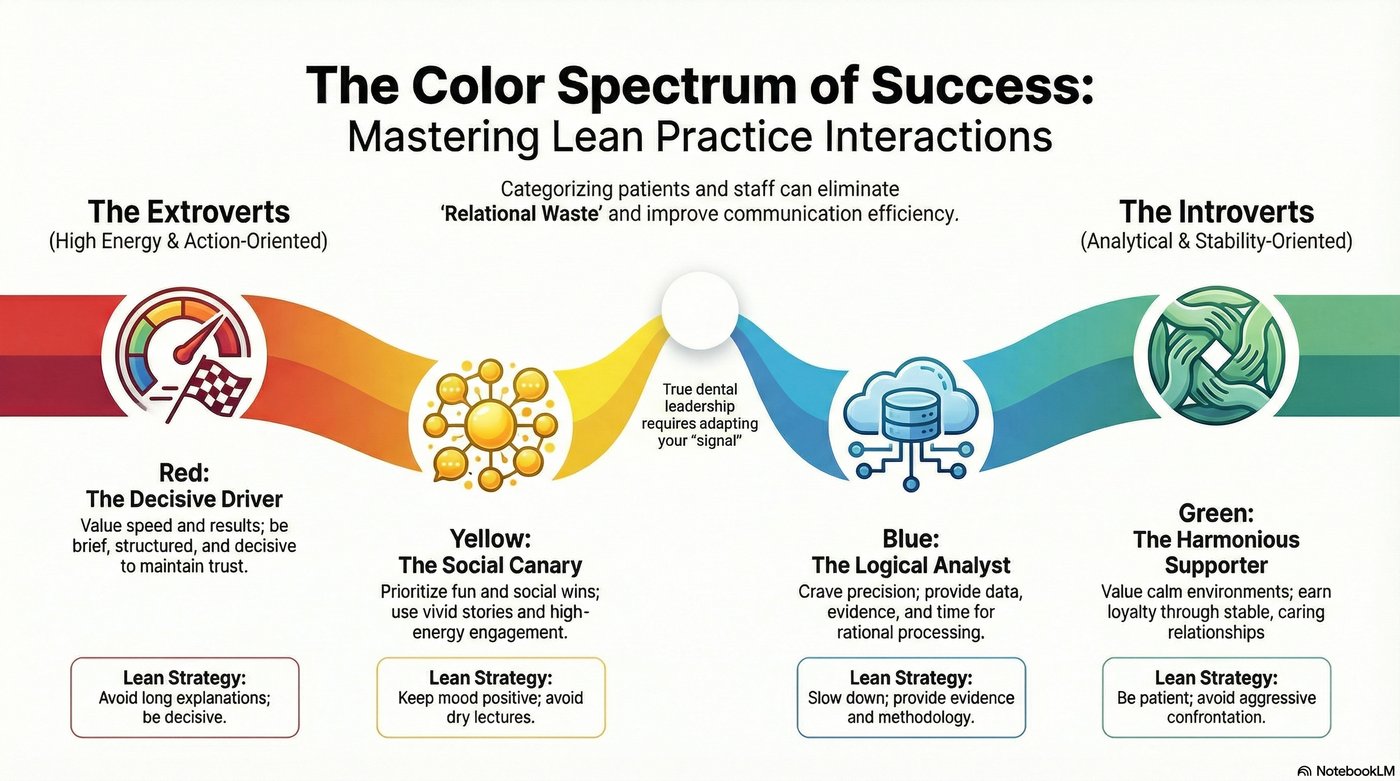
Beyond Natural Harmony
For years, many practitioners have operated under the belief that a “lack of harmony” with a specific patient or team member is simply an unavoidable personality clash. They view these frictions as fixed traits rather than variable outcomes of communication.
In lean orthodontics, we reclassify this friction as “Relational Waste.” Just as waiting for a lab case is a waste, waiting for intuition or “luck” to solve a communication breakdown is fundamentally inefficient and costly to the practice flow.
True dental leadership requires the active, conscious choice to make every professional relationship functional. It moves beyond passive tolerance toward a strategy of intentional adaptation.
By implementing a structured psychological framework—the four-color model—you can stop guessing and start communicating with surgical precision. This is the essence of operational excellence: adjusting your output signal so the receiver can process your message without distortion.
Red: The Decisive Driver
Red types are the “CEOs” of your practice. They are extroverted, dominant, and value speed above all else. They often arrive exactly on time and expect the clinical team to mirror that punctuality.
The Signal: They are brief, structured, and hate “beating around the bush.”
The Lean Strategy: Do not overwhelm them with 20-minute theoretical explanations of biomechanics. Be decisive, provide a clear treatment stance, and focus on the final results and timeline.
If you hesitate or show uncertainty, a Red patient will immediately lose trust in your clinical authority. To them, practice efficiency—from the check-in to the chair—is the ultimate proof of your competence.
Blue: The Logical Analyst
Blue types are the scientists of the patient base. These introverted thinkers crave facts, statistics, and high-level technical precision. They have likely researched your bracket systems before the first appointment.
The Signal: They ask for data, read the fine print, and have a high aversion to risk.
The Lean Strategy: Slow down the pace of the consultation. Provide the evidence, the specific methodology, and the logical “why” behind every clinical recommendation you make.
Never attempt to rush a Blue type into a contract. They require adequate time to process the data rationally. Emotional appeals fail here; they need to feel logically secure before they can commit to a long-term plan.
Yellow: The Social Canary
Yellow types provide the social energy of the practice. They are high-energy, expressive, and love being the center of an engaging, positive experience. They are your best source for word-of-mouth referrals.
The Signal: They are talkative, may have a scattered focus, and prioritize fun and engagement.
The Lean Strategy: Keep the energy high and the mood light. If the clinical consultation feels like a dry, technical lecture, you will lose their interest and their business.
Use vivid stories and focus on the “social win”—how a beautiful smile will improve their confidence and lifestyle. Keep the paperwork simple and the interactions vibrant to ensure they stay engaged with the treatment journey.
Green: The Harmonious Supporter
Green types are the stabilizing heart of the clinical team and the community. They value calm, steady environments, predictability, and long-term loyalty above all else.
The Signal: They are soothing and cooperative but can be easily overwhelmed by “Red” aggression or “Yellow” chaos.
The Lean Strategy: Be caring and down-to-earth. Avoid aggressive sales tactics or sudden changes in the schedule. They rarely decide on the spot and often need to consult with a spouse or partner.
Once you earn their trust through a stable, personal relationship, they become your most faithful followers. For Green patients, the feeling of safety and belonging within your practice is the primary driver of treatment adherence.
Mastering these interactions allows a practice to eliminate the “waste” of misunderstood instructions and failed consultations. By adapting to the spectrum, you ensure that every patient feels heard, understood, and confident in your care.
Conclusion
The journey toward true operational excellence in dentistry begins not with hardware upgrades, but with a refined approach to human interaction. When viewed through the lens of lean methodology, communication friction is a quantifiable cost—a form of Relational Waste that erodes efficiency and patient retention. Leadership is the deliberate choice to mitigate this waste. By abandoning the passive assumption of unavoidable personality clashes and instead actively leveraging the four-color communication spectrum, practitioners move from reaction to intentional design. This strategic adaptation ensures that the unique needs of the Red Driver, Blue Analyst, Yellow Socializer, and Green Supporter are met with surgical precision. Ultimately, mastering these interactions transforms your practice from a clinic that treats teeth into a highly functional organization that masterfully manages relationships, driving higher treatment acceptance, stronger loyalty, and genuine, sustainable success.