

The CEO Mindset: Breaking the “Clinical Trap” in Orthodontics
Published on: Jun 3, 2026
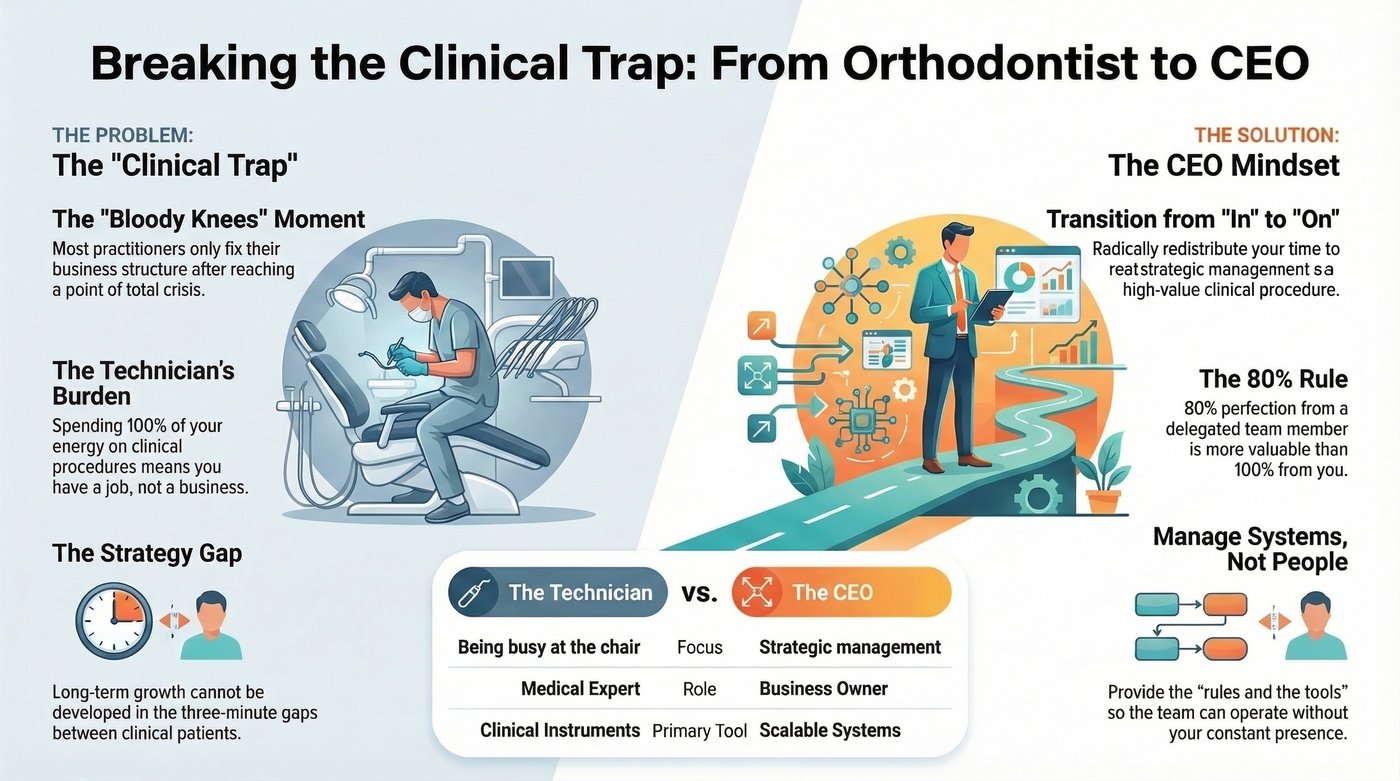
In the orthodontic profession, we are often victims of our own work ethic. We equate “being busy at the chair” with success. However, there is a fundamental difference between being a high-level technician and being a business owner. If you spend 100% of your energy performing clinical procedures, you aren’t running a business—you are working a very demanding job.
This “clinical trap” is a common pitfall where the practitioner’s technical expertise becomes a barrier to organizational growth. While exceptional clinical outcomes are non-negotiable, they must be reproducible and systemized to scale beyond the individual. A true CEO understands that the highest-value activity is designing the system, not always executing every step within it. This perspective allows for leverage and sustainable long-term financial health.
To achieve true operational excellence, you must master the transition from working in your business to working on it. This shift isn’t just about delegation; it’s about a radical redistribution of your identity and your time. This means dedicating non-negotiable blocks in your schedule to strategic tasks—forecasting, budget review, marketing oversight, and leadership development—tasks that directly impact profitability but do not involve patient-facing care.
Defining the Dual Roles
The primary hurdle in this transition is the failure to recognize that you are simultaneously a medical expert and a CEO. In the beginning, these roles overlap. But as the practice scales, the lack of role clarity becomes a bottleneck.
The medical expert role focuses on diagnosis, treatment planning, and delivering superior patient care. The CEO role, conversely, is responsible for vision, culture, financial stewardship, and mitigating systemic risk. These are two distinct skill sets that demand different cognitive resources. For example, the focus required for precise bracket placement is vastly different from the high-level critical thinking needed to assess the effectiveness of your collections process.
If you do not consciously separate these positions, your energy will be drained by conflicting tasks. You cannot develop a long-term growth strategy in the three-minute gap between a bracket change and a debonding. You must recognize that Strategic Management is a high-value clinical procedure in its own right—one that requires its own instruments, environment, and dedicated time. This necessitates scheduling “CEO time” away from the chair, perhaps in a separate office, to focus solely on high-level business functions. This protected time is not an optional luxury; it is the most critical appointment on your calendar.
Avoiding the “Bloody Knees” Moment
Many orthodontists wait for a crisis—impending burnout, a mass staff exodus, or financial stagnation—before they look at their business structure. In lean management, we call this the “bloody knees” moment. This is when the pain of the current situation finally outweighs the discomfort of initiating change.
While pain is a motivator, it is a poor foundation for building. Reacting to a crisis often leads to hurried, emotional, and poorly implemented solutions that only offer temporary relief. For instance, a sudden drop in case starts should prompt a proactive review of the treatment coordinator’s sales process, not a panicked, superficial change to the fee structure.
It is far more efficient to build the “fire station” before the fire starts. By organizing your systems while they are still simple, you create a scalable foundation that requires maintenance rather than a total rebuild during a crisis. This means documenting Standard Operating Procedures (SOPs) for every function—from new patient onboarding and insurance verification to equipment maintenance. These proactive systems allow the practice to absorb shocks, like staff turnover, without compromising clinical or operational flow.
Overcoming the Ego of Irreplaceability
The biggest barrier to growth is the belief that “no one can do it as well as I can.” This mindset, while rooted in dedication to quality, is ultimately a leadership failure disguised as a commitment to quality. If your team cannot handle a task to your standard, it is because you have not empowered them with the “rules and the tools.”
A high-performing practice must shift its focus from the doctor’s individual skill to the collective competence of the system. Your role as the CEO is to define the standard, not perpetually enforce it through personal oversight. True quality assurance comes from robust training modules and clear checklists, not from hovering over every action.
Stop Micromanaging: Accept that 80% perfection from a delegated team member is more valuable for the business than 100% perfection that requires your constant presence. Delegate tasks like inventory management, scheduling optimization, and even routine clinical steps (where permissible and well-defined). This frees up your time for tasks only you can do: complex treatment planning and strategic business development.
Invest in Training: Bridge the gap between your experience and their current ability through documented, video-based onboarding. Training should be viewed not as an expense but as a direct investment in the practice’s capacity for leverage. Implement a continuous learning culture where team members regularly train on mock procedures or review patient safety protocols, ensuring consistent, high-level execution across the board.
Trust the System: A lean leader doesn’t manage people; they manage the systems that manage the people. Systems provide consistency, predictability, and a defined pathway for error correction. They transform tacit knowledge—what you know intuitively—into explicit, measurable processes that everyone can follow, making the entire operation less reliant on a single individual.
Conclusion
Escaping the clinical trap is not a betrayal of your medical oath; it is the highest expression of professional leadership. By successfully transitioning from a highly paid technician to a strategic CEO, you unlock the practice’s potential for scalable growth, financial stability, and reduced personal burnout. The path forward requires discipline, a willingness to delegate, and the commitment to build robust systems. Begin today by scheduling your first non-clinical CEO hour—the most impactful hour you will spend all week.