

The CEO as a Fly on the Wall: Mastering the Gemba Walk for Practice Excellence
Published on: Jun 11, 2026
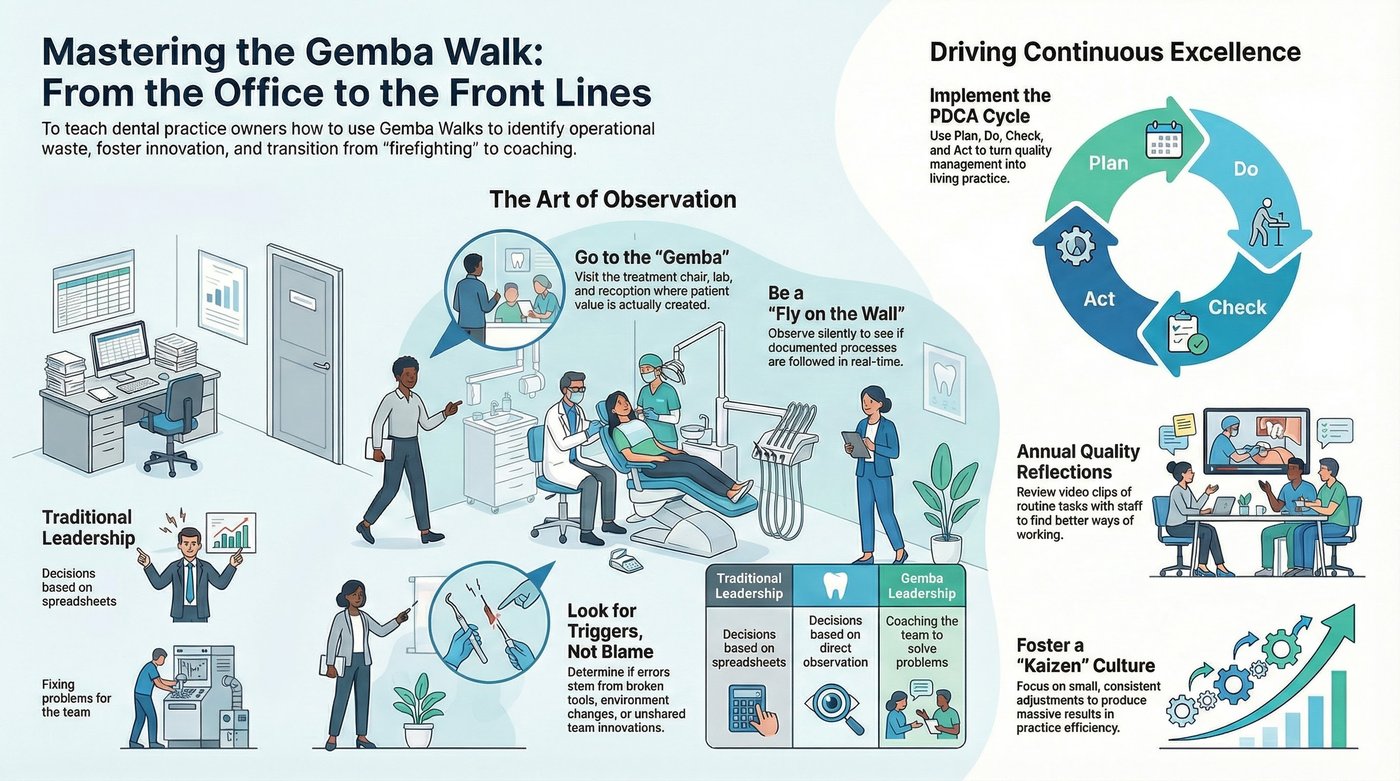
In the trajectory of a successful orthodontic career, there is a common but dangerous evolution. As the practice grows from a single-chair operation to a multi-doctor facility, the owner naturally migrates from the clinical “trenches” to the administrative office. This shift is often necessary for business scaling, but it creates a physical and psychological distance between leadership and the patient experience. Decisions start being made based on computer screens, financial reports, and second-hand accounts from office managers. While metrics are vital, they only tell you *what* is happening, not *why* it is happening. True dental leadership requires staying connected to the “Gemba”—the Japanese term for the actual place where the work happens, and value is created.
If you only observe your practice from the sidelines or through the lens of a monthly P&L statement, you are leading in the dark. You might see that clinical production is down, but you won’t see the assistant struggling with a faulty suction line that adds three minutes to every procedure. To optimize your clinical processes and maintain a world-class standard, you must master the art of the Gemba Walk. This is not about micromanagement or “snooping” on your team; it is about intentional presence and the relentless pursuit of operational excellence. It is the difference between being a distant administrator and a visionary leader who understands the heartbeat of their clinic.
If you only observe your practice from the sidelines, you are leading in the dark. To optimize your clinical processes and maintain a world-class standard, you must master the art of the Gemba Walk. This is not about micromanagement; it is about intentional presence and the relentless pursuit of operational excellence.
Understanding the “Gemba” in Orthodontics
In Lean management, “Gemba” refers to the actual location where value is created. In our world, this means the treatment chair, the laboratory, the sterilization area, and even the reception desk. These are the front lines of the patient journey where trust is built and clinical results are delivered. As you add more employees and chairs, the distance between your management role and the patient’s clinical reality grows. You may think your new patient intake process is seamless because you designed it three years ago, but the Gemba may reveal a different story—perhaps a bottleneck at the X-ray machine or a lack of privacy during financial discussions.
The Gemba Walk is the tool that closes this gap. It allows you to step out of the “boss” mindset and become a student of your own systems. By being physically present where the work occurs, you can see the friction points, the brilliant workarounds created by clever staff members, and the hidden wastes—like unnecessary walking or looking for misplaced pliers—that no spreadsheet will ever show you. Practical insights gained here often lead to “low-hanging fruit” improvements that immediately reduce stress for the team and improve the flow for the patients.
The Gemba Walk is the tool that closes this gap. It allows you to step out of the “boss” mindset and become a student of your own systems. By being physically present where the work occurs, you can see the friction points, the brilliant workarounds, and the hidden wastes that no spreadsheet will ever show you.
The Art of Silent Observation
The most critical rule of a successful Gemba Walk is to act as a “fly on the wall.” This requires a high degree of emotional intelligence. You are there to join a work process and observe, not to interfere, correct, or lecture. If you start correcting an assistant’s technique mid-procedure, you destroy the psychological safety required for an honest observation. The goal is to see if your documented processes are actually being followed in real-time or if they have morphed into something else due to practical necessity. You are looking for the “current state” of the practice, not the idealized version you have in your head.
In a traditional, non-lean culture, if a doctor sees an assistant doing something “wrong,” the instinct is to blame the person and demand they do better. In a lean practice, we look for the trigger. We assume that our team members want to do a good job and that failures are usually systemic, not personal. When you see a deviation from the standard, your first question should be “Why?” instead of “Who?”
In a traditional, non-lean culture, if a doctor sees an assistant doing something “wrong,” the instinct is to blame the person. In a lean practice, we look for the trigger.
Is the necessary tool broken?
Has the clinical environment changed?
Or, perhaps most interestingly, has the employee found a more efficient “short-cut” that hasn’t been shared yet?
Consider a scenario where you notice an assistant moving back and forth between the chair and the supply cabinet four times during a simple debonding. In a blame-culture, you might tell them to be more prepared. In a Gemba culture, you ask if the kit was missing an item or if the tray setup is inefficient. If you discover a team member has innovated a better way to organize the ortho-kits or has found a more ergonomic way to handle wire changes, you don’t punish the deviation—you document it and implement it for the entire team. This is how you turn your clinic into a learning organization that evolves every single day.
Implementing the PDCA Cycle for Quality Control
To ensure your observations lead to tangible improvement, we utilize the PDCA cycle: Plan, Do, Check, Act. This framework prevents the Gemba Walk from being just a casual stroll and turns quality management into a living, breathing process. When an issue is identified during a walk, you plan an experiment, do the change on a small scale, check the results through further observation, and then act to standardize the improvement across the entire practice. This systematic approach ensures that problems are actually solved rather than just discussed in a staff meeting and forgotten.
For example, once a year, even our most senior staff members record short video clips of specific routine tasks, such as digital scanning or bracket placement preparation. We then review these together as a team in a collaborative environment. This isn’t a high-pressure exam or a “gotcha” session; it’s a professional reflection on quality and ergonomics. We ask: “Is this truly the best way of working? Does this process cause physical strain? Should we experiment with this new deviation found during the last Gemba Walk?” This keeps your practice from becoming a victim of a static “binder of rules” that gathers dust on a shelf while the actual work deviates further into inefficiency.
Conclusion: Coaching Over Firefighting
A Gemba Walk is a failure if you spend the whole time solving problems for your staff. Your job is not to be the practice “firefighter” who rushes in to save the day every time a schedule gets tight or a piece of equipment fails. If you solve every problem, your team stops thinking; they simply wait for you to tell them what to do. Instead, use your observations to coach. When you see a bottleneck at the front desk, don’t jump in and start answering phones. Instead, later ask the team, “What do you suggest we do here to handle the 4 PM rush? What have you already tried that didn’t work?”
By empowering your team to solve their own problems through your guidance and Socratic questioning, you foster a culture of Kaizen—continuous, incremental improvement. These small, consistent adjustments—saving ten seconds here, removing a redundant form there—are what eventually produce gigantic results in practice efficiency, team morale, and patient satisfaction. When the CEO masters the Gemba Walk, the practice moves from surviving to thriving, creating an environment where excellence is not just a goal but a daily habit. Ultimately, the Gemba Walk is about showing your team that you value their work enough to stand beside them and see the world through their eyes.
By empowering your team to solve their own problems through your guidance, you foster a culture of Kaizen—continuous, incremental improvement. These small, consistent adjustments are what eventually produce gigantic results in practice efficiency and patient satisfaction.