

The Bottleneck Dilemma: Mastering Delegation Through the Eisenhower Matrix
Published on: Jun 1, 2026
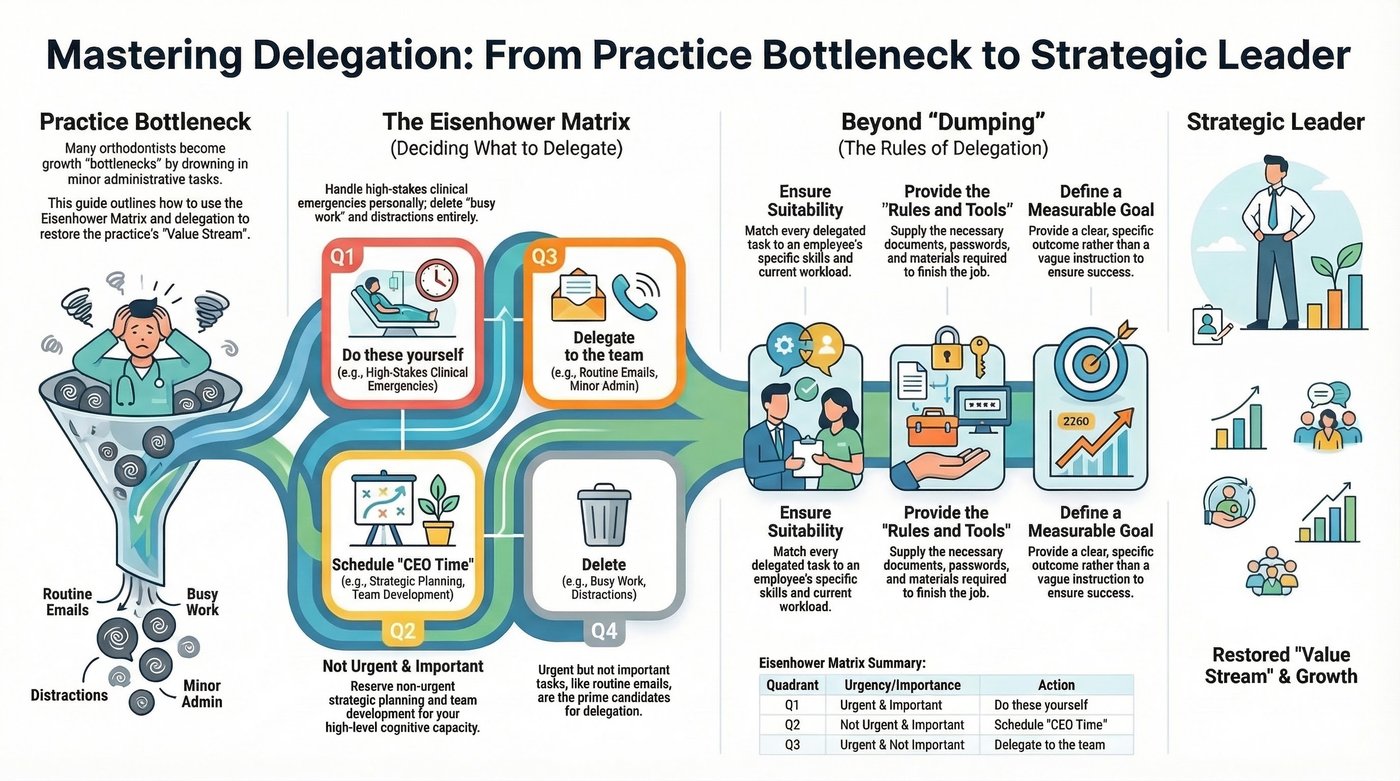
In the journey of an orthodontic practice, there is a dangerous point where the owner’s individual hard work becomes the very thing limiting the practice’s growth. Many orthodontists find themselves drowning in a sea of small, administrative tasks—answering emails, troubleshooting minor billing errors, or managing supply orders—while their clinical strategy and long-term vision sit on the back burner.
This plateau is common when a practitioner transitions from a solo provider to a business leader. The skills that made you a great clinician—attention to detail and hands-on control—can become liabilities when they prevent you from overseeing the broader health of the enterprise.
Consider a typical day: if you spend 45 minutes resolving a shipping delay for brackets, that is 45 minutes not spent analyzing your referral conversion rates or mentoring an associate. Over a year, these hundreds of hours of leakage stunt the entire organization’s potential.
As Dr. Martin Baxmann emphasizes, if you do not learn to pass these responsibilities to your team effectively, you will remain the bottleneck of your own success. True dental leadership requires mastering the “Science of Letting Go.”
Letting go is not about losing control; it is about establishing systems that allow for control without your physical presence. It is the shift from “doing the work” to “ensuring the work is done to your standard.”
The Logic of Selection: The Eisenhower Matrix
The first step in clinical leadership is not doing more but deciding what not to do. To achieve operational excellence, we utilize the Eisenhower Matrix. This four-quadrant system categorizes every task based on Urgency and Importance.
In a fast-paced clinic, everything feels urgent. The matrix forces a pause, requiring you to filter requests through the lens of long-term value versus immediate noise. This clarity is essential for maintaining your mental energy for complex cases.
Quadrant 1 (Urgent & Important): Critical clinical emergencies or high-stakes business decisions. Do these yourself.
These are the “fires”—a patient with a significant clinical complication or a sudden legal issue. These demand your unique expertise and cannot be passed off without risk to the practice’s reputation or safety.
Quadrant 2 (Important but Not Urgent): Strategic planning, tax optimization, and team development. Schedule these for your “CEO Time.”
This is where growth happens. It includes reviewing your monthly KPIs, planning your next marketing campaign, or designing a training manual for new hires. Because these lack a “deadline,” they are often ignored until it is too late.
Quadrant 3 (Urgent but Not Important): Minor interruptions, routine emails, and logistical glitches. These are the prime candidates for delegation.
A sales rep calling without an appointment or a minor scheduling conflict between two staff members feels urgent, but doesn’t require a doctorate to solve. Empower your office manager to handle these interruptions autonomously.
Quadrant 4 (Neither Urgent nor Important): Distractions and “busy work.” Delete these entirely.
Excessive social media scrolling, perfectionist tweaking of a font on an internal memo, or attending redundant meetings fall here. These are “time-vampires” that must be ruthlessly eliminated to protect your focus.
By strictly adhering to this matrix, you free your cognitive capacity for high-level work that only you—with your specialized training and vision—can execute.
Beyond “Dumping”: The Difference Between Delegation and Abandonment
A common mistake in practice management is “delegation by proximity”—grabbing whichever staff member is nearby and barking an instruction. This is not delegation; it is a recipe for failure and resentment.
When you “dump” a task without context, the employee often feels overwhelmed and under-equipped. This leads to “reverse delegation,” where the employee brings the half-finished task back to you, and you end up doing it yourself anyway.
To achieve superior dental team performance, you must provide the “Rules and the Tools.” You are essentially installing a software update into your team’s workflow. Effective delegation requires a structured approach to ensure the outcome meets your expectations.
Suitability: Matching the task to the employee’s specific skills and current workload.
Don’t ask your best clinical assistant to handle complex insurance aging reports if they have no background in billing. Identify the “Subject Matter Expert” within your team for each specific category of administrative work.
Resources: Giving them the documents, passwords, or materials needed to finish the job.
Delegation fails when an employee has to stop every five minutes to ask you for a login or a file. Before handing off a project, ensure the “toolbox” is full and accessible, removing any friction that would slow them down.
The Goal: Defining a clear, measurable outcome rather than a vague instruction.
Instead of saying “Fix the schedule,” say “I need all gaps in the next 48 hours filled with recall appointments by 3:00 PM today.” Specificity prevents assumptions and ensures the team knows exactly what success looks like.
Conclusion: Reclaiming Your Strategic Throne
Delegation is not a sign of laziness; it is the hallmark of a professional entrepreneur. When you stop being the “everything person” in your clinic, you move from being a co-worker at the chair to being the strategist who sets the direction of the business. By clearing the clutter of minor tasks, you restore the “Value Stream” and create a practice that can grow without breaking the doctor.
Ultimately, your role is to be the visionary. Every hour you spend on a $20-per-hour task is an hour you’ve stolen from your $1,000-per-hour strategic responsibilities. Reclaim your throne and watch your practice thrive.
Conclusion: The Path to Sustainable Growth
Transitioning from clinician to CEO is the most significant hurdle in orthodontic practice management. By applying the Eisenhower Matrix, you create a filter that protects your most valuable asset: your time. This discipline allows you to cultivate a team that is not just reactive but proactive and empowered.
Mastering delegation is the only way to build a legacy that outlasts your physical presence at the chair. It provides the freedom to innovate, the space to lead, and the energy to provide world-class patient care. Start today by choosing one Quadrant 3 task and handing it off correctly—your future self will thank you.