

The Birth of an Improvement: Redefining Error Management in Orthodontics
Published on: Jun 2, 2026
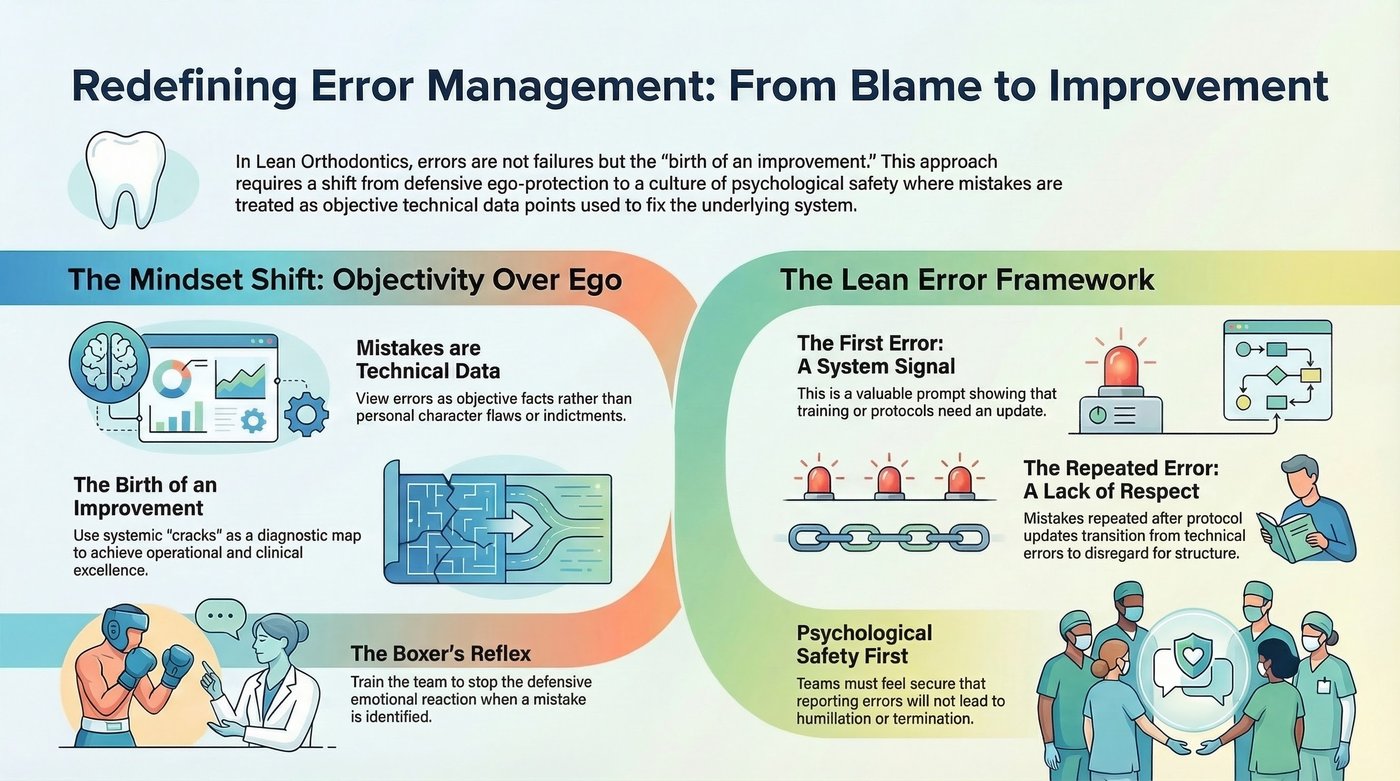
In many orthodontic practices, a mistake is treated like a source of shame or a reason for blame. We instinctively want to sweep errors under the rug to protect our reputation or our ego. This cultural habit, while rooted in a desire for clinical perfection, is ultimately antithetical to sustainable growth and long-term organizational mastery. This defensive posture ensures that the same systemic vulnerabilities persist, waiting for the next team member to inevitably trigger them.
However, in the philosophy of Lean Orthodontics, an error is not a sign of failure—it is the birth of an improvement. It represents a tangible data point where a process failed to protect the clinician or staff member from human fallibility. If you want to achieve clinical and operational excellence, you must stop hiding the cracks in your system and start using them as a diagnostic map for progress, leading to fewer re-bonds, better appliance fit, and streamlined scheduling. This philosophy reframes mistakes as necessary data for calibrating superior systems.
Mastering error management requires a radical shift from a defensive culture to a culture of psychological safety. When mistakes are viewed as technical data points—such as an inaccurate bracket placement, a lapse in infection control protocol, or a missed debonding appointment—rather than character flaws, the practice transforms into a high-learning organization. This systemic approach is the bedrock of world-class healthcare delivery, ensuring consistent, high-quality patient outcomes and lowering operational stress.
The shift must start with leadership defining “error” not as a moral failing but as an outcome that reveals a gap between current performance and ideal process design. For instance, a high bracket failure rate is not a ‘bad assistant’ but a signal that the moisture control protocol or curing light maintenance schedule needs immediate revision, potentially involving a move to a new bonding agent or a refresh of staff training on specific technique components.
The Foundation of Psychological Safety
To drive professional growth, you must create a foundation of trust. This environment must assure every team member, from the newest sterilization tech to the lead treatment coordinator, that their honest disclosure of a mistake will not lead to punitive action. If a clinical assistant makes a technical error during a procedure, such as mixing two types of impression material or logging a case under the wrong lab code, they must feel secure that they won’t be humiliated or terminated. They should feel safe bringing forward information that will protect the patient and the practice.
As the leader, you are the architect of this culture. Transparency is the only way to allow the team to learn collectively. This means that when a process breakdown occurs—for instance, a scheduling conflict resulting in a patient wait time exceeding 30 minutes—the post-mortem analysis must be performed with the entire team. The discussion should focus solely on the “what” and the “how,” never the “who.” This open approach fosters collective ownership of the system’s success, migrating accountability from the individual to the documented procedure.
The crucial element of psychological safety is that it unlocks immediate reporting. When staff can report a near-miss—for example, almost seating the wrong clear aligner tray, or noticing an expired product on a cart—before it becomes a patient-facing error, the practice gains invaluable, proactive data. This immediate feedback loop drastically reduces the long-term clinical and financial cost of mistakes, preventing costly remakes, time-consuming corrections, and potential board complaints.
The First Error: A valuable signal that the system or training needs an update. This is embraced. When a new assistant forgets a specific step in the ultrasonic cleaning cycle, it signals a flaw in the onboarding checklist or the visual cue system, not an issue with the individual. The system is then improved for everyone through visual management tools like shadow boards or laminated step-by-step guides.
The Repeated Error: If a mistake is repeated after the system has been updated, the training has been reinforced, and the protocol has been clarified, it transitions from a “technical error” to a “lack of respect” for the shared structure. This requires a leadership intervention focused on accountability and commitment to established protocols. This is where process integrity meets personal responsibility, demanding a coaching conversation about adherence and focus.
Objectivity over Ego: The Boxer’s Reflex
Pointing out a mistake often triggers a defensive reflex, much like a boxer dropping their guard after a hit. This innate human response—to defend oneself when feeling exposed—is the single greatest barrier to learning in any practice. Training yourself and your team out of this emotional reaction is essential for success, particularly when discussing complex procedures like TAD placements, clear aligner adjustments, or complex archwire bends. Your role as a leader is to model this non-defensive posture relentlessly.
We make thousands of decisions daily; mathematically, some will be wrong. A skilled practice leader understands that the energy spent defending a mistake is wasted energy that could be spent analyzing and correcting the error. The goal is to move the conversation from “Why did you do that?” to “What in the process allowed that to happen?” This linguistic shift depersonalizes the failure and opens the door for collaborative problem-solving, rather than closed-off self-justification.
Instead of viewing a mistake as a personal indictment, view it as a “stain on a shirt” that can be washed out. It is a temporary, removable blemish on the system, not a permanent mark on the professional. By remaining objective and focusing on the mechanics of the situation—rather than the person involved—you remove the emotional friction that prevents the team from solving the root cause of the problem. This detached analysis prevents team morale from dipping and maintains a focus on continuous improvement.
For example, if a patient returns with a broken bonded retainer, the objective discussion focuses on the composite type, the etching protocol, the patient education provided, and the specific bite force analysis—not on the assistant who last saw the patient. This methodical, process-centric analysis, known in Lean methodology as a Root Cause Analysis (RCA), is what drives true, lasting quality improvement. It converts perceived weaknesses into documented, measurable strengths by creating an immediate and specific action plan to prevent recurrence across the entire clinic.
Conclusion
Redefining error management is not about being “soft” on mistakes; it is about being strategically intelligent about them. It is the leadership imperative to convert the fear of failure into the fuel for refinement. By cultivating a culture of psychological safety and maintaining rigorous objectivity, orthodontic and dental leaders can transform every procedural slip-up or administrative lapse into a catalyst for system refinement. When every team member understands that error is merely data, not a judgment, the practice stops managing damage and starts continuously perfecting its operations. The ultimate result is not just a more efficient clinic but superior clinical outcomes and a reputation built on consistent, trustworthy excellence. This systematic approach is the highest form of clinical and organizational leadership.