

The Binary Brain: Reducing Complexity through Systematic Choice
Published on: Jun 16, 2026
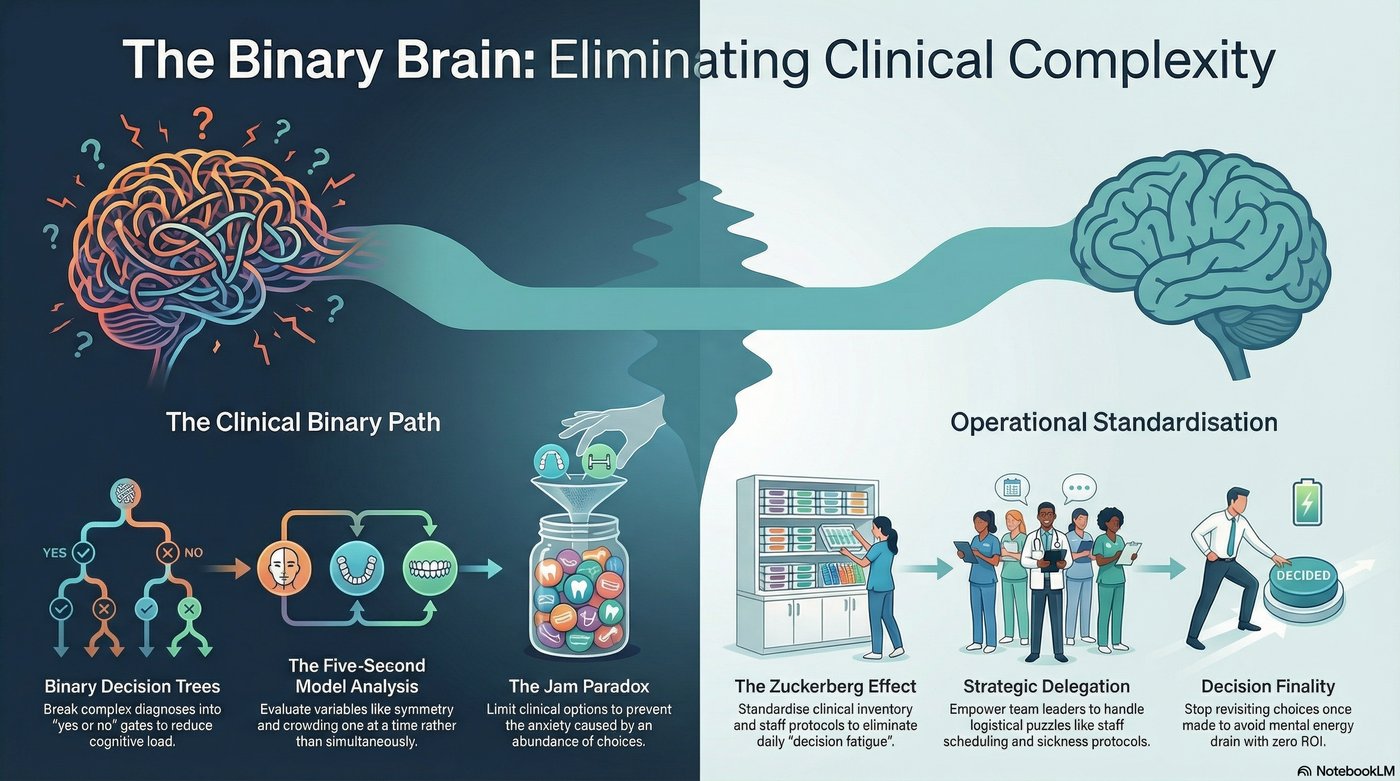
In clinical orthodontics, the sheer number of variables in a single case can be paralyzing. We often attempt to hold the entire complexity of a Class II surgical-orthodontic case in our heads at once, leading to a state of “analysis paralysis.” This mental gridlock prevents timely decision-making, extends chair time, and ultimately increases stress for the clinical leader. To achieve operational excellence and eliminate this stress, we must learn and master the art of Binary Decision Trees.
This approach forces clarity in even the most challenging diagnostics. Consider the perennial extraction versus non-extraction dilemma. Instead of simultaneously weighing cephalometric data, crowding indices, root parallelism, and profile aesthetics, a Binary Decision Tree isolates one critical factor at a time. By breaking down complex diagnoses into a sequence of “yes or no” gates—a true/false assessment—you significantly reduce the cognitive load of treatment planning. This systematic approach—the cornerstone of Lean Orthodontics—allows you to navigate through a million facts using a structured, low-energy path, preserving your mental capital for patient interaction and surgical execution.
The “Jam Paradox” and Limiting Clinical Options
Psychological research into the “Jam Paradox,” famously demonstrated by the variety-induced indecision in consumer choice, proves that an abundance of clinical options leads to anxiety and indecision for the practitioner. If your clinic offers twenty types of brackets, utilizes multiple bonding agents, or employs ten different wire sequences, you force your brain to re-evaluate the “best” path every single time a new case presents. This constant re-evaluation is a tax on your mental resources and introduces unnecessary variability into patient outcomes.
A Lean leader limits clinical options and standardizes protocols to conserve mental energy and promote predictability. We deliberately standardize our inventory, selecting a single prescription of brackets and a streamlined sequence of wires (e.g., NiTi, SS) that covers 90% of our patient base. By establishing clear decision protocols, like the ABCD System for arch form selection or a Five-Second Model Analysis for initial assessment, we don’t look at 100 variables; we look at one at a time. The power lies in exclusion. The initial assessment is designed to ask only high-impact, binary questions:
Is it Class I, II, or III?
Is it symmetrical, or is unilateral mechanics required?
Is there significant crowding requiring intervention beyond simple expansion?
Each “yes/no” answer closes a door and eliminates dozens of potential treatment paths, leading you closer to the final plan without the exhaustion of “reinventing the wheel” for every patient. This standardization accelerates both the planning phase and the delegation of tasks to highly trained clinical assistants.
The “Zuckerberg Effect” in Practice Management
Decisions are an expenditure of time and mental energy, regardless of whether they relate to patient care or clinic operations. Just as figures like Mark Zuckerberg or Steve Jobs intentionally wore the same simple outfit every day to eliminate “closet fatigue,” you can apply this principle of conserved energy to your clinic’s management structure. The goal is to offload operational decisions that do not require your specialized clinical expertise. Standardize non-clinical, high-frequency protocols, such as your staff’s “sickness protocol.” In an optimized practice, the clinical leader should not be the bottleneck for routine problems. For example, I have delegated the authority to reshuffle the schedule and contact covering staff to a designated team leader. That operational puzzle is solved entirely by the team. This saves me twenty minutes of high-level mental energy on a stressful Monday morning before I even pick up a mirror, allowing me to focus immediately on complex cases. This effect extends to supply chain management—instead of deciding on reordering specific items, the decision is binary: Is stock below level X? Yes/No. Authority to act is automatically granted to the inventory manager.
Decisive Action and the Recovery Phase
Once a treatment or operational decision is made and documented, you must immediately stop revisiting it. Analyzing a choice ten times after the fact—what psychologists call rumination—is a massive drain of mental energy with zero return on investment (ROI). If the initial diagnostic facts were clear and the system was followed, walk the path with conviction. Leadership requires momentum. If you find yourself in a dilemma where two options (e.g., two different appliance systems or two equal financial investments) seem exactly equal based on your objective data, do not freeze. If they are truly equal in projected outcome, you cannot make a mistake—simply pick one and move forward. The act of deciding and generating forward momentum is often exponentially more valuable than the exhaustive search for the theoretical “perfect” choice that does not exist.
Remember:
Effective self-management and sustainable leadership fundamentally require a structured recovery phase. After a period of heavy cognitive load, such as completing a complex debond or reviewing multiple surgical plans, intentionally take five minutes of silence, step away from the clinic floor, or perform a simple, repetitive task to clear your working memory. By systematically managing your activities and aggressively limiting your choices, you will find that you suddenly have the necessary mental energy to lead not just your practice, but your entire professional and personal life, with profound clarity, purpose, and joy.