

The Balance Bike Philosophy: Mastering the Strategic Pillars of Lean Orthodontics
Published on: Jun 17, 2026
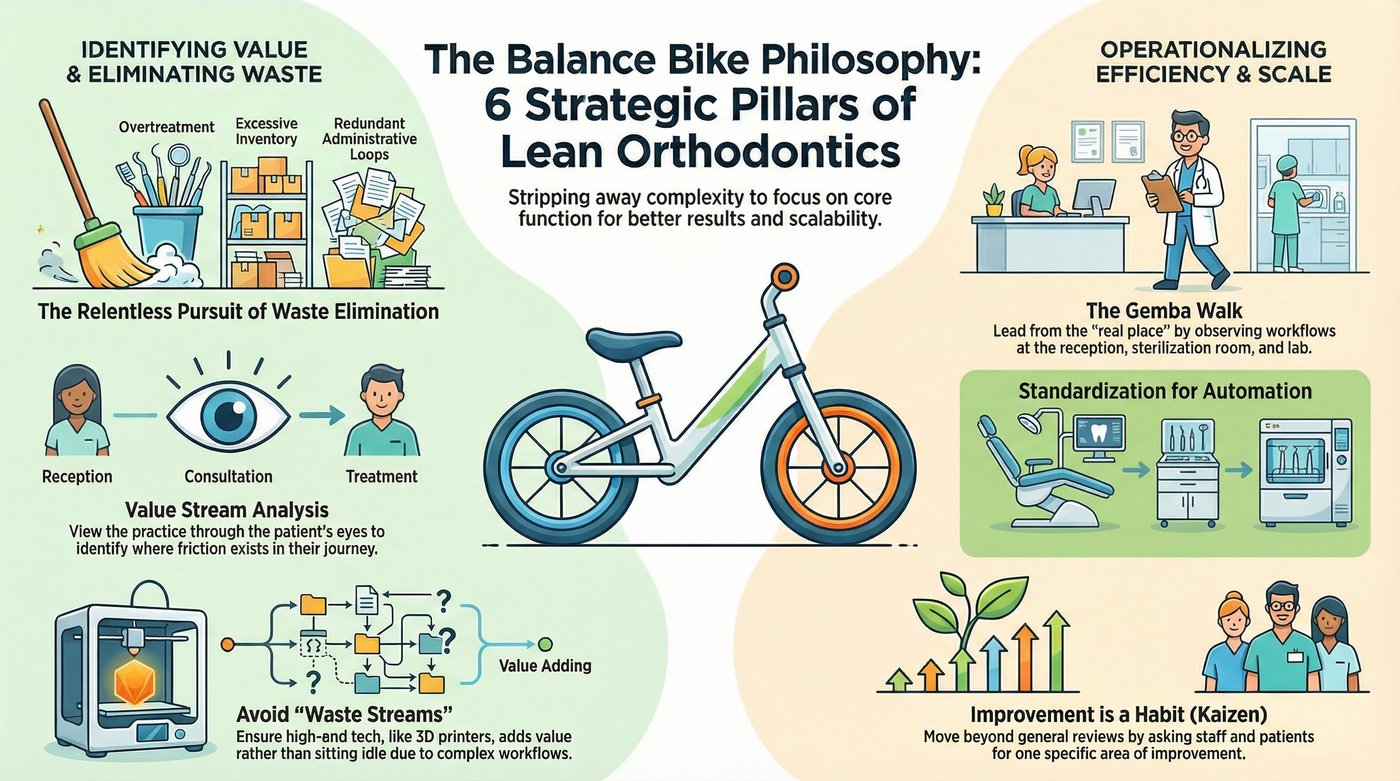
In the quest to improve our practices, our natural instinct is often to add complexity: more high-tech devices, more specialized staff, and more rigid rules. However, true professional mastery comes from doing the exact opposite. In Lean Orthodontics, we look for the “balance bike” solution. For decades, children were taught to ride with training wheels and stabilizers, which added complexity. Lean thinking removed the pedals and the crankset, reducing the machine to its core function: balance. By taking things away, the learning process became faster and more effective.
This philosophy transcends childhood learning and applies directly to the complex environment of a modern dental or orthodontic clinic. The true barrier to efficiency is not a lack of resources, but an abundance of non-value-added activities. By focusing on essential processes, we reduce cognitive load on staff and enhance the patient experience, making the clinic intrinsically more profitable and scalable.
I am Dr. Martin Baxmann, and I want to share how stripping away the unnecessary allows the essential value of your clinic to shine. To move from a cluttered operation to a high-performance machine, you must first master the strategic pillars of Lean management.
1. The Definition of Lean: Eliminating Waste
The first pillar is the relentless pursuit of waste elimination. In an orthodontic setting, waste is not just what goes in the trash. It is any activity that consumes resources—time, material, or labor—but does not directly contribute to the final successful outcome for the patient or the practice’s financial health. Identifying and classifying these non-value-added steps is the critical first step to operational clarity.
It manifests as:
Overtreatment: Performing movements or procedures that don’t add to the final clinical result. For example, excessive stripping or unnecessary appliance adjustments that prolong treatment time without improving aesthetic or functional outcomes. These delays frustrate patients and tie up chair time that could be allocated to new starts.
Excessive Inventory: Trays of brackets or wires that sit unused for months. This isn’t just a cost of capital; it carries the hidden waste of storage space, inventory tracking, and risk of expiration or obsolescence. Implementing a just-in-time (JIT) ordering system, optimized through data on usage rates, minimizes this drain.
Administrative Loops: Repeating data entry or following redundant check-in protocols. A common example is asking a patient to fill out the same medical history form annually when only a few fields have changed. Streamlining digital intake forms and integrating practice management software eliminates this administrative drag, freeing up front-office staff for higher-value patient engagement.
2. Value Stream Analysis: Viewing the Practice Through the Patient’s Eyes
Where is the value truly created? We aren’t just bonding brackets; we are creating confident smiles. Value Stream Mapping (VSM) requires charting every single step a patient takes, from the initial phone call to the final retainer delivery. Every step must be categorized as value-added, non-value-added but necessary (like sterilization), or pure waste.
If a high-end 3D printer sits idle 95% of the time because the internal workflow is too complex, that printer is not part of a value stream—it is a “waste stream.” Instead of focusing on the technology itself, analyze the process: Is the friction in impression taking, software integration, or staff training? You must analyze your clinical data to identify where the friction lies in the patient’s journey from A to B. This analysis often reveals that the biggest friction points are in communication gaps between the clinician, the lab, and the front office.
3. The Gemba Walk: Leadership at the Source
“Gemba” is the Japanese term for “the real place.” You cannot lead an efficient practice from a closed back office. The only way to truly understand systemic bottlenecks is to physically observe operations in real-time. This active presence demonstrates commitment to improvement and fosters a culture of open communication among team members.
You must go to where the work happens: the reception desk, the sterilization room, and the lab. Stand and observe without interfering. The goal is not to police, but to understand how current processes genuinely function, not how the procedure manual says they should function.
Observation Tip: Watch how many steps an assistant takes to find a camera or why a login process takes thirty seconds longer than it should. These are the “invisible” drains on your profitability that a spreadsheet will never show you. For instance, a messy sterilization area can double instrument turnaround time, creating delays that ripple across the entire day’s schedule. Addressing this through a systematic 5S implementation (Sort, Set in Order, Shine, Standardize, Sustain) is an immediate Gemba-driven victory.
4. Standardization: The Backbone of Scalability
If every clinician in your practice plans cases differently, you don’t have a system; you have chaos. Standardization is the crucial step that transforms intuitive skill into repeatable, high-quality outcomes. It ensures every patient receives the same excellent care, regardless of which team member handles their appointment.
Standardization is what allows for intuitive automation. By using clear standards—like a specific five-second model analysis or a standardized ABC diagnosis—you prepare your practice for the age of AI. Consistent application of standardized operating procedures (SOPs) is what makes onboarding new staff fast and effective. If a process is a standard, it can be automated. This could involve auto-generating treatment letters based on a standardized diagnosis code. If it relies on “gut feeling,” it remains a bottleneck.
5. Continuous Improvement (Kaizen)
Improvement is not a one-time project; it is a habit. Kaizen, the philosophy of continuous incremental improvement, requires a mindset shift from firefighting to prevention. Instead of waiting for a quarterly disaster, team meetings should dedicate ten minutes to identifying one small thing that can be made marginally better this week.
We move beyond generic “five-star reviews” and instead ask patients and staff: “If there was one thing we could improve, what would it be?” Focus on actionable, internal metrics—like reducing average patient wait time from 12 minutes to 8 minutes—rather than vague satisfaction scores. Data-driven feedback is the only way to ensure that your practice is evolving rather than just repeating the same year twenty times. This iterative cycle of Plan-Do-Check-Act (PDCA) ensures that improvements are not only implemented but also sustained and validated by quantifiable results.
Conclusion:
Mastering Lean Orthodontics is not about drastic, overnight changes; it is about embedding these five strategic pillars into the DNA of your practice. Just as the balance bike teaches children the essential skill of balance by removing distractions, Lean principles teach clinic leaders to achieve high-performance results by systematically eliminating waste and focusing on what truly creates value for the patient. By applying these principles, you transform your practice from a complex machine that demands constant troubleshooting into a streamlined, high-value ecosystem ready for scalable growth in a competitive market.