

The Architecture of Joy: Why Systematization is the Antidote to Professional Burnout
Published on: Jul 5, 2026
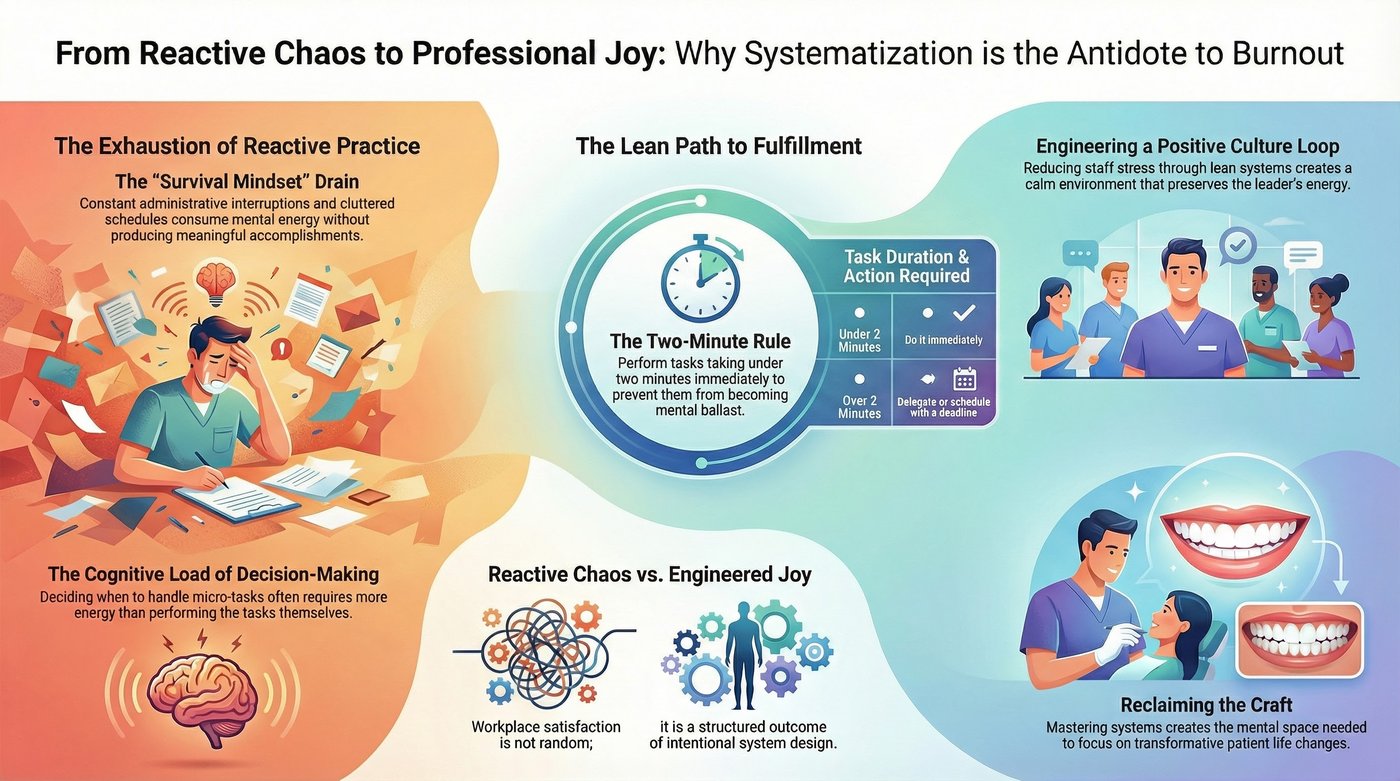
The Exhaustion of Reactive Practice
It is a common phenomenon in our profession: you finish an eight or ten-hour day feeling physically spent, yet you struggle to name a single meaningful accomplishment. You were busy, yes, but were you productive? For many orthodontists, the workday is a series of “fires” to be extinguished—administrative rejections, staffing hiccups, and the constant pressure of a cluttered schedule. This state of reactive chaos is the primary thief of professional satisfaction.
The sensation of perpetual ‘busyness’ masks a profound lack of control. True productivity is measured by progress on strategic goals, not merely frantic task completion. When standardized systems are absent, every unexpected event—such as a misplaced patient file or a complex insurance query—demands significant, immediate cognitive investment from the clinic leader.
In the world of lean orthodontics, we recognize that joy in the workplace is not a random occurrence; it is an engineered outcome. Systematic thinking requires a critical shift from continuous firefighting to intentional fire prevention. Leaders must map out core workflows to eliminate common organizational waste, such as waiting time or excessive motion, before they erode professional enthusiasm.
To find lasting fulfillment, we must move away from a “survival” mindset and toward a structured, lean approach that purposefully preserves our most valuable resource: our mental energy. A systemized practice ensures that empowered staff can resolve 90% of routine operational issues independently. This liberates the doctor to focus exclusively on high-value clinical work and strategic development, maximizing daily impact.
The Two-Minute Rule: Clearing Mental Clutter
One of the most exhausting parts of orthodontic practice management is the cognitive load of decision-making. Throughout the day, we are bombarded with micro-tasks: a quick signature, a brief staff question, or a short email. The mental effort of deciding when to do these things often takes more energy than the tasks themselves.
This constant cognitive friction, known as ‘switch-tasking,’ fragments attention and depletes executive function. For a clinic leader, every minor, pending decision occupies a small, non-refundable portion of mental bandwidth. Allowing these tiny taxes to accumulate over the day leads to profound and unnecessary mental fatigue.
To combat this, I advocate for the two-minute rule. It is a simple, non-negotiable protocol: if a task takes less than two minutes, do it immediately. Practical examples in a dental setting include approving an online lab submission, sending a brief, clarifying text to a vendor, or filing a critical insurance pre-authorization document.
By clearing these small items from your mental dashboard instantly, you prevent them from accumulating into a “mountain of ballast” that weighs on your mind all day. The discipline of immediate action fosters momentum and creates psychological closure. When your physical desk and digital inbox are systematically clear, your mind is free to concentrate entirely on the complex clinical demands of the patient.
If a task takes longer, it must be delegated or scheduled with a definitive deadline. Effective practice management requires setting up robust delegation protocols. This empowers non-clinical staff to own tasks exceeding the two-minute limit, ensuring that issues are resolved efficiently without being escalated back to the doctor.
Finding Motivation Beyond the Paycheck
While the financial success of a clinic is important, true dental leadership finds satisfaction in deeper sources. We find it in the transformative moments—when a patient sees their new smile for the first time and realizes their life has changed. However, to stay high-performing, we cannot rely solely on external praise.
The deepest motivation for a seasoned professional stems from achieving mastery over their practice environment. This is the critical difference between working in the business and working on the business. Systems are the indispensable tools of the entrepreneur-leader, enabling the predictable delivery of exceptional patient care and superior clinical outcomes.
Satisfaction also stems from the health of our internal culture. As a leader and entrepreneur, you are responsible for the environment in which your team operates. A positive culture is built not on superficial perks but on foundational clarity and fairness. When roles, responsibilities, and key performance indicators (KPIs) are clearly documented, ambiguity—a primary source of team stress and conflict—is drastically reduced.
When you implement lean systems that reduce the stress of your employees, you create a positive feedback loop. For instance, a standardized sterilization procedure or a streamlined financial intake process eliminates confusion and friction. This allows team members to consistently perform their best work without unnecessary resistance or duplicated effort.
A happy, efficient team creates a calm environment, which in turn preserves your own energy and allows you to focus on the “most beautiful profession in the world.” Systematization is fundamentally an act of service to your staff. By reducing their administrative burden through structure, you empower them to find joy and professional pride in their direct patient interactions.
Conclusion: Engineering Your Professional Life
Professional satisfaction is the result of a long chain of individual decisions. By choosing to implement structure over chaos, you are choosing a path of longevity and fulfillment. This commitment is a long-term strategic asset, making the practice resilient to major challenges like unexpected staff turnover, economic fluctuations, and internal operational breakdowns.
Lean systems are not just about profit; they are about creating the mental space to enjoy your craft, your team, and your life outside the clinic. This intentionally reclaimed mental capacity allows leaders to transition from reactive micro-management to proactive, visionary strategy, focusing on practice expansion, innovation, or a healthier work-life balance.
When you master your systems, you reclaim your joy. The most successful practices begin by identifying one area of significant friction—be it scheduling, inventory management, or patient communication—and build a replicable, robust process. The systemized practice is the definitive blueprint for a career defined by deliberate achievement, not reactive exhaustion.