

The Architecture of Autonomy: Why Your Delegation Fails and How to Fix It
Published on: Jun 22, 2026
Many orthodontic practice owners operate in a state of constant frustration, believing they are surrounded by a team that is either unmotivated or incapable of following instructions. We tell ourselves, “If I want it done right, I have to do it myself,” and in doing so, we become the primary bottleneck of our own clinical growth. This self-imposed restriction not only caps productivity but also stifles staff development, turning high-potential team members into passive order-takers.
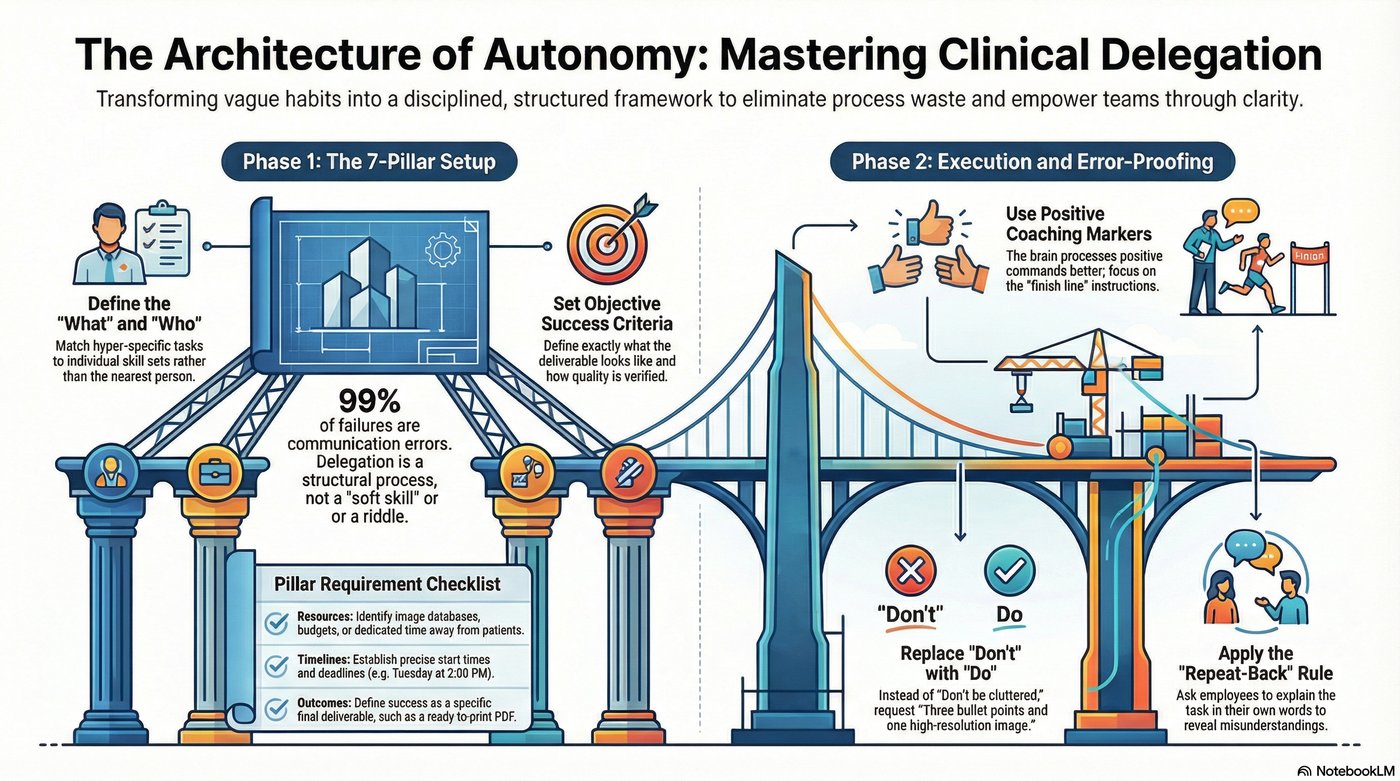
However, from a lean leadership perspective, the brutal truth is that 99% of delegation failures are actually failures of communication by the leader, not a lack of competence in the team. When a task is performed incorrectly, the owner-doctor pays twice: once for the wasted labor and time, and again for the necessary rework or corrective action. This ‘process waste’ is the hidden cost of poor leadership structure.
I am Dr. Martin Baxmann, and I am here to explain that delegation is not a “soft skill”—it is a structural process. It is the engineering of a successful outcome before the task even begins. When you skip the foundational steps of delegation, you aren’t just giving a task; you are creating “process waste”.
To move your practice from chaos to autonomy, you must transition from vague requests to a disciplined framework of “backwards engineering”. This framework transforms a simple request into a guaranteed system for success, driving efficiency from the front desk to the operatory.
The Seven Pillars of a Delegated Task
The biggest mistake in practice management is assuming your employees can read your mind. We give instructions like “Please organize the flyers,” which is far too abstract. This vagueness forces the employee to guess your intention, often leading to a subpar result that reflects the riddle you presented, not their actual capability.
Before you delegate a task, you must answer seven specific questions for yourself to ensure you are providing a roadmap, not a riddle:
What is the task? Be hyper-specific (e.g., “Create a flyer for orthodontic prophylaxis”). Do not just say “handle the inventory”; instead, specify: “Audit and reconcile the stock levels of all clear aligner accessories.”
What resources are needed? Access to image databases, budget, or dedicated time away from the chair. For example, does the administrative staff member need temporary access to the patient management software’s reporting module? Clearly defining resource needs prevents delays and excuses.
Who is the right person? Match the task to the skill set, not just the nearest person. Delegation must be strategic: assigning the task of insurance verification to the team member who has successfully resolved the most complex billing cases over the last quarter.
When does it start? Specifying a clear start time, like “Begin at 9:00 AM on Monday,” ensures the task is properly blocked out on the employee’s schedule and doesn’t get pushed aside by day-to-day emergencies.
When is the deadline? Be precise (e.g., “Tuesday at 2:00 PM”). A precise deadline, rather than a vague “ASAP” or “by end of week,” manages expectations and allows you to build follow-up checks into your own calendar.
What does success look like? Define the final deliverable (e.g., “A ready-to-print PDF”). This is your objective standard. For a sterilization task, success means “All instruments are logged, packaged, and labeled according to OSHA standards.”
How will we verify it? Establish objective criteria for quality. This could be a mandatory 5-minute status review meeting before printing, or a sign-off on a clinical checklist by a senior assistant.
By providing these guardrails, you eliminate the “guessing game” that causes employee anxiety and leads to rework. You are providing the “expert intelligence” necessary for the team to succeed, turning a vague chore into a high-leverage project.
Positive Instructions: Coaching for the Finish Line
In the high-pressure environment of an orthodontic clinic, we often default to negative instructions: “Don’t make it too cluttered,” or “Don’t forget to call the lab”. This is ineffective communication. The human brain processes positive commands more efficiently because they immediately focus attention on the intended action, rather than the undesired one.
Think of it like coaching a child on a balance beam: you don’t say, “Don’t fall”; you say, “Look at the end of the beam”. In your practice, instead of saying what not to do, provide precise, positive markers for success: “Please include exactly three bullet points and one high-resolution image”.
Translate clinical negatives into aspirational positives. Instead of, “Don’t leave the patient chart incomplete,” command: “Ensure the chart review section is fully signed off before the patient leaves the operatory.” This clarity focuses the team on the desired outcome and builds their clinical confidence, creating a culture of achievement instead of avoidance.
The “Repeat-Back” Rule: Closing the Loop
One of the most dangerous phrases in a dental clinic is “Did you understand?” The answer is almost always a reflexive “Yes,” even if the employee is confused, because they do not want to appear incompetent. This false assurance introduces severe risk into the patient journey, particularly when dealing with complex post-operative care instructions or specific hardware reordering.
To ensure the patient journey is not disrupted by a misunderstanding, you must ask the employee to explain the task back to you in their own words. For example, after instructing a new assistant on sterilization protocol, ask them to verbally walk you through the process, step by step.
This is the ultimate tool for “error-proofing” your delegation. The repeat-back reveals gaps in understanding immediately—before any time is wasted and before the task goes off track. Crucially, this exercise is not a test of the employee; it is a leadership audit of the clarity and completeness of your original instructions. This simple loop creates immediate alignment and protects the efficiency of your workflow.
Conclusion: Engineering Your Practice for Autonomy
Effective delegation moves your role from that of a micro-manager to a strategic architect. By rigorously applying the Seven Pillars, communicating through Positive Instructions, and institutionalizing the Repeat-Back Rule, you shift the burden of success from the individual team member’s guesswork to the strength of your leadership system. The result is an orthodontic practice built not on compliance, but on true team autonomy, consistency, and professional confidence. This scalable framework is the key to unlocking significant clinical growth and achieving the leadership freedom you deserve.