

The Architect’s Blueprint: Why Your Practice Needs a Visual Customer Journey Map
Published on: Jun 13, 2026
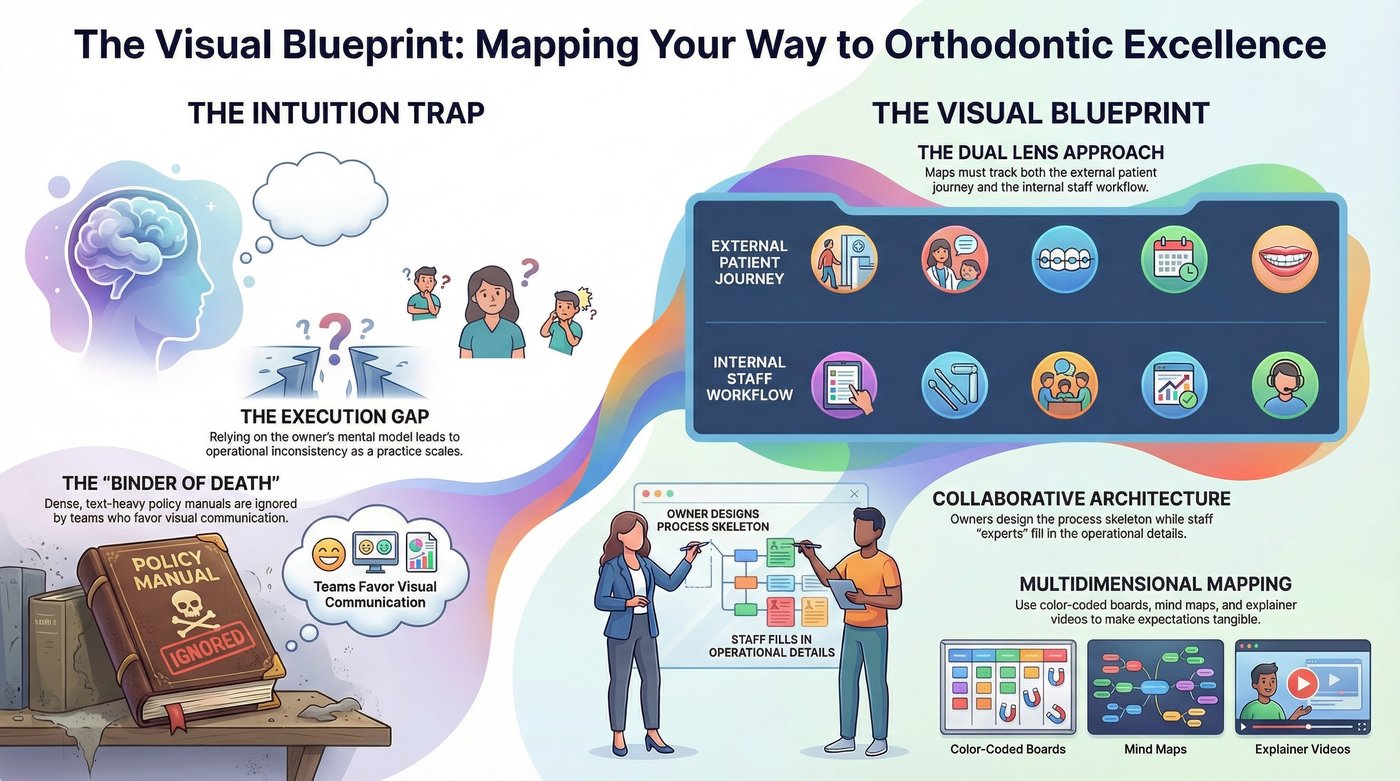
Many orthodontic practice owners operate under the “Intuition Illusion.” They believe their practice runs like a well-oiled machine because, as the founder and lead clinician, they have every process perfectly synchronized in their own minds. However, the moment a team member asks a fundamental question—or worse, makes a significant operational error—the reality sets in: there is a massive gap between the owner’s vision and the team’s execution.
Relying on intuition is a recipe for inconsistency. As you scale your clinic, the only way to maintain high-quality patient care and operational excellence is to move beyond mental models and create a comprehensive, visual customer journey map. This is not just a marketing exercise; it is the fundamental blueprint for your entire practice landscape.
Beyond A to B: Mapping the Multidimensional Process Landscape
In traditional orthodontic practice management, the patient journey is often viewed as a simple line: the patient enters, receives treatment, and leaves. In reality, a modern clinic is a complex web of intersecting micro-processes. A functional customer journey map is the framework that captures this entire landscape.
Think of your practice not as a single road, but as a multidimensional network of highways and local streets. This landscape includes every digital interaction, physical touchpoint, and administrative follow-up. By mapping this out, you define exactly what materials are needed at each stage, how communication should flow, and—most importantly—who owns each specific responsibility. Without this visual clarity, your team is essentially driving without a GPS, hoping they arrive at the right destination by accident.
The Dual Lens: Serving Internal and External Customers
A cornerstone of lean management in dentistry is the recognition that you serve two distinct groups: your external patients and your internal team. A successful journey map must address both.
Your employees are your internal customers. They have their own journey within your systems. If their internal touchpoints—such as the morning briefing, the sterilization workflow, or the digital charting process—are clunky and frustrating; they cannot provide a five-star experience to the patients. When you map the internal journey, you identify the “invisible waste” that leads to burnout and high turnover. By optimizing the internal process, you empower your team to perform at their peak, ensuring the external patient journey remains seamless and professional.
From Manuals to Mind Maps: Communicating with the Visual Learner
One of the greatest barriers to dental team performance is the “Binder of Death”—the thick, black-and-white policy manual that sits on a shelf gathering dust. We must recognize that our teams are often composed of diverse learners, many of whom are overwhelmed by dense, academic text.
If you want your systems to be implemented, you must speak the language of your team. This means moving away from text-heavy manuals and toward visual communication:
Visual Journey Maps: Color-coded boards that show exactly where each role fits.
Infographics and Mind Maps: Breaking down complex workflows into digestible graphics.
Explainer Videos: Using short visual clips to demonstrate “the way we do things here.”
A visual map makes your expectations tangible. It transforms an abstract concept into a physical blueprint that the team can refer to daily.
The Leader as Architect, the Team as Experts
In the Lean Orthodontics philosophy, the practice owner acts as the architect. You design the skeleton—the structural integrity of the processes. However, you must rely on your “subject matter experts”—your assistants, receptionists, and coordinators—to fill in the details.
Your team members are the ones “in the trenches.” They are the electricians and plumbers of your practice construction. They are the ones who can tell you if a digital form is too long or if a clinical setup is inefficient. By collaborating on the journey map, you gain their buy-in and benefit from their specialized insights. This collaboration leads to higher efficiency and a much higher quality of service.
Conclusion: Visualizing Your Way to Excellence
A well-defined customer journey map is the difference between a chaotic clinic and a streamlined, professional practice. It allows you to step back and view your operations from a bird’s-eye view, identifying bottlenecks before they become crises.
Don’t let your practice’s success depend on your daily presence or your team’s ability to read your mind. Sit down with a big board, gather your team, and start sketching your process landscape today. When the map is clear, the journey becomes effortless for everyone involved.