

The ABCDE System: Simplifying Complex Clinical Logic
Published on: Jun 30, 2026
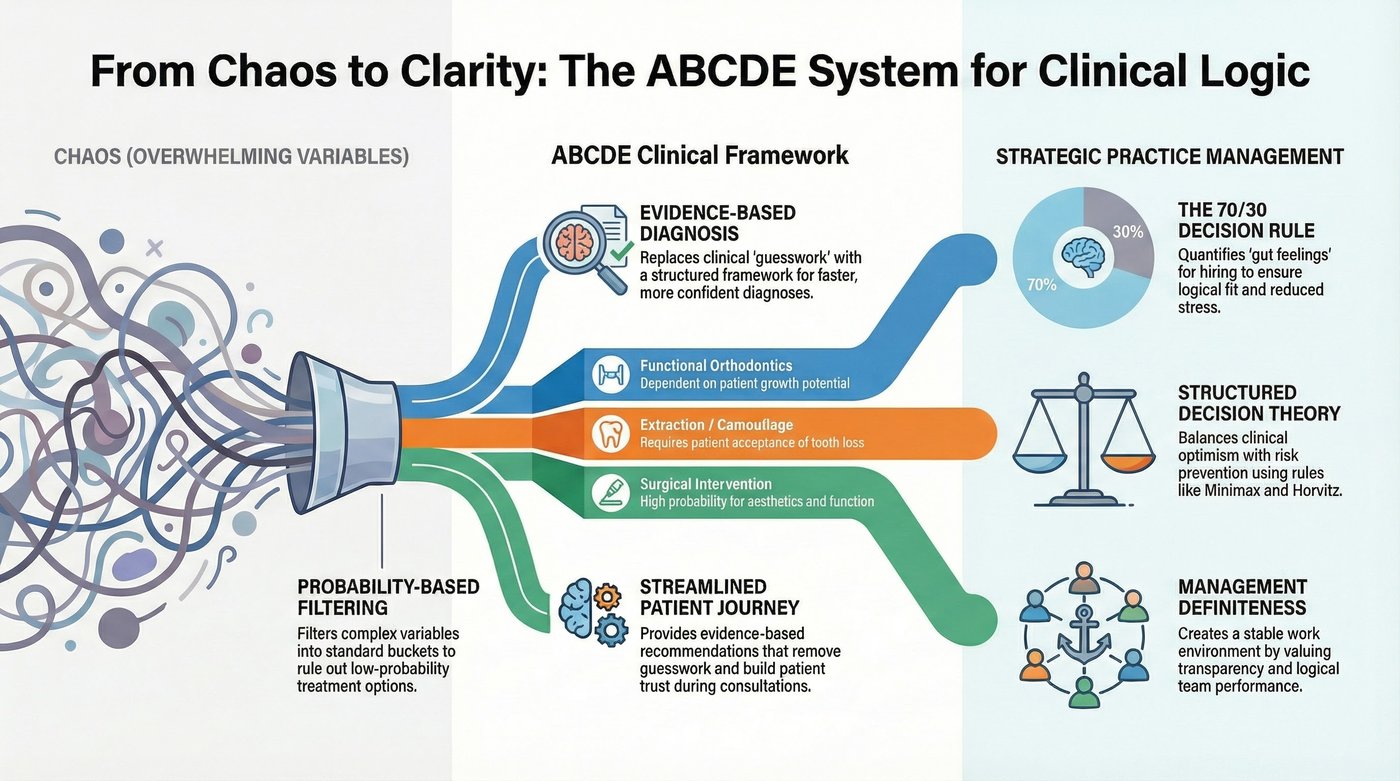
From Chaos to Clarity
When faced with a complex Class II case, the sheer volume of interceptive, compensatory, and surgical variables can feel overwhelming. The common clinical dilemma is often not what to do, but which option carries the highest probability of success for this specific patient. Do we extract? Do we distalize? Do we refer for orthognathic surgery? To achieve practice efficiency at scale, we need a standardized, repeatable system that filters these choices through the lens of calculated probability.
This structured approach is the purpose of the ABCDE system. It serves as a rapid-fire decision-making protocol that compels the doctor and clinic leader to immediately assign success probabilities to five potential treatment paths. By categorizing treatment paths into standard, predefined “buckets,” we can quickly rule out low-probability options that waste chair time and consultation energy.
The system does not seek to replace your deep clinical intuition; rather, it provides a rigorous, objective framework to harness it. This framework allows the doctor to reach a definitive diagnosis faster and present it with uncompromising confidence, which directly and positively improves the patient journey in orthodontics. For clinic leaders, standardizing this logic across associates ensures consistency in treatment planning and case presentations, protecting the practice’s brand equity.
Applying the Logic: A Case Study
To illustrate, consider a new patient—a 30-year-old female with a significant Angle Class II malocclusion and a severe premolar width discrepancy. The initial assessment identifies several potential routes, each with an associated clinical risk and patient acceptance hurdle.
Option A (Functional Orthodontics): The probability of achieving a meaningful skeletal change is near zero due to the cessation of growth in an adult patient. This option is immediately discarded in the clinical probability filter, saving time and avoiding false hope.
Option B (Compliance-Independent Distalization): Possible for reducing the Class II component, but it may not comprehensively address the patient’s underlying profile concerns or the severity of the width discrepancy. Its success is limited to dental-only movements, making it a medium-to-low probability for achieving aesthetic goals.
Option C (Extraction/Camouflage): A clinically viable path for correcting the bite, but it requires the patient to accept the permanent loss of four teeth, which is a major commitment and often a source of patient anxiety. The probability of aesthetic success is high, but the probability of patient acceptance is often lower.
Option D (Surgery): This option offers the highest probability of achieving profound skeletal, functional, and aesthetic success. Since the biological foundation is fixed, surgery offers a definitive result.
By systematically evaluating the patient’s stated goals—such as avoiding extractions but concurrently wanting a dramatic profile change—the “D” path (Orthognathic Surgery) becomes the irrefutable logical winner. The ABCDE system takes the “guesswork” out of the consultation, shifting the conversation from opinion to a clear, evidence-based recommendation that builds immediate trust. This clarity is paramount for achieving high case acceptance rates in complex, high-fee treatment plans.
Management Probability: Gut Feeling vs. Data
This essential probability-based logic extends directly from the operator to orthodontic practice management, especially in high-stakes decisions like capital expenditure or hiring new clinical staff. When you are deliberating over a critical new hire, the decision is often complicated by subjective feelings about personality or cultural fit. The discipline of the ABCDE system requires that you quantify your “gut feeling.”
For instance, develop a scorecard that assigns weighted values to core competencies (e.g., technical skill, case management history, alignment with clinic values). If the data-driven pros and cons lead you to a 70/30 conclusion in favor of a candidate, the choice is made, regardless of temporary emotional reservations. This quantitative approach to team decisions significantly reduces the emotional stress of management and prevents decision fatigue for the clinic leader.
It ensures that your dental team’s performance and staffing model are built on a logical, quantifiable fit rather than fleeting emotions or subjective impressions. In a lean, high-performing practice, we value this level of transparency and definiteness. It creates a stable, predictable work environment where roles and expectations are clear, allowing the team to focus entirely on patient care and clinical excellence.
Conclusion: The Professional Intuition Balance
Probability theory is not a call for ignoring your extensive clinical and leadership experience; it is a framework for rigorously structuring it. As experienced professionals, we must learn to integrate decision science with our history. Rules derived from established theory—such as the Minimax principle (the strategy of choosing the path that prevents the greatest potential harm) or the Horvitz rule (which factors in a calculated degree of clinical optimism when evaluating uncertain outcomes)—allow you to balance evidence-based medicine with your profound professional history.
By utilizing these simple yet powerful elements of decision theory, clinical and administrative dilemmas are transformed. They cease to be subjective crises and become structured, solvable puzzles with clear, objective solutions. This transition from reactive decision-making to proactive, probabilistic analysis defines the successful, scalable dental practice of the future. The ABCDE system is merely the language we use to articulate that successful strategy.