

The 80/20 Practice: Why Hard Work is Often the Enemy of High Performance
Published on: Jun 12, 2026
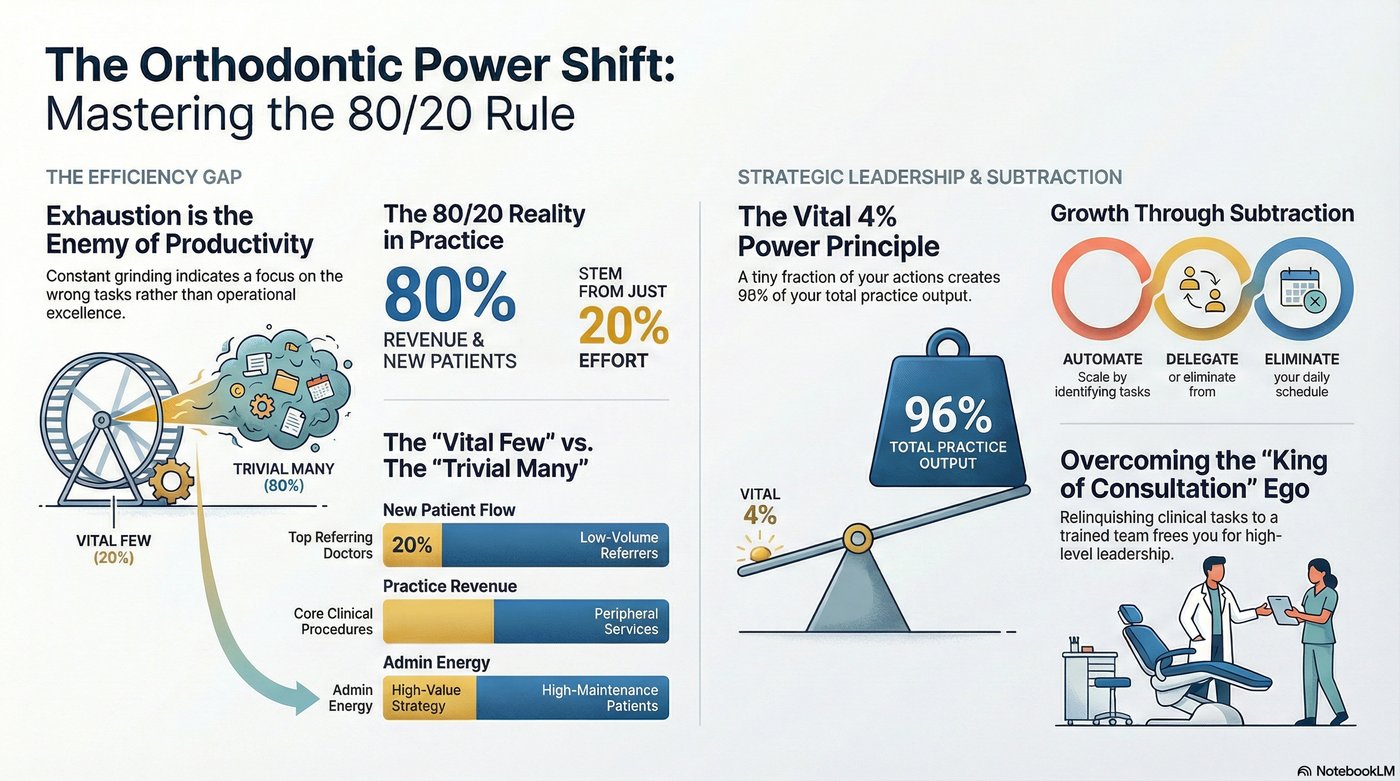
In the traditional world of orthodontics, we are often conditioned to equate exhaustion with achievement. We are raised with a “grind” mindset, believing that a ten-hour day at the chair is the ultimate badge of success. This cultural norm suggests dedication is measured by depletion, often leading clinic leaders toward burnout rather than true productivity.
However, high-level dental leadership requires a radical departure from this workaholic philosophy. If you are constantly exhausted, you aren’t being productive—you are likely focusing on the wrong things. You are trading maximum effort for minimal impact, a formula that limits both personal well-being and practice profitability.
To achieve true operational excellence, we must embrace the Pareto Principle, commonly known as the 80/20 Rule. This principle states that roughly 80% of your results come from just 20% of your actions. In a clinical setting, this means the vast majority of your effort is likely generating very little actual value.
For a thriving practice, focus is paramount. Leaders must analyze where their time yields the greatest return on investment (ROI). By identifying the “vital few” activities that drive your practice, you can reclaim your time and dramatically increase your impact. This strategic shift moves a leader from task execution to strategic direction, a necessary step for scaling any successful dental business.
+1
Identifying Your High-Value Drivers
The 80/20 ratio is a measurable reality in almost every orthodontic practice. Implementing this requires a data-driven audit of operational metrics, not just an assumption based on feeling busy. Leaders must commit to an objective analysis of input versus output. If you audit your data, you will likely find that:
20% of your referring doctors provide 80% of your new patient flow. This crucial 20% should receive 80% of your relationship-building and appreciation resources. The remainder can be managed with automated touchpoints.
20% of your services (the core clinical procedures) account for 80% of your revenue. This often involves complex full-mouth cases or specific high-margin procedures. Focus on optimizing the administrative and clinical pathways for these vital services, ensuring flawless execution and advanced team competence.
20% of your patients consume 80% of your administrative energy. These might be patients with complex insurance issues or frequent cancellations. Implementing standardized protocols for managing them is vital to protect the team’s capacity and maintain overall focus.
Recognizing these patterns allows you to stop “spinning your wheels” on high-effort, low-reward activities. Instead of trying to be everything to everyone, a lean leader focuses energy on the 20% of processes that yield the highest return. This deliberate focus transforms the practice model.
When you stop chasing low-value activities, you create the necessary mental capacity for true business growth. This isn’t just about saving time; it’s about creating the mental space necessary for high-level strategy, advanced marketing oversight, and focused team development. For example, if 80% of conversions originate from just two sources, 80% of the budget should be funneled there, avoiding the trap of marginal returns.
The Power Principle: Finding Your Vital 4%
If you apply the 80/20 rule to itself—the 20% of the 20%—you arrive at the “Power Principle”. This mathematically powerful concept suggests that a tiny fraction of your actions, roughly 4%, is responsible for a staggering 96% of your total output. This extreme leverage is the essence of true strategic impact.
This is the secret behind the most successful multi-practice entrepreneurs. They do not have more hours in the day; they simply have a ruthless focus on that vital 4%. For a clinical owner, this 4% must consist of activities that absolutely cannot be outsourced, automated, or delegated. This might include high-level clinical decision-making on the most complex cases, strategic hiring of key leadership talent (like a future COO), or defining the long-term brand vision and culture. These core, executive-level activities are the true, non-negotiable growth engines of the business.
To put this into daily practice, leaders should audit their entire week and categorize tasks by their potential for delegation or elimination. Every minute spent on basic patient charting or supply ordering is capacity stolen from this vital 4%. By creating robust standard operating procedures (SOPs) and delegating the other 96% of tasks, you move from the “hamster wheel” of daily operations into a position of true leadership. The ultimate goal is to maximize the minutes you spend acting as the CEO, not simply the most skilled technician. This focus on leverage is the only sustainable path to building a scalable enterprise.
Overcoming the “King of the Consultation” Ego
The greatest barrier to implementing the Pareto Principle is often the doctor’s own ego. Many practitioners believe they are the only ones capable of handling specific tasks, such as the initial consultation or financial presentation. This belief is rooted in a limiting sense of perfectionism, where leaders convince themselves that their personal expertise is irreplaceable. This mindset fundamentally limits business growth and scale.
However, true practice efficiency is achieved through delegation and trust. This requires dedicated investment in comprehensive team training, process standardization, and a system for accountability. The process begins by clearly documenting the “doctor standard” for every task and empowering a qualified Treatment Coordinator or Clinical Manager to consistently execute it.
I once believed I was the “king of the consultation,” but when I finally trained my team and analyzed the resulting data, I found they achieved the same or even better closing rates I did. This demonstrated that a strong system, not the individual doctor, was the key driver of conversion success.
By letting go of that direct patient-facing role, I freed up precious hours of my week for tasks that only I, as the owner, could perform, such as planning facility expansion, structuring financial strategies, or mentoring new associate doctors. Leadership is not about being the best at everything; it’s about building a system where everyone can be their best. Delegating these tasks is strategically elevating a team member to own a critical process, thereby multiplying the leader’s capacity. This disciplined release of control is the definitive mark of a scaling enterprise leader.
Conclusion: Subtraction as a Growth Strategy
The path to a more productive and scalable practice is not through addition, but through deliberate subtraction. Stop adding more hours, more meetings, and more responsibilities to your schedule. Instead, ruthlessly identify the 80/20% of tasks that drain your energy without moving the financial or strategic needle, and find ways to automate, delegate, or eliminate them entirely. This process of simplification allows the practice to operate with streamlined clarity and frees up critical resources.
When you focus on your vital 4%, you transform your practice into a high-output organization that runs with exceptional ease and predictability. This strategic focus guarantees that your daily efforts are always aligned with your highest long-term objectives. Embracing the 80/20 Practice philosophy means designing a system where predictable success is inevitable, not dependent on the personal exhaustion of the leader. Stop grinding and start leading. The true measure of a high-performing dental leader is defined by the precision and leverage of their effort. This critical shift is the difference between merely surviving in the operatory chair and truly thriving as an entrepreneurial owner.