

The 5S Framework: Clearing the Path to a High-Performance Clinic
Published on: Jul 4, 2026
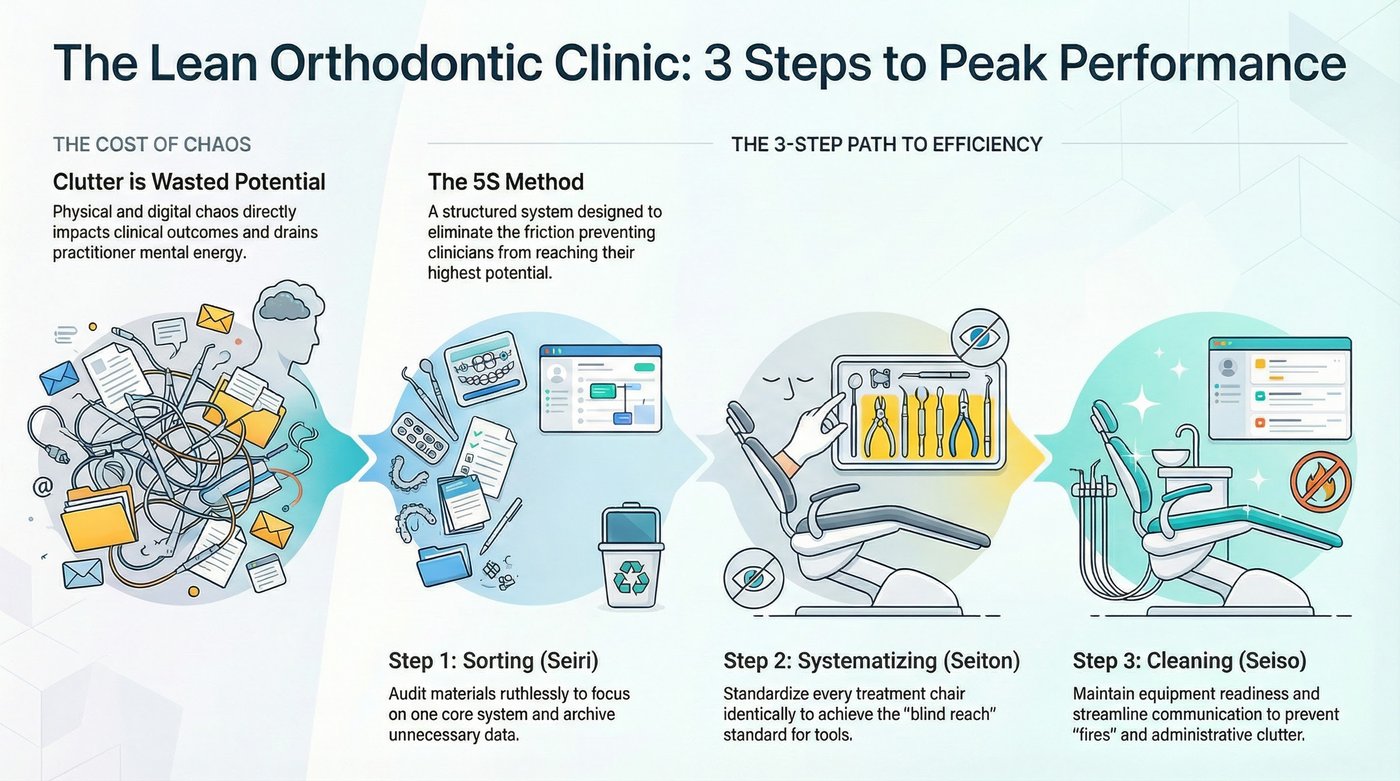
The Cost of a Cluttered Practice
A cluttered orthodontic practice is a visible symptom of wasted potential. When treatment rooms are overflowing with mismatched materials and desks are buried under administrative “ballast,” your mental energy is being drained by invisible distractions. In lean orthodontics, we recognize that physical and digital chaos directly impacts clinical outcomes.
To reclaim your focus, we implement the 5S method—a structured approach to organizational excellence. This system isn’t just about “tidying up”; it’s about eliminating the friction that prevents you from reaching your highest potential as a clinician and leader.
Step 1: Sorting (Seiri) — Eliminating the Unnecessary
The first step is a ruthless audit of what you actually need. Many orthodontists accumulate materials from dozens of manufacturers after attending various courses. This is a primary source of waste. Focus on one core system; you do not need ten different arch forms for every rare outlier.
Sorting also applies to your data and your patient list. Archive physical models digitally to free up space, and focus your cephalometric analysis only on the values that influence your treatment plan. Even “sorting” your patient list is vital—identifying non-compliant or consistently difficult patients allows you to pour your energy into the patients who actually value your expertise.
Step 2: Systematizing (Seiton) — Order for Flow
Once you have sorted your tools, they must be arranged so they are available exactly when needed. Systematizing means that every drawer at every treatment chair is stocked identically.
This allows for the “blind reach” standard: you should be able to reach for a pair of Weingart pliers or a specific archwire without taking your eyes off the patient. In a lean practice, we even systematize our clinical decisions using buckets like the ABCDE system, making treatment planning fast and predictable.
Step 3: Cleaning (Seiso) — Maintaining Mental Hygiene
In the 5S method, “cleaning” refers to more than just sterilization. It is about equipment readiness and mental hygiene. If a curing light or a chair motor fails, it creates a “fire” that disrupts the entire schedule.
Cleanliness also applies to communication. Using internal systems for work-related needs—rather than sending unrelated videos or messages—ensures that information flows without “clutter.” Clarifying clinical questions immediately, rather than letting them sit for a day, prevents the waste of waiting.
Conclusion: The Foundation of Efficiency
By implementing the first three stages of 5S—Sorting, Systematizing, and Cleaning—you build the physical and mental foundation for a high-performing practice. You remove the distractions that lead to exhaustion and create a space where your talent can truly shine.