

The 10x Value of Strategic Time: Balancing the Doctor and CEO Roles
Published on: Jun 9, 2026
A common struggle for practice owners is the “guilt” of the back office. Many orthodontists feel that if they aren’t actively seeing patients, they aren’t making money. They view time spent on business strategy, systems, and leadership as “admin time” that takes them away from their “real” work.
This mindset is an insidious barrier to scale. The feeling of guilt stems from a transactional view of income: revenue is directly linked to hands-on clinical procedures. However, this high-leverage model traps the owner in the chair, severely limiting overall practice potential.
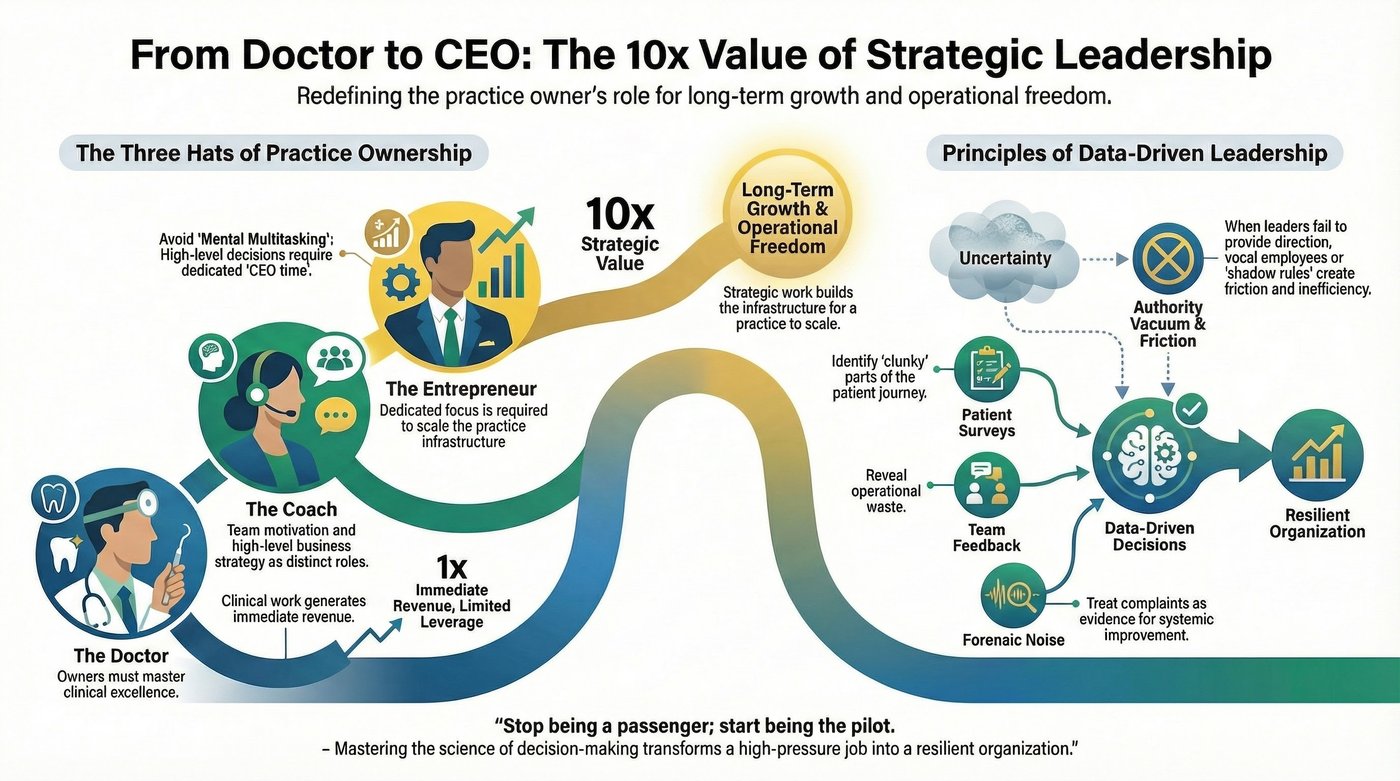
In the philosophy of Lean Orthodontics, this is a fundamental misunderstanding of value. Strategic planning time is actually ten times more valuable than clinical time. While clinical work generates immediate revenue, strategic work builds the infrastructure that allows the practice to grow, scale, and function without the owner’s constant presence at every chair.
A single strategic decision—such as optimizing the new patient flow or delegating financial oversight—can save hundreds of hours per year and increase case acceptance rates permanently. This single-hour investment delivers a multiplier effect far exceeding the immediate revenue from an hour spent on chair-side adjustments.
Navigating the Three Roles: Entrepreneur, Doctor, Coach
To lead a successful practice, you must learn to wear three different hats, often in the same day. However, you cannot wear them all at the same time. It is crucial to recognize which hat you are wearing at any given moment and transition cleanly between them.
Trying to solve a complex staffing issue while performing an intricate surgical extraction is a recipe for error and cognitive overload. Successful practitioners understand that cognitive switching costs are high, and attempting to multitask across these distinct domains leads to diluted results and increased stress.
The Doctor: Focused on clinical excellence and patient treatment. This role demands precision, focus, and technical expertise. Clinical time is valuable, but it is a linear resource that cannot be leveraged for exponential growth.
The Coach: Focused on training, motivating, and realigning the team. This involves developing standardized operating procedures (SOPs), conducting effective morning huddles, and providing continuous feedback to elevate team competency.
The Entrepreneur: Focused on high-level decision-making and business strategy. This includes capital allocation, market expansion planning, technology adoption, and protecting the long-term enterprise value of the practice.
Most owners fail because they try to act as entrepreneurs while in the middle of a clinical procedure. You cannot make high-level decisions while focused on a complex bracket placement. To succeed, you must carve out a dedicated setting and the mental space to reflect.
Successful clinic leaders schedule “CEO time” as sacred, non-negotiable blocks on their calendars—often outside of clinical hours or off-site. This dedicated setting is where you analyze your “twist flex” wires of information and plot the future of your business with clarity, free from immediate patient demands.
Systemic Thinking and the “Vacuum” Effect
Your practice is a living molecule, and every person is a particle in motion. In this system, the leader’s primary job is to provide direction and structure. When you neglect your role as the entrepreneur, the system becomes unstable.
This instability manifests as inconsistency. For example, if there is no clear written policy for patient rescheduling or financial hardship cases, each team member will create their own workaround. The patient experience becomes fragmented and unpredictable, damaging your brand equity.
If you are afraid to make direct decisions because you want to be “one of the team,” you inadvertently create an authority vacuum. In any organization, a vacuum will eventually be filled—often by the most vocal employee or by a set of “shadow rules” that don’t align with your vision.
These shadow rules undermine professional governance. A common example is a culture where certain staff members consistently arrive late or circumvent mandatory checklists because the established leader avoids confrontation to maintain harmony. This short-term comfort destroys long-term operational integrity.
Embracing your role as an entrepreneur is an act of service to your team; it provides them with the clarity they need to do their jobs without second-guessing. When the leader sets clear boundaries and expectations, staff can operate efficiently and autonomously, reducing burnout and improving morale.
Data-Driven Leadership: Beyond Intuition
A true entrepreneur moves away from leading by “gut feeling” and toward leading by data. This requires a genuine interest in the reverse flow of information, treating every operational report and piece of feedback as a key indicator of your practice’s health.
Survey your patients: Identify where the journey is clunky. Look specifically at net promoter scores (NPS) and areas like wait times, consultation clarity, and post-treatment follow-up to pinpoint friction.
Listen to your team: They see the operational waste that you miss while at the chair. Implement weekly anonymous feedback loops to capture friction points in inventory, cross-departmental handoffs, and equipment issues that consume clinical time.
Analyze the “Noise”: Don’t ignore complaints or negative feedback; treat them as forensic evidence for system improvement. A spike in complaints about payment options, for instance, isn’t a staff failure—it’s a system failure requiring a new financing SOP.
This rigorous analysis is necessary because clinical intuition—which is vital for patient care—is often misleading in business operations. For instance, you might feel busy, yet data may show your production per hour is flat due to inefficient scheduling templates or poor patient retention strategies.
By making decisions based on analyzed reports and survey results rather than vague intuitions, you remove the emotional stress of leadership. You stop “guessing” and start “knowing” exactly what your practice needs to reach the next level of operational excellence.
Conclusion: The Path to Long-Term Growth
Success in orthodontics is a marathon, not a sprint. While your clinical skill will get you through the day, your entrepreneurial skill will build your future. By embracing your role as the business owner, you stop being a passenger in your practice and start being the pilot.
The transformation from clinician to CEO requires disciplined time blocking and a commitment to systemic improvement. You must view the investment in strategic time as an exponential generator of future wealth and freedom, not a distraction from today’s production schedule.
Invest in your leadership. Create the space for strategic reflection. Listen to the data coming from your clinic. When you master the science of decision-making, you transform your practice from a high-pressure job into a thriving, resilient, and high-output organization.
The ultimate measure of a thriving practice is its ability to perform at a high level without the owner physically present. By dedicating time to the 10x-value work of strategy and systems, you create a self-managing enterprise that secures both professional fulfillment and lasting financial independence.