

Strategic Visibility: Why the “Sniper” Approach Wins Local Orthodontic Search
Published on: Jul 2, 2026
Moving Beyond the “Shotgun” Marketing Method
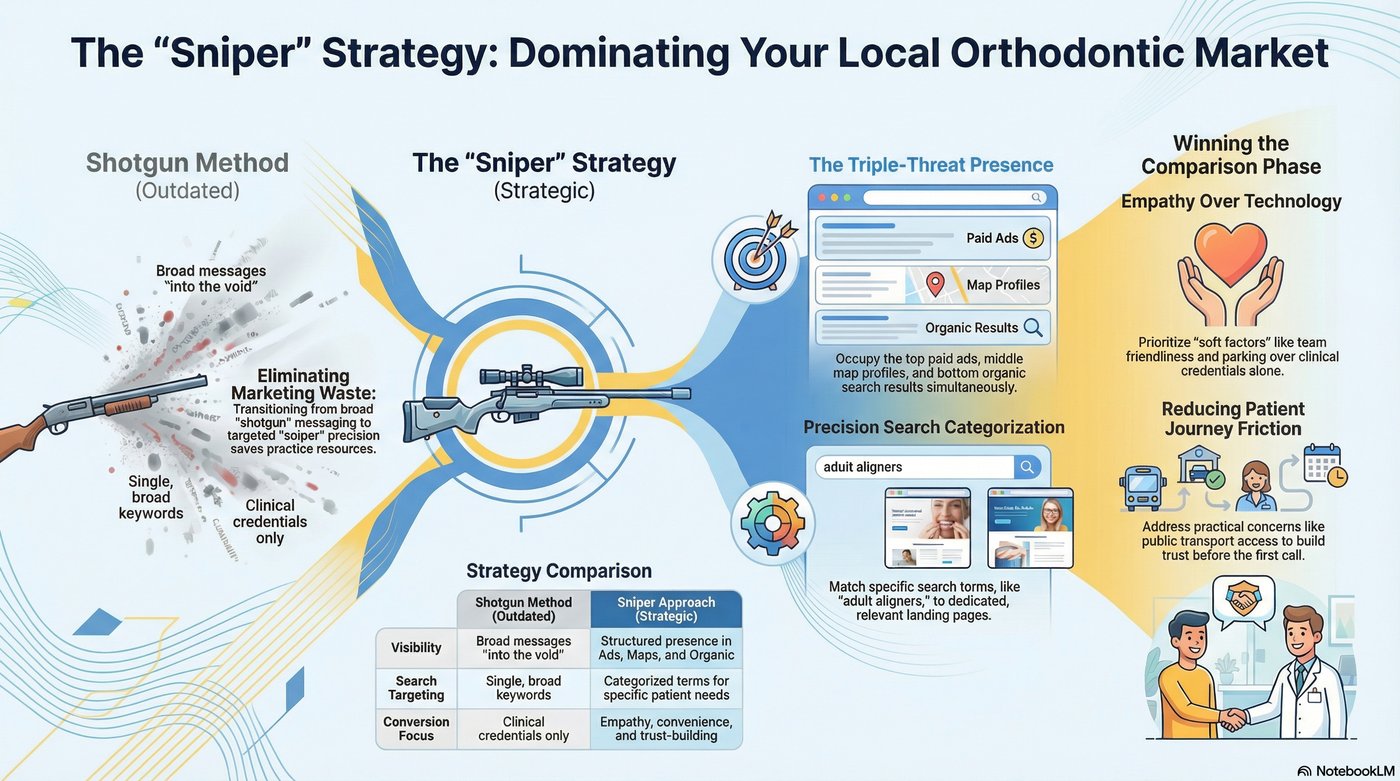
Many orthodontists approach online marketing like a shotgun—firing broad messages into the void and hoping to hit something. In the world of lean orthodontics, this is a massive waste of resources and energy. To truly dominate your local market, you must transition into a “sniper” mindset. This means moving beyond being merely seen to being actively chosen.
The “shotgun” strategy relies on generic volume, often resulting in deep impressions but disastrously low conversion rates. For a high-value, elective service like orthodontics, scattering your budget across vague demographic targeting is a costly error. The sniper approach, conversely, focuses capital only on prospects exhibiting high-intent search behavior. This commitment to precision dramatically lowers Customer Acquisition Cost (CAC) and optimizes budget allocation.
The digital landscape is not a mystery; it is a structured environment with three primary tiers of visibility. To achieve operational excellence in your growth strategy, you should aim to occupy all three: the paid advertisements at the top, the local map profiles in the middle, and the organic search results below. By appearing in every section, you signal authority and reliability to the local community.
This “triple-play” strategy reinforces trust. When a potential patient sees your practice listed in the Google Ads section (top of funnel), confirmed by a strong Google Business Profile (mid-funnel), and validated by a high organic ranking (bottom of funnel), the perceived risk of choosing your practice is significantly reduced. This omnipresence acts as an irrefutable professional endorsement, driving greater confidence in the decision-making process.
The Comparison Phase: Where Empathy Outperforms Technology
Once a potential patient finds you, they enter the “comparison” phase. They aren’t just looking at your clinical credentials; they are comparing you against every other local option. This is where dental leadership and “soft factors” become your greatest competitive advantages.
The comparison goes beyond comparing costs and treatment types. It shifts to evaluating the overall patient experience. Clinic leaders must recognize that the digital front door—your website—is the first true point of service. If this experience is confusing, slow, or impersonal, the prospect will quickly navigate elsewhere, regardless of your clinical reputation.
Patients are looking for trust and convenience. Your digital presence must answer the practical questions that influence a parent’s decision: Is there parking? Is the team friendly? Is it easy to reach by public transport? By addressing these empathetic details on your website and local profile, you reduce the friction of the patient journey in orthodontics before the patient even calls the office.
This is where authentic social proof is paramount. High-quality video testimonials showcasing happy patients and their parents provide context and emotional resonance that static text and photos cannot match. Ensuring your Google Business Profile features recent, detailed reviews that specifically mention your team’s kindness or operational efficiency can be the final decisive factor in a competitive local search. Effective dental leadership means designing the practice’s digital interface to mirror the warmth and professionalism of the physical clinic.
Search Term Analysis: The Foundation of Precision
You cannot dominate a market by targeting a single broad term. Search behavior is highly specific. One user might look for “adult aligners,” while another searches for “orthodontist for kids in [City Name]”.
A sophisticated “sniper” strategy demands a granular understanding of long-tail keywords—the specific phrases that indicate clear intent. For example, a search for “Invisalign cost consultation near me” shows much higher conversion potential than a simple “orthodontist.” Investing marketing dollars into these long-tail, high-intent keywords generates superior ROI.
To improve practice efficiency, you must categorize these search terms and match them to specific landing pages. This level of precision ensures that when a user clicks your ad, they find exactly what they were looking for. This reduces “bounce rates” and ensures your marketing budget is spent on high-quality leads who are ready to book a consultation.
This categorization should segment terms by treatment type (e.g., metal braces, ceramic braces, clear aligners) and patient segment (e.g., early intervention, adult cosmetics, retention). Each segment needs a dedicated, highly optimized landing page that speaks directly to that user’s pain points and goals. A landing page dedicated to “Phase 1 Orthodontics for Young Children” will resonate far more deeply with a concerned parent than a generic home page, significantly boosting the likelihood of scheduling an initial exam.
Conclusion: The Choice to Lead
Dominating local search results is a strategic decision. It requires moving away from the “hope-based” marketing of the past and embracing a structured, systemic approach. By appearing in all three search areas and focusing on the soft factors that build trust, you ensure your practice remains the top choice in your region.
In the highly competitive landscape of local orthodontics, market leaders are not waiting to be found; they are intentionally positioning themselves to be unavoidable. This systemic deployment of resources—precision in ad placement, optimization of the local profile, and strategic content creation—is the defining mark of a resilient and growth-focused practice. The transition from “shotgun” volume to “sniper” accuracy is not just a marketing pivot; it is a fundamental choice for dental leadership to control the practice’s destiny and solidify its role as the dominant regional provider.