

Strategic Team Design: Balancing Harmony and Innovation in Orthodontics
Published on: Jul 4, 2026
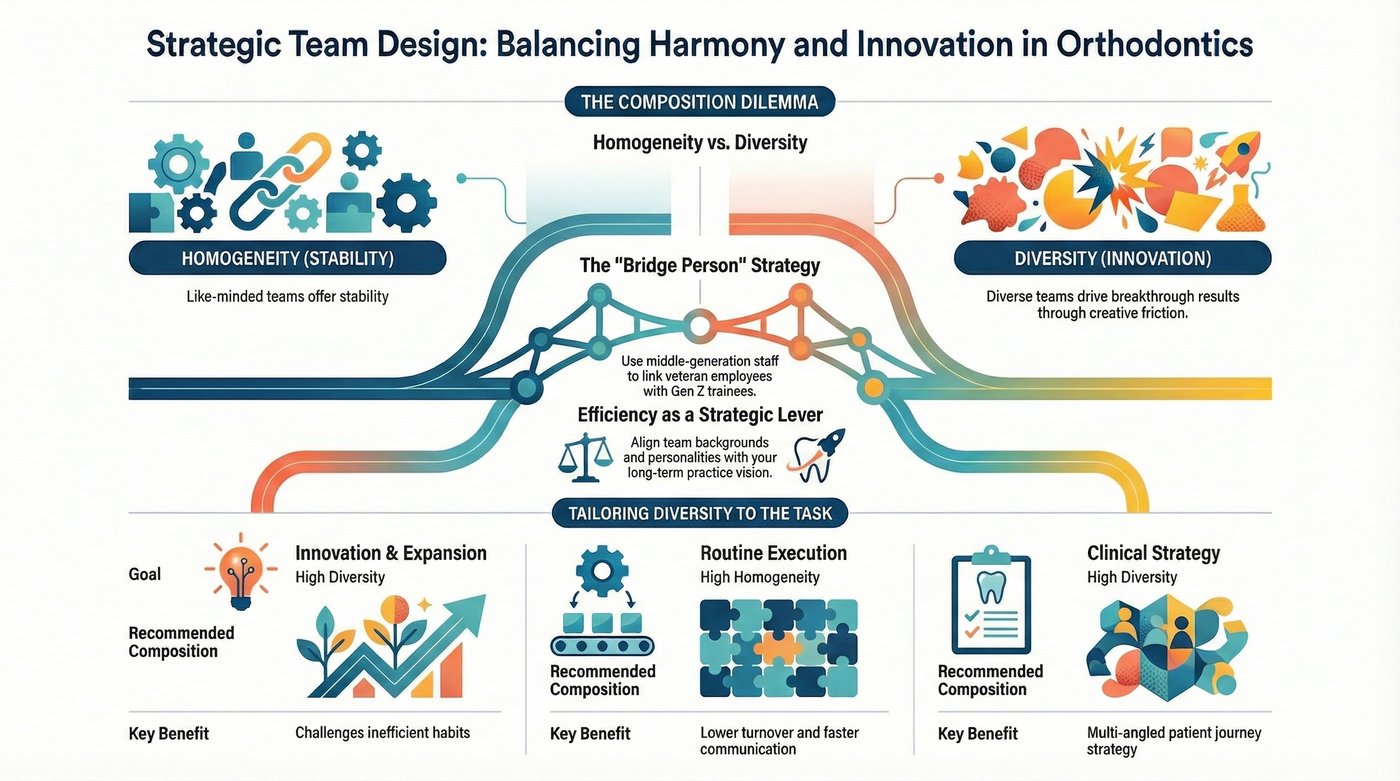
The Composition Dilemma: Like-Minded vs. Diverse
Most orthodontists aim for a “harmonious” office, but harmony can sometimes be the enemy of growth. If everyone on your team thinks exactly like you, the practice will be relaxed and conflict-free, but it may also stagnate. Homogeneity ensures quick agreement and rapid execution of established protocols, offering a comforting stability that minimizes stress for the doctor and staff. However, this stability often blinds the practice to emerging technologies or shifting patient expectations.
On the other hand, a team of opposites brings an “explosive” creativity that can lead to breakthrough results, yet it carries the risk of friction. A diverse team challenges the status quo, forcing a deeper examination of inefficient habits like manual charting or outdated inventory systems. The resulting tension, when properly managed by strong dental leadership, acts as a crucible for true innovation, leading to proprietary processes or better patient communication strategies.
In lean orthodontics, we view team composition not just as a human resources task but as a strategic lever for practice efficiency. A strategic leader must constantly assess whether the current goal is stabilization—requiring homogeneity for process adherence—or transformation—requiring diversity for radical problem-solving. This decision dictates recruiting and deployment strategy.
The key to successful dental leadership is knowing when to lean into homogeneity for stability and when to intentionally inject diversity to drive innovation. For example, when redesigning the clinical schedule flow, an experienced practice manager who values structure must work alongside a younger, tech-savvy team member who can propose disruptive software integration. This clash of viewpoints ensures that the new system is both compliant and modern.
The Generation Gap: Building Bridges
One of the most common challenges in modern orthodontic practice management is the age gap. You may have veteran staff members who have been with the practice for twenty years, working alongside Gen Z trainees. The veteran can practically read the doctor’s mind, understanding unspoken clinical cues, while the newcomer feels like they are speaking a different language, often struggling with analog systems still in place.
This gap can lead to a breakdown in dental team performance, manifesting as friction over technology adoption or differing patient interaction styles. Veterans bring institutional memory—knowing which past protocols failed and why—which is invaluable for risk mitigation. New hires, conversely, bring native fluency with digital tools and an understanding of how today’s patients prefer to consume information and engage with services.
To solve this, a proactive leader looks for a “bridge person”—someone in a middle age bracket who can link the generations. This individual often possesses high emotional intelligence, translating the veteran’s experience into modern language and training the newcomer on practice culture without dismissing their digital expertise. They facilitate cross-training and mentor pairings to ensure knowledge flows in both directions.
This person facilitates communication and ensures that the lifestyles and interests of a diverse team don’t pull the practice apart during team events or daily huddles. Successful practices formalize this bridging role through structured mentorship programs. For instance, a Gen X treatment coordinator might mentor a Millennial marketing assistant, helping them align cutting-edge social media campaigns with the practice’s long-established core values of patient care.
Tailoring Diversity to the Task
The level of diversity you need depends on the goal of the specific department. Not all teams require the same strategic composition. A one-size-fits-all approach to diversity will either stifle stability in routine areas or fail to generate sufficient challenge in creative areas.
You need a diverse team for Innovation and Expansion. Opposing ideas must collide to inspire new ways of acting and to question old, inefficient habits. This is crucial for departments like marketing or finance or when launching a new service line, such as an in-house clear aligner program. You need team members with different educational backgrounds—perhaps one with a business degree and another with clinical hygiene experience—to fully vet the feasibility and patient appeal of the initiative.
If you need fast, conflict-free communication for repetitive clinical tasks, such as instrument sterilization, wire preparation, or chairside assisting, a more homogeneous team is often superior for Routine Execution. These teams usually have lower turnover and lower rates of illness because the environment is stable and predictable, operating much like a synchronized surgical unit. In these areas, deviation is risk; consistency is quality. The goal is efficiency, achieved through standardized, identical execution.
In my own clinics, our medical team of doctors is highly diverse. We intentionally use our varying perspectives to debate clinical opinions, ensuring the patient journey in orthodontics is backed by the best possible multi-angled strategy. Conversely, our front office scheduling team is trained for high homogeneity in patient greeting and checkout processes. This dichotomy ensures that patient-facing interactions are reliably excellent, while treatment planning remains intellectually rigorous.
Conclusion: Diversity as a Solution Strategy
Strategic team assembly is about aligning your human resources with your long-term vision. It requires an intentional, department-by-department assessment of current and future operational needs. By understanding the backgrounds, ages, and personality types of your staff, you can build bridges that turn potential chaos into solution strategies.
A high-performing practice views diversity not as a challenge to be overcome, but as a resource to be strategically deployed. When managed correctly, this intentional diversity translates directly into key performance indicators (KPIs), such as higher case acceptance rates, improved online review scores reflecting broader patient affinity, and a reduction in clinical errors due to multi-angled checks. A well-composed team doesn’t just work together; they complement each other to create a high-performing practice that can serve a wide range of patients with excellence, guaranteeing long-term sustainability and market leadership. This strategic approach to human capital is the definitive mark of effective dental leadership.