

Strategic Stability: Why Outsourcing is the Ultimate Lean Move for Practice Billing
Published on: Jun 20, 2026
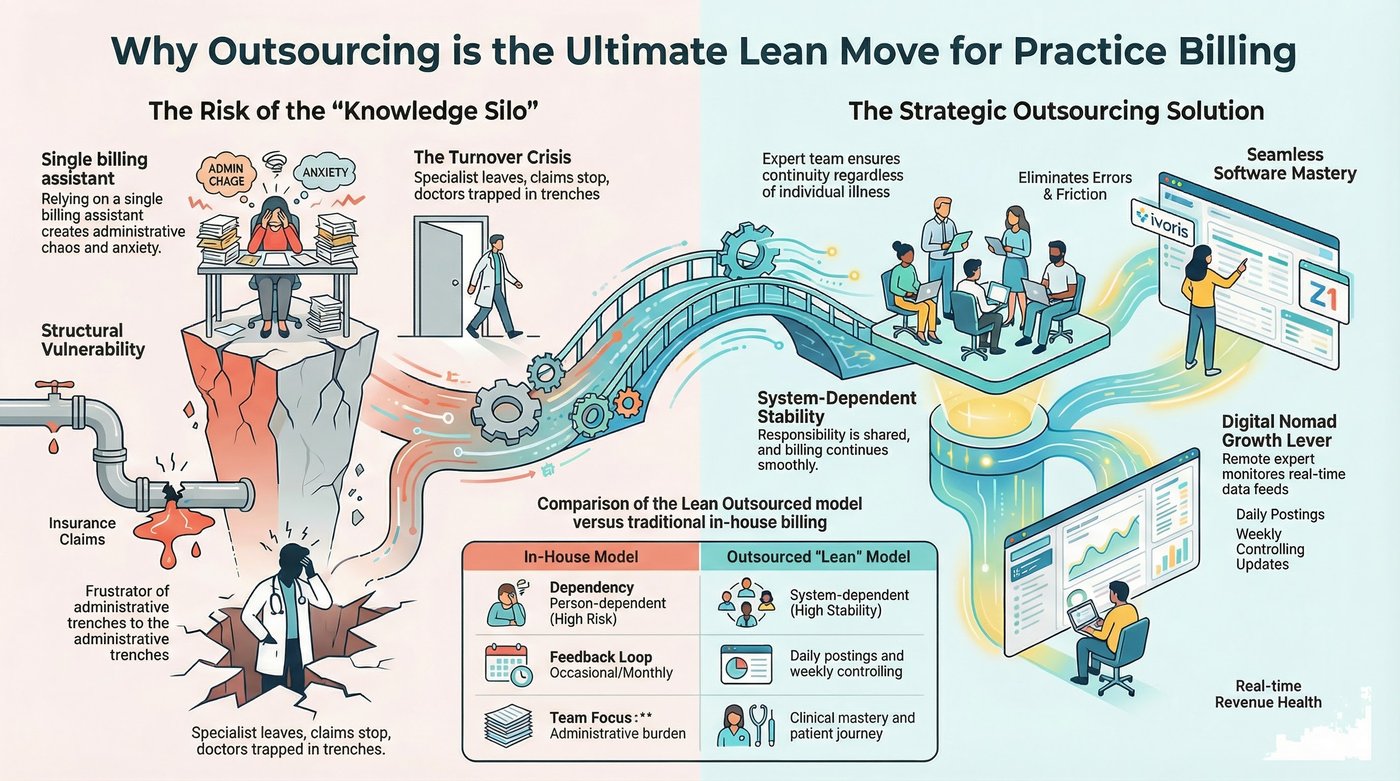
In the high-pressure environment of orthodontic practice management, many clinicians live in a state of constant anxiety regarding their “financial backbone.” The dread of a specialized billing assistant quitting is a reality for many, as finding a replacement with the necessary expertise in codes, regulations, and specific software interfaces is increasingly difficult in today’s labor market. In Lean Orthodontics, relying on a single “knowledge silo” is a significant structural risk—a form of waste that can lead to delayed cash flow and administrative chaos.
This knowledge-silo risk is magnified by the complexity of specialized dental billing, which involves hundreds of constantly changing fee schedules, coordination of benefits, and varying state regulations. When that single point of failure occurs, the practice often faces an immediate spike in denied claims and aging accounts receivable (A/R), directly eroding profitability. A lean practice seeks to distribute intelligence and eliminate such high-impact vulnerabilities.
I am Dr. Martin Baxmann, and I believe it is time to fundamentally rethink how we handle our billing. The lean approach is not to frantically search for an in-house replacement, but to consider professional external support as a strategic upgrade. By moving the administrative burden out of the practice, you gain stability, expert intelligence, and the freedom to focus on clinical mastery.
This strategic pivot is about recognizing that billing is an expert function, not a clerical task. Outsourcing grants access to a deep bench of credentialed professionals whose sole focus is maximizing collections and minimizing compliance risk. This allows the practice owner to dedicate 100% of their leadership energy to enhancing patient care and optimizing clinical throughput.
From Crisis Management to Strategic Outsourcing
When a billing specialist leaves an unorganized practice, the results are often catastrophic: bookkeeping falls behind, insurance claims are delayed, and the doctor is forced back into the “administrative trenches.” Outsourcing should not be viewed as a desperate measure, but as an optimization of your practice architecture.
The true cost of an in-house lapse is not just salary; it is the opportunity cost of management distraction. For instance, a doctor spending hours reconciling ledgers or chasing insurance companies cannot focus on new patient consultations or staff training. Strategic outsourcing eliminates this costly management overhead and ensures uninterrupted revenue cycle operations.
A professional external billing service provides a level of stability that an in-house solution rarely can. You are no longer vulnerable to a single employee calling in sick or suddenly resigning. Instead, you have a dedicated contact person backed by a team of experts. This transition shifts the responsibility from a person-dependent process to a system-dependent process, which is a core tenet of lean leadership.
A system-dependent process means your billing is secured by standardized operating procedures (SOPs), quality checks, and redundant staffing. It integrates the practice’s billing guidelines into the vendor’s robust compliance framework. This resilience is the ultimate form of strategic stability, ensuring that administrative disruption simply cannot happen.
Seamless Integration: The Software Ecosystem
For delegation to be effective, the integration must be seamless. The individuals handling your billing—whether internal or external—must be experts in your specific software ecosystem, such as ivoris, Z1, or Computer Forum. They must possess the “talent” to navigate complex interfaces effortlessly.
Expertise extends to knowing the specific modules of these platforms—for example, how to use custom reporting features to spot underpayments quickly, or how to efficiently manage batch electronic submissions. This specialized knowledge is too expensive and time-consuming to cultivate in a single in-house employee. Outsourced specialists treat your software as their primary tool.
True competence in billing goes beyond entering codes. It requires the ability to navigate patient journals, cross-reference treatment plans with performed activities, and track discrepancies. When you delegate to true specialists who “get the logic” of the interface, you eliminate the “friction” that causes billing errors.
This reduction in friction is immediately felt by the patient-facing staff. When they are not bogged down fixing complex billing errors, they can dedicate their time to high-value tasks like patient financial consultations and scheduling. This focused front-desk attention is crucial for building unshakeable trust and converting new patient leads.
The Digital Nomad Model: Remote Billing as a Growth Lever
Many practitioners still hold the outdated belief that everyone must sit in the same room to work effectively. However, a remote billing structure offers undeniable advantages. A remote specialist can provide daily postings and real-time feedback. If a lab receipt is missing, they notify the team instantly, preventing a “forgotten” cost.
Daily reconciliation is a powerful operational tool. Rather than discovering issues weeks later during monthly closing, the remote specialist alerts the team within 24 hours of any error, missing data, or coding discrepancy. This rapid feedback loop allows for immediate corrections, significantly improving clean claim rates and reducing the cycle time for payment.
Furthermore, remote experts can provide weekly “controlling” updates, giving you a clear window into your revenue and the health of your patient pipeline. These reports move beyond simple A/R aging to offer strategic management insights, such as collections trends segmented by payer or the impact of fee schedule changes.
This “digital nomadism” in your practice structure means the best talent in the country can work for your clinic, regardless of your physical location. By embracing these modern working models, you build a practice that is agile, resilient, and ready for the future. The ability to tap into specialized, high-level expertise remotely transforms billing from a constraint into a scalable growth lever.
Conclusion
For clinic leaders and dental professionals committed to the principles of Lean management, outsourcing billing is not a cost center; it is a strategic investment in operational resilience. It is the definitive move away from fragile, person-dependent processes toward a robust, system-backed financial architecture. By trusting proven external expertise, you safeguard your revenue cycle, liberate your administrative team to focus on the patient journey, and achieve the true strategic stability necessary for long-term practice growth.