

Strategic Selection: Why Lean Leadership Requires Qualifying Your Patients and Team
Published on: Jun 12, 2026
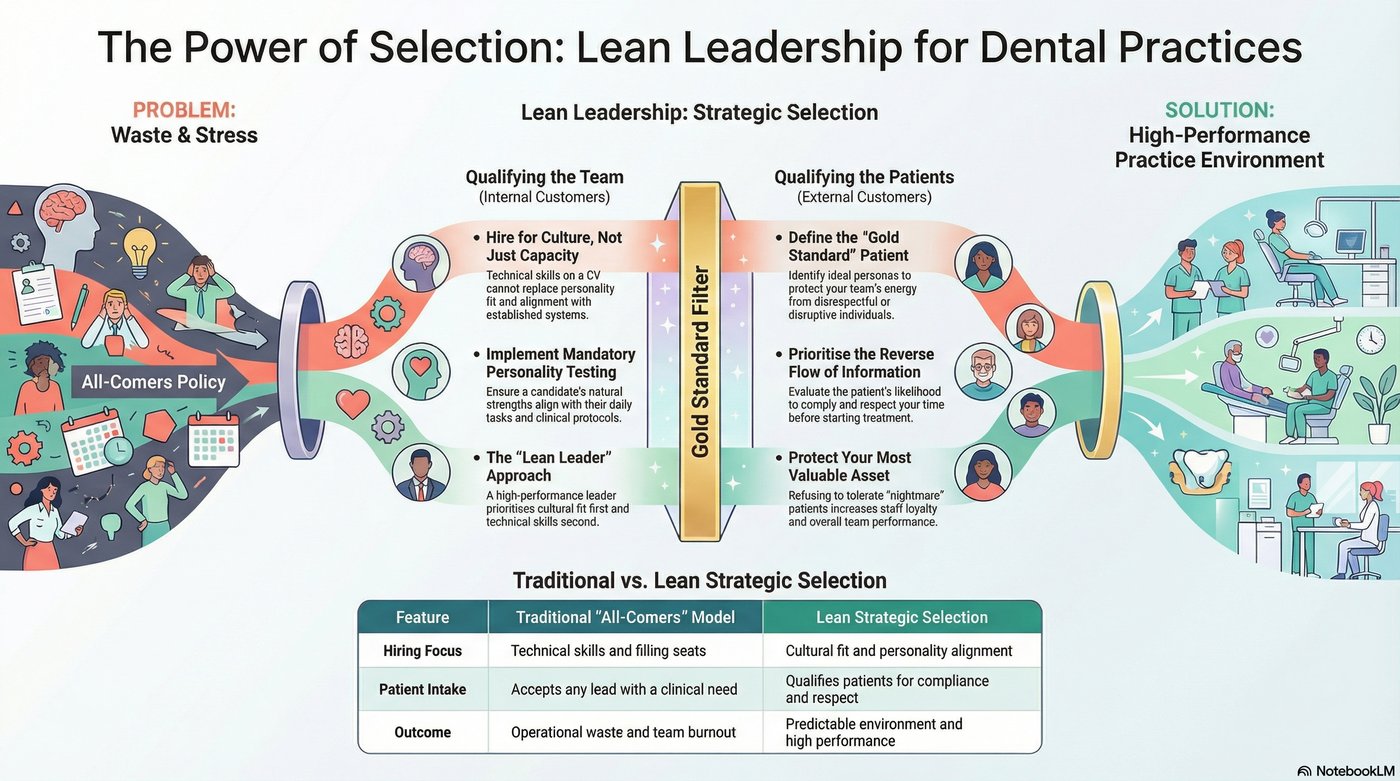
In the pursuit of practice growth, many clinic owners adopt an “all-comers” policy. They believe that every new lead is a good lead and every warm body is a potential employee. However, a cornerstone of lean management in dentistry is the understanding that true efficiency comes from being selective. Not everyone is a fit for your specific practice culture, and trying to force a fit is a primary source of stress and operational waste.
Effective dental leadership involves qualifying both your “internal customers” (your team) and your “external customers” (your patients). By establishing a clear “Gold Standard” for who enters your system, you protect your team’s performance and create a predictable, high-functioning environment where excellence can thrive.
Hiring for Culture, Not Just Capacity
A common mistake in orthodontic practice management is hiring out of desperation—filling a seat because the schedule is full. However, a person’s CV tells you only about their technical skills; it says nothing about their personality or their ability to integrate into your established systems.
At our level of leadership, we utilize personality testing as a non-negotiable part of the hiring process. This is not about judging people; it is about ensuring their natural strengths align with their daily tasks. For instance, a highly creative, independent thinker may struggle in a role that requires strict adherence to repetitive, perfectionistic clinical protocols.
I once encountered a candidate who refused to take a personality test, viewing it as too revealing. This refusal was the most valuable data point I could have received. It signaled a lack of trust and an unwillingness to follow basic structural instructions—traits that would have eventually compromised our team performance. A lean leader hires for fit first and skills second.
The Power of the “Gold Standard” Patient
Just as we qualify our team, we must also qualify our patients. Not every patient who walks through the door is a “Gold Standard” patient. Some individuals, regardless of their clinical needs, bring a level of negativity or disrespect that can ruin the atmosphere for your entire staff.
To maintain a healthy practice culture, you must be willing to be selective. This involves:
Defining your ideal persona: Identifying the characteristics of your most loyal and satisfied patients.
Implementing a strike system: Documenting negative behaviors, such as consistent disrespect toward staff or disruptive outbursts.
The “Exit” Strategy: Having the courage to part ways with patients who are a fundamental mismatch for your values.
By being selective, you protect your most valuable asset: your team’s energy. When your staff feels supported by a leader who refuses to tolerate “nightmare” patients, their loyalty and performance reach new heights.
The Reverse Flow of Information
In a traditional clinical setting, information flows from the doctor to the patient. We educate them on why they need us. In a lean system, we prioritize the reverse. During the initial interaction, we are the ones gathering data.
We aren’t just looking at the malocclusion; we are evaluating the human being. Is this person likely to comply with treatment? Do they respect our time? Do they value the expertise we provide? This “pre-qualification” allows you to focus your energy on patients who will be advocates for your practice, rather than drains on your resources. This is the essence of practice efficiency: spending your time where it produces the highest return in both satisfaction and revenue.
Creating a Predictable Environment
Ultimately, the goal of strategic selection is to create a practice that is predictable. When you have a team whose personalities are aligned with their roles and a patient base that respects your culture, the “chaos” of daily practice vanishes. You are no longer putting out fires; you are managing a high-performance system.
This predictability is the ultimate reward of lean leadership. It allows you to invest more deeply in the patient journey, knowing that your efforts are being directed toward people who appreciate the value you deliver. It creates a “win-win” where the team is happy, the patients are satisfied, and the practice thrives.
Conclusion: The Courage to Be Selective
Leadership is not just about what you do; it is about what you allow. By identifying the right patient personas and team personalities, you move from a reactive state to a proactive one. Do not be afraid to set a high bar for entry. The most successful and enjoyable practices are those built on a foundation of mutual respect and cultural alignment.