

Strategic Resilience: Building a Crisis-Proof Orthodontic Practice
Published on: Jun 27, 2026
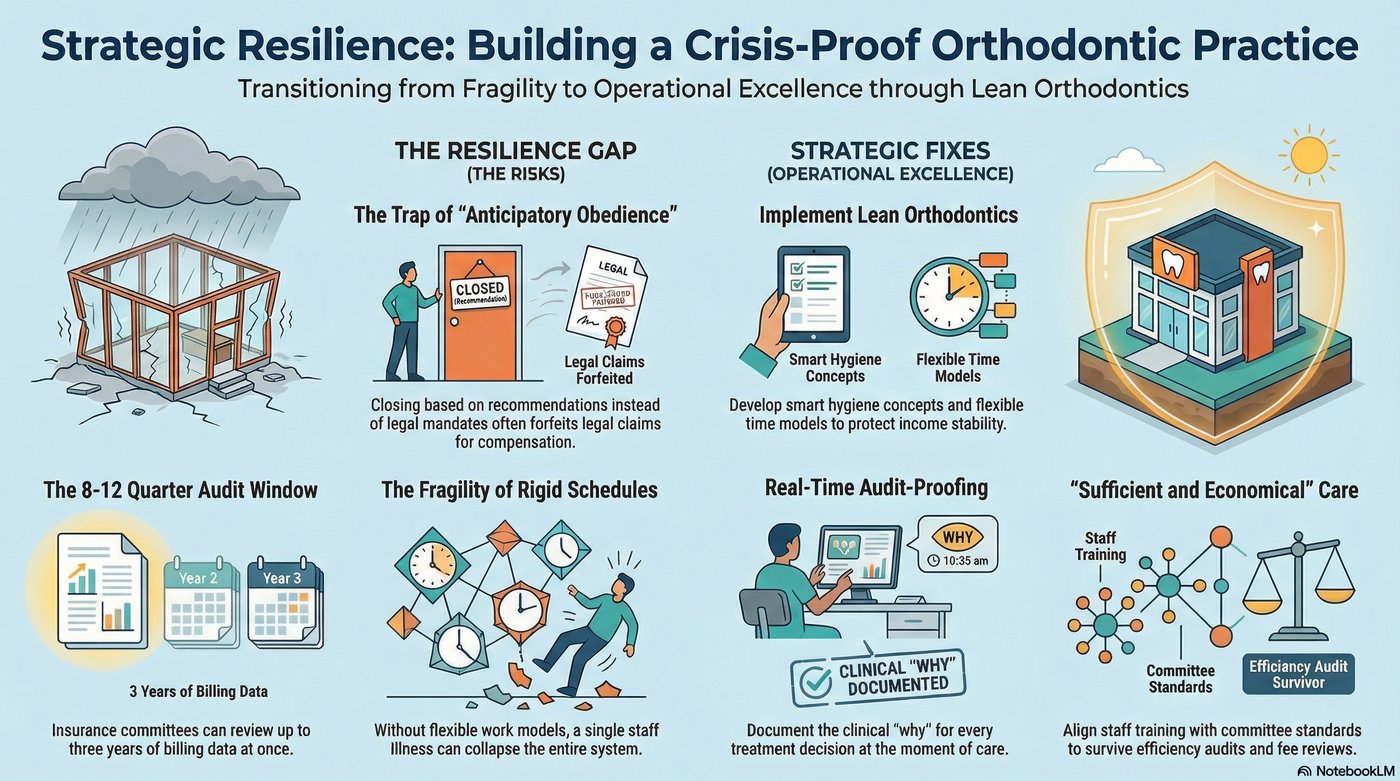
The Trap of “Anticipatory Obedience”
The transition from being a clinical expert to a resilient entrepreneur is often forced upon us by external shocks. During recent global health crises, many practitioners made a fatal mistake: they closed their doors based on “professional recommendations” rather than legal mandates. Because these closures were technically voluntary, many were left without a legal claim for compensation from state authorities or insurance providers.
This “anticipatory obedience” stems from a deep-seated desire to follow authority, yet in a business context, it can be devastating. When you act on a suggestion rather than a directive, you assume the full financial risk of that decision. A crisis-proof practice requires a leader who can pause, analyze the legal landscape, and wait for official orders before making moves that impact the clinic’s solvency.
In lean orthodontics, we move beyond reactive fear. A leader must distinguish between a recommendation and a directive. Resilience starts with a hygiene concept that provides real security for patients and staff alike, ensuring the facility remains a safe space even during community outbreaks.
By developing smart time models and flexible work schedules, such as staggered shifts or team “bubbles,” you ensure that if one person falls ill, the entire system doesn’t collapse. For example, dividing your clinical staff into two independent teams prevents a single quarantine order from shuttering your entire operation. This protects both the continuity of care for your patients and the long-term stability of your income.
Prevention Over Damage Control
From a legal and economic perspective, many colleagues only seek help when a problem has already become a disaster. In the statutory health insurance system, committees can look back at eight to twelve quarters of billing at once. This retrospective look means that a documentation habit formed two years ago could come back to haunt you today with massive financial penalties.
If your documentation is irregular or lacks clear clinical justification, you could face massive fee reductions without warning. Many practitioners assume that “good results” are enough, but in an audit, if it wasn’t documented with the correct codes and reasoning, it effectively didn’t happen. Prevention means building a robust system that justifies every treatment step before the bill is even generated.
To achieve operational excellence, you must treat your billing and documentation with the same precision as your clinical treatments. This involves setting up internal protocols where every entry is checked against the “economic and sufficient” standards required by the health insurance guidelines.
Audit-Proof Documentation: Don’t wait for a review to justify your choices. Document the “why” in real-time, focusing on the diagnostic necessity that supports higher-value billing codes.
Clinical Justification: Ensure your training matches what committees define as “sufficient and economical.” By standardizing clinical narratives for common procedures, you minimize the risk of subjective interpretation during an efficiency audit.
Addressing Under-Treated Areas: Focusing on periodontal needs or functional diagnostics within approved frameworks provides essential care. This clinical depth improves patient outcomes while legitimately strengthening the practice’s financial health.
Ultimately, resilience is a mindset. It is the ability to maintain clinical standards while rigorously defending the business side of the practice. By automating documentation and staying informed on legal nuances, you create a clinic that doesn’t just survive a crisis but emerges from it more efficient and more profitable than before.
Conclusion: From Survival to Strategic Advantage
Building a crisis-proof practice transcends clinical skill; it requires a commitment to strategic leadership and operational rigor. The true test of resilience lies in the ability to protect your business stability while maintaining uncompromising clinical care. Leaders must reject the default setting of “anticipatory obedience,” instead relying on legal directives and well-established, lean protocols.
By proactively ensuring audit-proof documentation and implementing flexible, secure operational models—like clinical team bubbles—you shift the practice mindset from reactive damage control to proactive system defense. This strategic focus not only safeguards your financial future against external shocks but also cultivates a more efficient, profitable, and ultimately, a more enduring orthodontic enterprise.