

Strategic Profitability: Navigating the Complex Architecture of Orthodontic Billing
Published on: Jun 21, 2026
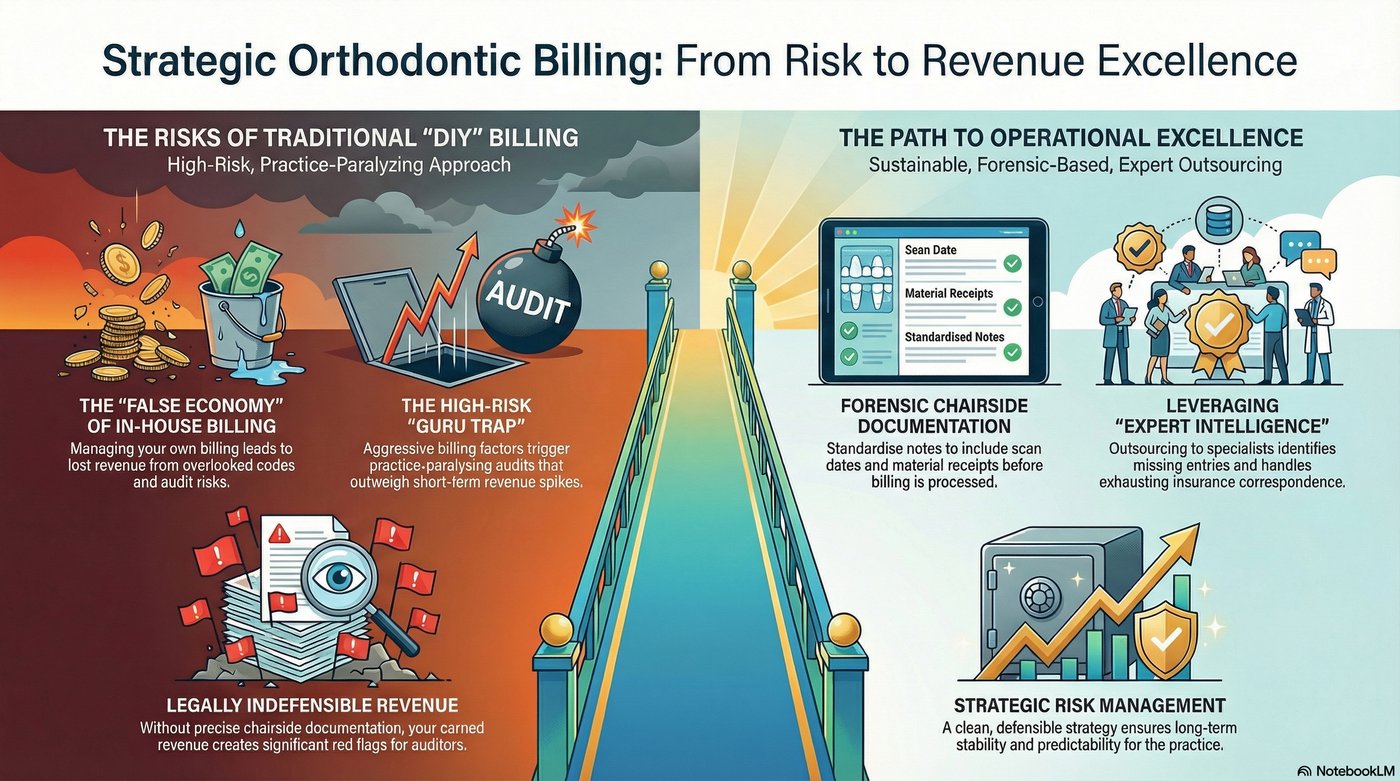
In the intricate landscape of orthodontic practice management, billing is often viewed as a back-office administrative task—a necessary but tedious part of the business. However, for the clinician operating within highly regulated environments, such as the German system of GOZ and BEMA, billing is actually a critical clinical process. Many practitioners attempt to manage their own billing to save on overhead, but this is often a false economy.
I am Dr. Martin Baxmann, and through my collaboration with billing experts like Tamara Maier of 4KFO, I have seen how “DIY billing” leads to two forms of massive waste: lost revenue from overlooked codes and the catastrophic emotional and financial drain of expert audits. To achieve true operational excellence, you must stop viewing billing as a series of codes and start viewing it as a system of forensic documentation and strategic risk management.
Billing is the direct translation of clinical expertise into realized profit. Failure to manage this conversion accurately means the difference between reinvesting in advanced technology, like 3D printing, and merely sustaining the practice. This is especially true in specialized fields like orthodontics, where treatment plans often span years and involve complex, multi-stage procedures.
The false economy of DIY billing stems from a lack of specialization. An in-house team managing billing alongside scheduling and patient communication is constantly distracted, resulting in coding errors, missed submission deadlines, and ultimately, a significant lag in cash flow. The true cost of an audit, beyond any clawbacks, is the total loss of clinical productivity and the deep erosion of staff morale.
The Foundation of Forensic Documentation
Effective billing does not begin at the computer; it begins at the chairside. In a lean practice, we emphasize that “the work is not done until the documentation is complete.” If you bill for a specific procedure—such as cementing an orthodontic band—but your records do not show the preceding separation appointment or the corresponding lab receipt, you are creating a red flag for auditors.
You must train your clinical team to document every step of the patient journey as if a forensic auditor is reading over their shoulder. This level of precision is the only way to protect your revenue. If the documentation is missing, the revenue is legally indefensible. By standardizing your chairside notes to include scan dates, material receipts, and specific procedural milestones, you create a “bulletproof” foundation that ensures you get paid for every ounce of expertise you provide.
Forensic documentation is the continuous, meticulous record of medical necessity. For every bracket placed or wire changed, there must be a corresponding note detailing the clinical rationale, time spent, and materials used. This transforms a simple procedure note into a legally sound justification for the fee charged.
Consider the example of treating a complex skeletal Class II malocclusion. Your notes must explicitly link the specific appliances chosen—such as Herbst or Forsus—back to the initial diagnosis and the projected outcome. Generic entries will not withstand scrutiny. Practices must establish a non-negotiable policy where treatment codes are only generated after the corresponding chairside entry, imaging, or laboratory slip has been uploaded and verified in the patient file. This closed-loop system is the primary defense against recoupment efforts.
Outsourcing as a Scalability Lever
The current shortage of skilled labor has made finding qualified in-house billing specialists nearly impossible. Attempting to train a general receptionist to handle the complexities of orthodontic billing is a recipe for error. A lean leader recognizes when a task requires “Expert Intelligence” that is better sourced externally.
Outsourcing your billing to a specialized service allows you to leverage professionals who live and breathe orthodontic codes. These experts log in remotely to check your daily protocols, identify missing entries, and handle the exhausting correspondence with insurance companies. This strategic delegation frees your front-of-house team to focus on the patient journey and the “human” elements of the practice, which is where their value is highest.
The decision to outsource is not about reducing headcount; it is about maximizing the value of your existing team. A specialized orthodontic billing partner brings an institutional memory of evolving codes and regulatory shifts that a single in-house employee cannot match. They act as a sophisticated layer of external quality control.
These services offer real-time financial transparency, often using software integrations to track claim status and payment velocity, giving clinic leaders predictive cash flow models. Moreover, outsourcing shields the practice from the vulnerabilities of staff turnover. When a qualified in-house biller resigns, the entire revenue cycle is jeopardized, whereas a specialized firm offers continuity and guaranteed expertise, functioning as a non-disruptive scalability lever for growth.
The “Guru” Trap: Balancing Revenue with Risk
There is a dangerous trend in dental leadership where “gurus” promise massive revenue spikes through aggressive billing factors (e.g., consistently using 3.5x multipliers for bracket difficulty). While this may look good on a monthly report, it is often a high-risk strategy.
A lean approach to billing is about long-term sustainability. Is it worth fighting for an extra €50 if it triggers a six-hour audit that paralyzes your entire practice? Often, a clean, defensible strategy—using codes you can easily explain and justify—is more profitable than an aggressive one that invites scrutiny. In billing, as in clinical work, stability and predictability are the hallmarks of a master.
The “Guru” trap preys on the desire for quick, unsustainable financial gains. Aggressive billing practices, particularly those involving routine application of the highest possible multipliers without clear justification, signal poor risk management to insurers and auditors. These strategies often lead to a rapid increase in denied claims and a subsequent, crushing wave of retrospective reviews.
True financial leadership requires a balanced approach: optimizing legitimate revenue streams while minimizing audit risk. For example, a practice should consistently monitor its average factor application against industry benchmarks. If a practice is an outlier, the risk profile increases exponentially. Prioritize meticulous documentation that supports a 2.3x factor over vague justification for a 3.5x multiplier, ensuring that every claim is a clear reflection of the clinical complexity, not just a grab for maximal payment.
Conclusion
Orthodontic billing is fundamentally a strategic function, not a clerical one. Moving from an outdated, reactive mindset to a proactive, systems-based approach is essential for long-term profitability. By establishing a culture of forensic documentation, strategically leveraging expert outsourcing, and maintaining a sustainable, risk-aware billing factor strategy, clinic leaders can transform their billing department from a source of anxiety into a robust engine for practice growth. Mastery in the complex architecture of billing is the ultimate benchmark of a well-run, lean, and profitable orthodontic practice.