

Spaghetti Diagrams and Productive Bubbles: Mapping Your Way to Clinical Flow
Published on: Jun 11, 2026
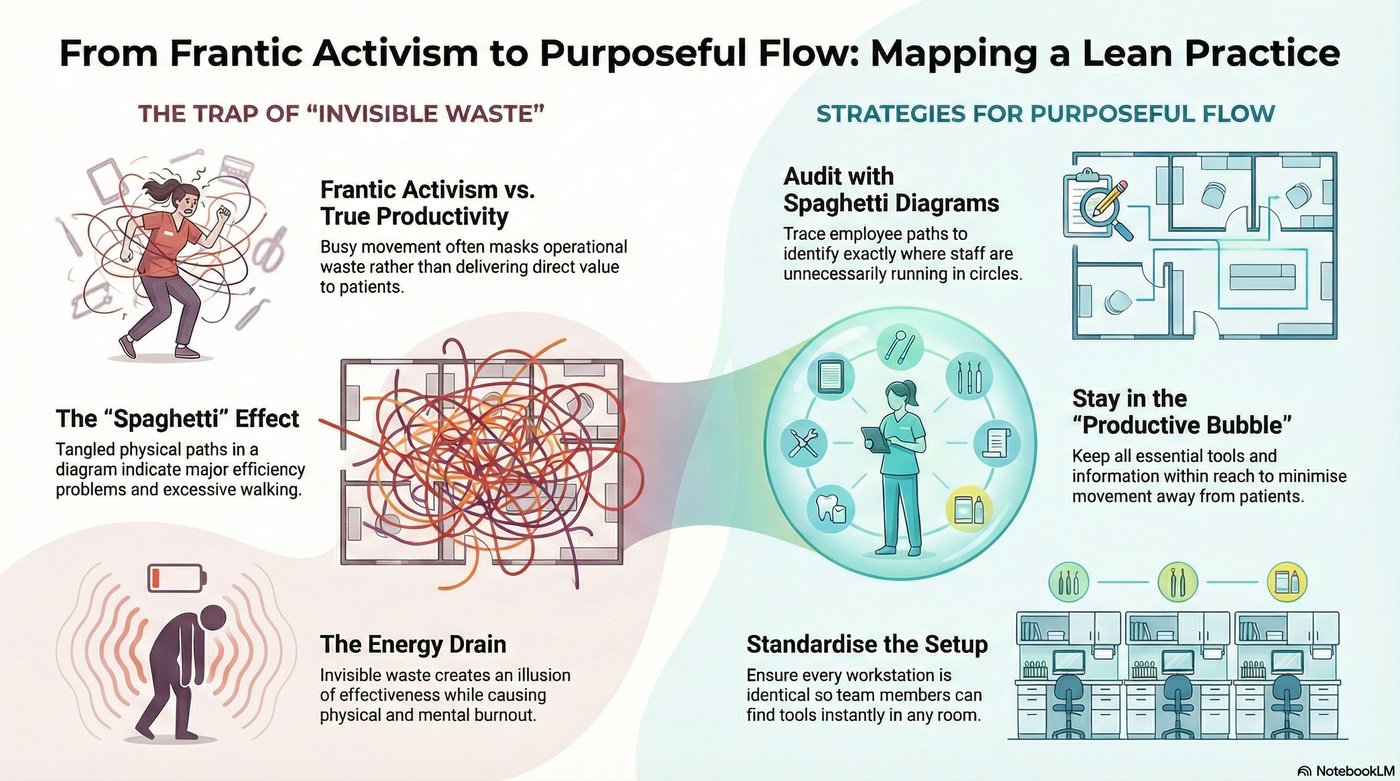
In the philosophy of Lean Orthodontics, we often talk about the “value stream”—the direct path to delivering a result to the patient. However, many practices are unknowingly suffering from “excessive activism.”
This occurs when staff feel busy and productive because they are constantly moving, but a significant portion of that movement is actually waste. In a clinical setting, this “noise” can mask underlying inefficiencies that delay patient care.
A truly lean leader recognizes that high energy does not always equate to high output. When your team is running between the front desk and the sterilization room, they are losing focus and increasing the risk of clinical errors.
To achieve operational excellence, we must audit our physical movements with the same rigor we apply to our clinical diagnostics. One of the most effective tools for this is the Spaghetti Diagram.
By mapping every step taken by a technician during a standard procedure, such as a bracket bonding or a wire change, we can visualize the literal path of inefficiency that exists within the four walls of the clinic.
Tracing the Path of Waste
A Spaghetti Diagram involves tracing the physical path an employee takes during a specific process or over the course of a day. If the resulting drawing looks like a tangled mess of pasta, you have a major efficiency problem.
Consider a typical orthodontic assistant who must leave the chair three times to find a specific scaler or a curing light. Each trip is a break in the clinical flow and a distraction for the patient sitting in the chair.
These diagrams provide an objective, data-driven look at how your office is actually functioning versus how you think it is functioning. It is the first step toward a radical reorganization of your physical workspace.
Excessive walking distances are a primary source of “invisible waste.” It drains physical energy and creates an illusion of productivity. Over a ten-year career, these extra miles can lead to significant physical fatigue and chronic pain for your team members.
Many people believe they are effective multitaskers, but in reality, no one can multitask at a high level. True competence is staying within your “productive bubble”—a zone where all tools and information are present.
In a lean practice, the “bubble” means the clinician never has to turn their back on the patient or reach further than an arm’s length for a critical instrument. This maintains the psychological connection with the patient and speeds up the procedure naturally.
Optimizing the Neglected Zones: The Lab and Beyond
While much focus is placed on the clinical floor, the dental laboratory is often the most neglected area of the practice. It frequently becomes a graveyard for unorganized models and outdated equipment.
Yet, the risk of injury or long-term health issues—due to poor air filtration or awkward posture—is frequently higher in the lab than in the operatory. Ignoring the lab’s ergonomics is a leadership failure that impacts the entire practice.
A lean leader ensures that these internal resources are just as optimized as the patient-facing areas. Workplace safety and efficiency in the lab protect the specialized talent in your building.
By ensuring that the lab is ergonomically sound and highly organized, you prevent the “bottlenecks” that occur when support staff are slowed down by a poorly designed environment. This translates to faster turnaround times for appliances and retainers.
Investing in high-quality dust extraction and adjustable-height lab benches is not an expense; it is a long-term investment in the health and retention of your most valuable employees.
From Frantic Activism to Purposeful Flow
To clear the “workarounds” that have taken on a life of their own in your practice, you must be willing to engage in radical reduction. This means stripping away unnecessary steps and supplies.
When a process is complicated, staff naturally create shortcuts. While well-intentioned, these shortcuts often lead to inconsistency and variability in the final clinical result, which is the antithesis of lean flow.
Standardize the Setup: Every workstation should be identical so that any team member can step into any room and find exactly what they need instantly.
Standardization reduces “decision fatigue.” If every drawer in every room is organized the same way, the brain doesn’t have to hunt for items, allowing the clinician to focus entirely on the patient’s treatment needs.
Audit the Movement: Use Spaghetti Diagrams to identify where staff are “running in circles.” This physical evidence makes it impossible to ignore the need for change.
Empower your team to conduct these audits themselves. When they see the “spaghetti” on paper, they become the biggest advocates for reorganizing the floor plan to better serve the value stream.
Encourage Meaningful Rest: Use the time between patients not just to rush to the next chair but as a postural reset and a moment of mental refocus.
A practice that operates at 100% capacity at all times is a practice on the verge of breakdown. Built-in moments of “white space” allow the team to maintain a high level of precision throughout the entire day.
Conclusion: Investing in Your Team’s Longevity
Clinical efficiency is not just about seeing more patients; it is about seeing them in a way that preserves the health and energy of your team. When you optimize the workplace, you reduce the physical and mental friction that leads to burnout.
A high-performing practice is a calm practice. By focusing on reduction and creating a manageable, standardized environment, you ensure that every move counts. Take a fresh look at your workstations today and replace the “noise” of frantic activity with the quiet power of a lean, optimized system.
Ultimately, clinical flow is a byproduct of disciplined design and thoughtful leadership. By auditing physical movement and reclaiming the productive bubble, you create a sustainable environment where both your patients and your staff can thrive. Let the spaghetti diagram be your roadmap to a more purposeful and profitable future.