

Solution-Oriented Language: The Secret to High-Performing Orthodontic Teams
Published on: Jul 2, 2026
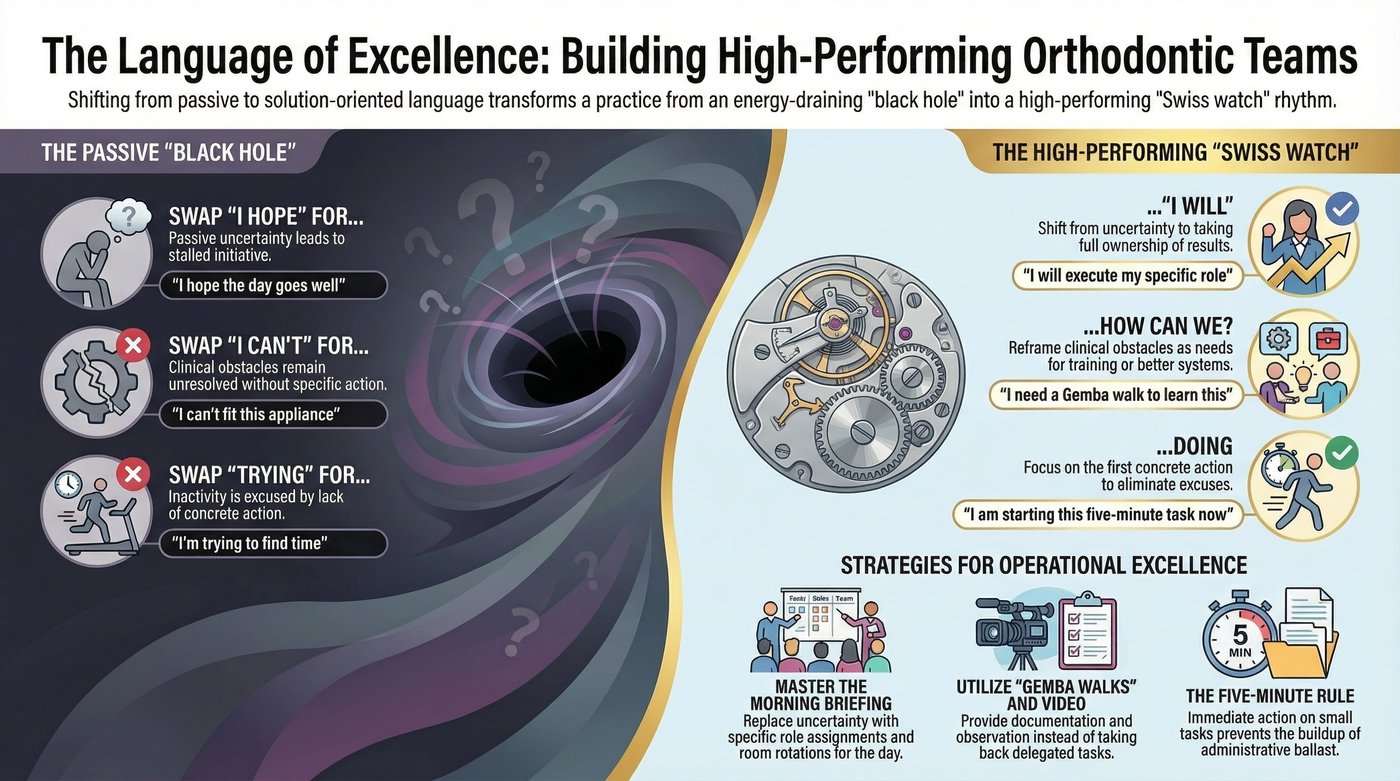
The “Black Hole” Effect in Practice Management
We have all worked with someone who acts as an energy drainer—a “black hole” that leaves the rest of the team feeling like a squeezed-out wet rag. In a high-stakes clinical environment, this negativity is contagious and quickly impacts patient care.
Often, this negative energy is carried through specific, repetitive phrases that stall progress and kill initiative. In orthodontic practice management, these “deadly terms” are more than just bad habits; they are significant obstacles to operational excellence.
When a clinical assistant says, “That’s just how we’ve always done it,” they are essentially closing the door on innovation. This linguistic stagnation creates a ceiling for the practice’s growth and team morale.
True dental leadership involves identifying these linguistic traps and providing the team with a new, empowered vocabulary. It requires the doctor to model the behavior they wish to see in the clinic.
By shifting from passive to active language, you create a more resilient, motivated, and efficient office environment. This transition is not about semantics; it is about changing the psychological framework of the entire team.
Replacing Powerlessness with Responsibility
The shift from “I hope” to “I will” is the first step in mastering dental team performance. “Hope” is not a strategy; it is a declaration of lack of control over the outcome.
When a team member says, “I’ll do what is necessary to make this work,” they are taking ownership of the result. This is the hallmark of a lean mindset where every individual feels responsible for the success of the patient visit.
Consider the treatment coordinator following up on pending contracts. Instead of “hoping” the patient calls back, an empowered TC says, “I will call the Smith family by Tuesday morning to address their financial concerns.”
In our morning briefings, we don’t just hope the “bus” of patients doesn’t overwhelm us; we plan the specific roles and room rotations to ensure success. We look at the schedule and identify potential bottlenecks before they happen.
This eliminates the “administrative ballast” of uncertainty and ensures that every member of the team feels capable. When the schedule is heavy, solution-oriented language keeps the focus on the flow rather than the stress.
Turning “I Can’t” into a Growth Opportunity
When an employee says “I can’t,” they are often signaling a need for better systems or more training. It is rarely a sign of laziness and usually a sign of a structural deficit in the practice.
As a leader, your job is to convert that “I can’t” into “How can we?” This shifts the focus from a dead-end wall to a problem-solving exercise. It encourages the team to look at the process rather than the person.
If a dental assistant feels they cannot independently fit a specific appliance, the solution is to provide the video documentation or the Gemba walk observation they need. We provide the tools for success rather than criticism for failure.
Replacing “I can’t” with “I am looking for solutions” keeps the practice in a state of continuous improvement. This is the essence of Kaizen in the orthodontic world—small, daily changes that lead to massive long-term results.
It prevents the “yo-yo effect,” where the practice runs well for a while but then collapses back into old, limited behaviors. Sustained growth requires a language that supports expansion and learning.
This growth-oriented language is essential for a practice that wants to innovate. In a competitive market, the team that asks “how” instead of saying “can’t” will always be the market leader.
The “Do” Mindset: Eliminating the Excuse of “Trying”
In lean orthodontics, the most successful practitioners are those who take the first step immediately. They understand that perfection is the enemy of progress.
While others are still “trying” to find the time to implement a new clinical analysis or a delegation protocol, the high-performers are already seeing the results. They move from theory to practice in hours, not weeks.
For example, if the team decides to improve the sterilization turnaround, the high-performing team doesn’t try” to change the workflow—they change one specific bin placement today.
“Trying” is a special form of inactivity that provides a psychological safety net for failure. It allows us to feel good about ourselves without actually achieving the desired result.
To put your practice on autopilot, you must encourage your team to focus on the first concrete action. If a cabinet needs sorting, don’t try to find time—set a five-minute timer and start right now.
This bias toward action is what creates a “Swiss watch” rhythm in the clinic. It ensures that the patient journey remains smooth, predictable, and remarkably free of avoidable delays.
Conclusion: The Superpower of Precision
The words we choose have a lasting impact on our professional reality and our personal well-being. By systematically removing energy-draining terms, you protect your team’s motivation and your own clinical energy.
You create a culture where everyone is a problem-solver and where “excellence” is simply the way things are done. This environment attracts top talent and keeps them engaged for the long term.
Start today: listen for the deadly terms in your hallways, replace them with active commitments, and watch your practice thrive. The transformation begins with the very next sentence spoken in your office.