

Servant Leadership in Orthodontics: Why Your Team is Your First Customer
Published on: Jun 12, 2026
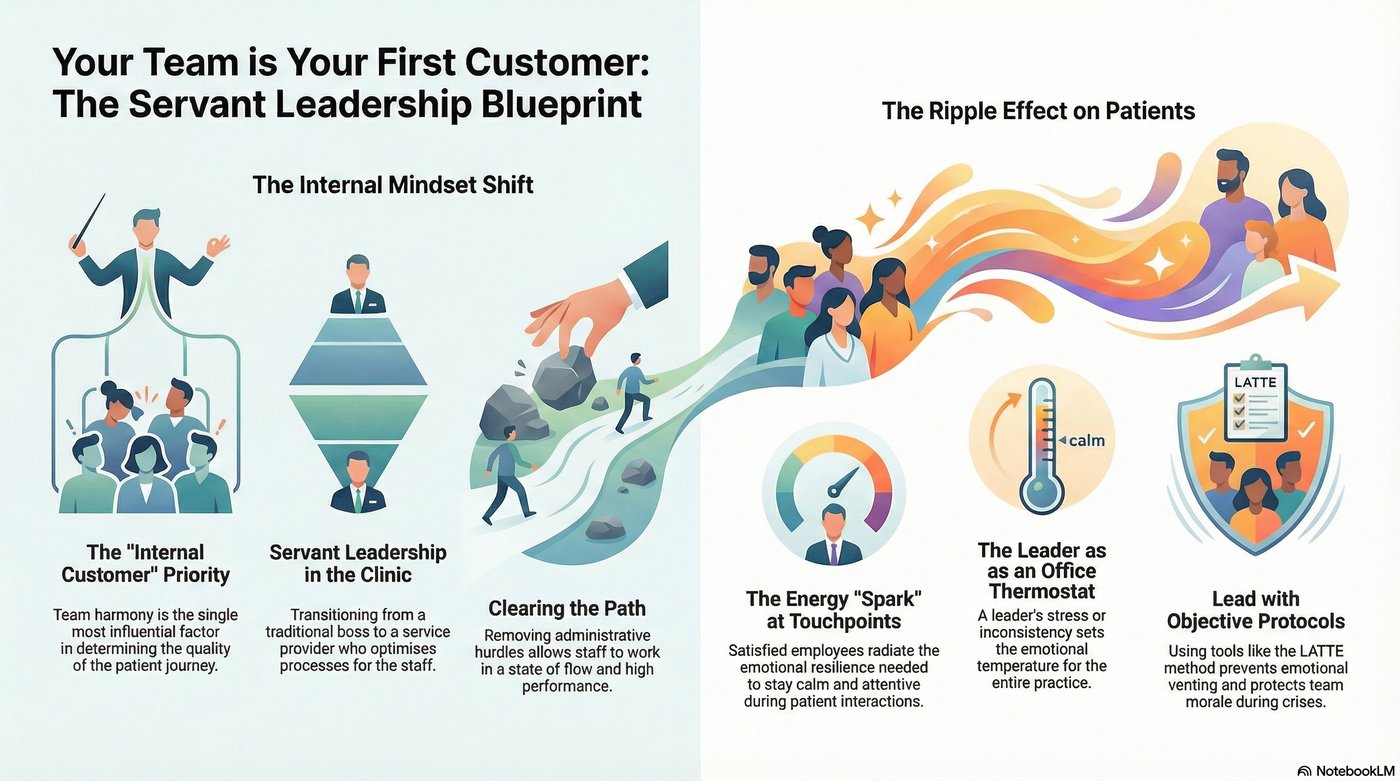
Many orthodontic practice owners spend their entire careers chasing the “perfect” patient experience. They invest in high-end waiting room furniture, automated reminder systems, and the latest clinical technology, yet they often overlook the single most influential factor in patient satisfaction: the emotional state of their team. In a high-performance environment, an unsatisfied staff is the fastest way to erode a patient’s trust.
The high cost of staff turnover is a tangible example of this oversight. Replacing a trained clinical assistant or treatment coordinator incurs significant recruitment, training, and lost productivity costs, far outweighing the price of fostering a supportive internal environment. Prioritizing the internal customer is not a soft skill; it is a critical financial strategy for lean practice management.
As leaders, we must undergo a vital mindset shift. We must stop thinking exclusively about the external patient and start focusing on the “internal customer.” To lead a lean and successful clinic, the practice owner must transition from a traditional boss into a servant leader—one who understands that the quality of the patient journey is a direct reflection of the team’s internal harmony.
Furthermore, staff stress directly correlates with clinical accuracy and case acceptance rates. When team members feel supported and unhurried, they perform procedures with greater focus and present treatment plans with genuine confidence. This transition to servant leadership ensures that the entire practice operates as a unified, patient-centric ecosystem, improving both morale and the bottom line.
The Core of Servant Leadership: Clearing the Path
In the philosophy of Lean Orthodontics, the role of the leader is not to micromanage clinical tasks, but to act as a service provider for the team. Servant leadership means viewing yourself as the individual responsible for optimizing processes so that the staff’s work becomes easier, more predictable, and more fulfilling.
A clear example of path-clearing is the implementation of streamlined inventory and sterilization protocols. When team members constantly face inconsistent supply levels or inefficient equipment maintenance, their focus is diverted from patient care to operational frustrations. The servant leader proactively solves these systemic issues, ensuring all clinical and administrative tools are predictable and optimized for use.
When you clear the administrative and operational hurdles for your team, you allow them to operate in a state of flow. This involves matching natural talents to specific roles. When an employee is placed in a position where they can excel, they stop merely “working” and start contributing. This internal efficiency is the foundation upon which every successful patient interaction is built. If the internal engine is grinding, the patient will feel the heat.
This strategic alignment of talent involves deeply understanding each team member’s strengths. For instance, a staff member who excels at organization might be best utilized in managing compliance documentation and practice metrics, while a highly empathetic person should lead the treatment coordinator role. By placing individuals where their natural talents align with the workflow, the practice generates higher-quality output with less perceived effort.
This proactive stance significantly reduces “waste” in the Lean sense. Waste includes unnecessary movement, waiting time, and rework—all symptoms of a poorly designed system, not a poor staff member. By optimizing the system, the leader ensures the team spends their energy on high-value patient interactions, rather than correcting avoidable operational friction.
The Spark at the Contact Point
Every patient journey is a sequence of touchpoints. A touchpoint is where two entities meet and interact—and in a clinic, it is the moment where the energy of the staff “jumps” across to the patient. Satisfied employees radiate engagement and emotional stability. They possess the mental bandwidth to be attentive and the emotional resilience to stay calm during stressful moments or when de-escalating a complaint.
Consider the critical touchpoint of post-operative care instructions or financial discussions. An anxious employee is likely to rush the explanation or fumble details, leaving the patient confused and uncertain. Conversely, a confident and supported staff member delivers complex information with clarity and patience, significantly improving patient compliance and reducing follow-up calls.
We have all experienced a retail environment where a stressed employee pulls a long face. Even if their frustration has nothing to do with us, it creates an immediate sense of being unwelcome. In a dental setting, it is not the patient’s job to make the team feel comfortable; it is the practice culture’s job. When satisfaction is baked into the culture, every interaction feels authentic, positive, and professional.
This ‘spark’ is often most visible during moments of perceived failure, such as a scheduling conflict or insurance denial. If the front-office staff is internally supported and empowered to resolve issues, they handle the situation with poise, turning a potential complaint into a moment of service recovery. The resulting positive memory solidifies the patient’s trust in the practice’s reliability, not just its clinical skill.
Authentic engagement, stemming from internal well-being, cannot be faked or scripted. While training manuals dictate what to say, a healthy practice culture dictates how to say it—with warmth, sincerity, and undivided attention. This emotional investment by the team creates a powerful, differentiating factor in a competitive healthcare market.
The Fish Smells from the Head: Leading by Example
There is an old saying: “The fish starts to smell from the head.” In practice management, this means that the mood and behavior of the leader act as the thermostat for the entire office. If you are stressed, reactive, or inconsistent, that energy will inevitably trickle down to the staff.
The leader’s consistency is the bedrock of trust. Practice owners must approach both clinical and administrative decisions with transparent, objective criteria, avoiding reactionary measures driven by emotion or fatigue. This predictable leadership style reduces anxiety in the team, allowing them to focus on their roles rather than navigating the leader’s fluctuating moods.
A common leadership failure is the “personality disconnect”—venting frustrations on a staff member in the back office and then instantly putting on a charming face for a patient in the chair. This creates a psychological rift. Employees see the inauthenticity and feel undervalued, which eventually bleeds into their own patient interactions. To prevent this, a leader must be aware of their own “internal journey.”
Furthermore, servant leaders view their own emotional regulation as a strategic clinical tool. They understand that an outburst in the breakroom is as damaging to productivity as a broken X-ray machine. By modeling calmness and structured problem-solving, the leader trains the team to respond to pressure with professionalism, not panic.
Using objective protocols, like the LATTE method for handling complaints, allows you to manage crises in a controlled, professional manner that protects the team’s morale. Protocols like LATTE serve a dual purpose: resolving the patient’s issue and protecting the team’s morale. When a team member knows the leader has a clear, established system for managing high-stress situations, they feel psychologically safe. This sense of protection empowers them to handle minor complaints independently, knowing the leadership framework supports their decision-making.
Conclusion: Creating a Culture of Excellence
The connection between employee satisfaction and revenue is not abstract; it is direct. Happy teams lead to loyal patients and higher referral rates. By shifting your focus toward serving your internal customers, you ensure that the practice remains a place where both employees and patients want to be.
This strategy is the defining characteristic of a resilient, modern dental practice. It moves beyond tactical fixes and establishes an institutional strength where high morale acts as a buffer against market fluctuations and competitive pressures. A cohesive, internally motivated team is the ultimate competitive advantage, ensuring sustainable growth over decades, not just quarters.
True orthodontic leadership is about balance. You must be the clear and consistent pilot of the ship, making the tough decisions when necessary, but always with the goal of maintaining a healthy, high-performing environment. When your team is satisfied, they don’t just move teeth—they build the trust that sustains your practice’s future. The transformation begins when the leader commits to serving those who serve the patient.