

Scaling Without Chaos: The Lean Infrastructure for Multi-Location Mastery
Published on: Jun 24, 2026
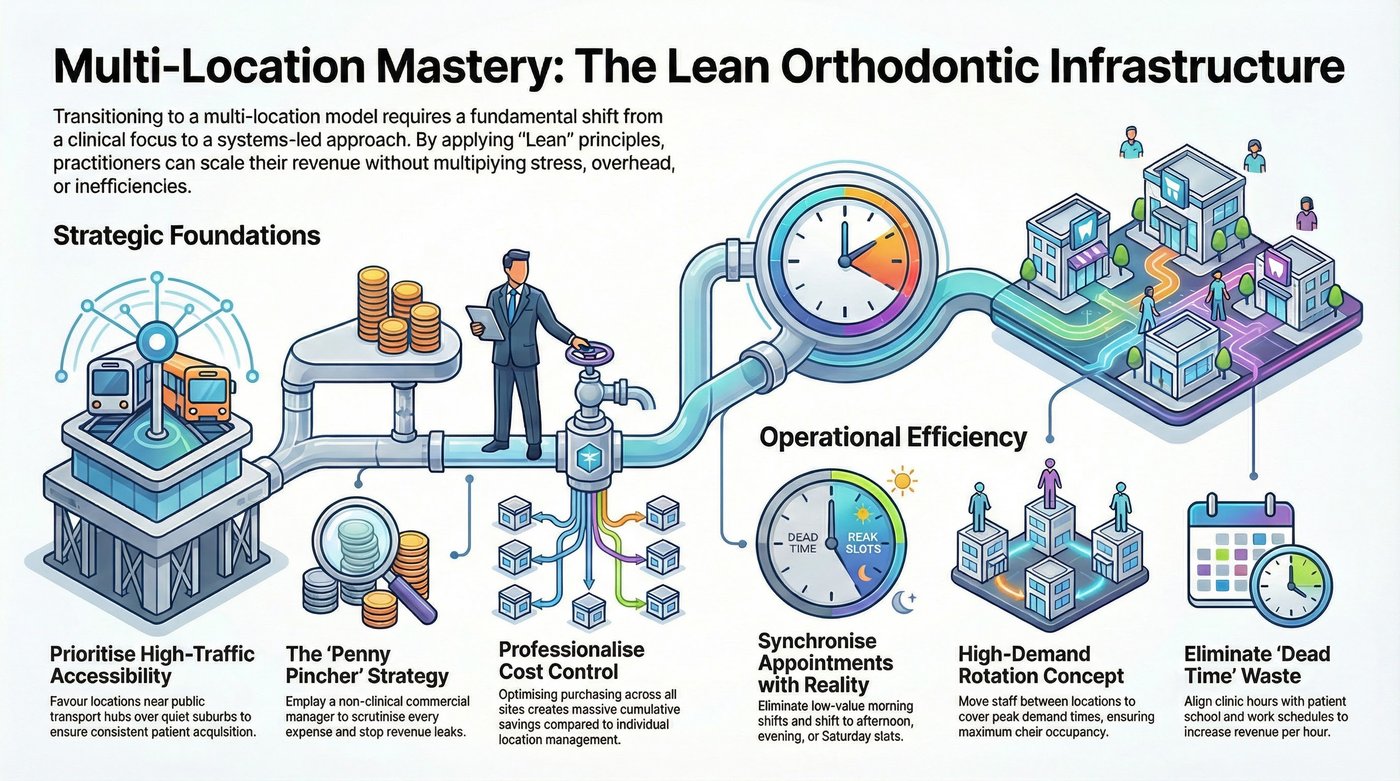
In the orthodontic world, expansion is often viewed as the ultimate benchmark of success. However, adding a second or third location is a double-edged sword. Without a rigorous, lean structure, you aren’t just multiplying your revenue; you are multiplying your inefficiencies, your overhead, and your stress.
I am Dr. Martin Baxmann, and I’ve seen that the transition from a single practice to a “practice group” requires a fundamental shift in leadership. You must stop thinking like a clinician and start thinking like a systems architect. To run multiple locations without losing your mind, you must focus on the “less” rather than the “more”—less waste, less unnecessary cost, and less time spent on unproductive tasks.
This architectural mindset demands centralized non-clinical operations. Functions like billing, IT support, and HR should be consolidated under a single administrative hub, preventing duplication across locations. This ensures that your high-value clinical staff remains exclusively focused on patient care, thereby maximizing revenue per provider hour.
The Location Audit: Accessibility as a Foundation
The first step in a lean expansion strategy is a cold, hard look at your geography. Many practitioners choose locations based on tradition or personal convenience, but in modern orthodontics, accessibility is everything.
If a location is tucked away in a quiet suburb but lacks direct access to public transport (subway, tram, or bus), you are fighting an uphill battle for patient acquisition. A lean leader must be willing to admit when a location isn’t working. Sometimes, the most profitable move you can make is to sell a low-performing branch and move to a medical center or a high-traffic hub where the patients already are.
A comprehensive audit involves geospatial demographic mapping, not just traffic counts. Analyze residential density, local school zones, and the commuting patterns of your ideal patient profile to ensure capital is invested wisely. Furthermore, pursuing co-location within medical centers or with high-volume dental GPs creates organic cross-referral synergy. This minimizes patient acquisition costs by leveraging established professional networks.
The “Penny Pincher” Strategy: Professionalizing Cost Control
As you scale, you can no longer be the CEO, the lead clinician, and the financial controller simultaneously. To double your profitability across multiple sites, you need a dedicated commercial manager—someone who is not a doctor.
I often refer to this role as the “Penny Pincher”. Their job is to scrutinize every expense with an objective, non-clinical eye. Whether it is a major equipment purchase or the cost of water bottles in the waiting room, these numbers matter. When you standardize and optimize purchasing across five locations, the cumulative savings are massive. Profitability isn’t just about finding more patients; it’s about ensuring that the revenue you already have doesn’t leak out through unmonitored expenses.
This manager must implement professional supply chain management. This includes standardizing lab protocols and utilizing Just-In-Time (JIT) inventory systems across all sites to leverage volume discounts and prevent overstocking waste. Crucially, they enforce complete technical standardization: every location must run the same cloud-based practice management software. This reduces IT maintenance complexity, simplifies training for rotating staff, and provides group leaders with real-time, consolidated performance data.
The Appointment Revolution: Syncing with Reality
Many practices open at 8:00 AM because that is the tradition. But from a lean perspective, a Tuesday morning is often “dead time”. Children are in school, and adults are at work. Filling these slots with low-value tasks or enduring high cancellation rates is a form of waste.
A lean multi-location model adapts to the patient. Consider eliminating morning shifts on certain days and opening from 1:30 PM until late evening, or adding Saturday slots. These high-demand times fill up immediately, significantly increasing your revenue per hour. This requires a “rotation concept” where your team moves between locations to cover peak demand, ensuring that your staff stays productive and your chairs stay full when it matters most.
To successfully implement this revolution, leaders must analyze objective metrics like chair utilization rates and no-show percentages by time slot. This data identifies which hours are truly valuable and which should be repurposed for administrative tasks, optimizing facility costs. The integrity of the staff rotation concept depends on robust cross-training. For instance, ensuring every orthodontic assistant is proficient in basic front-desk tasks allows them to shift roles fluidly during peak check-in or billing demands, maximizing payroll efficiency and minimizing service interruptions.