

Scaling for Profit: How to Increase Orthodontic Practice Efficiency While Reducing Overhead
Published on: Jun 12, 2026
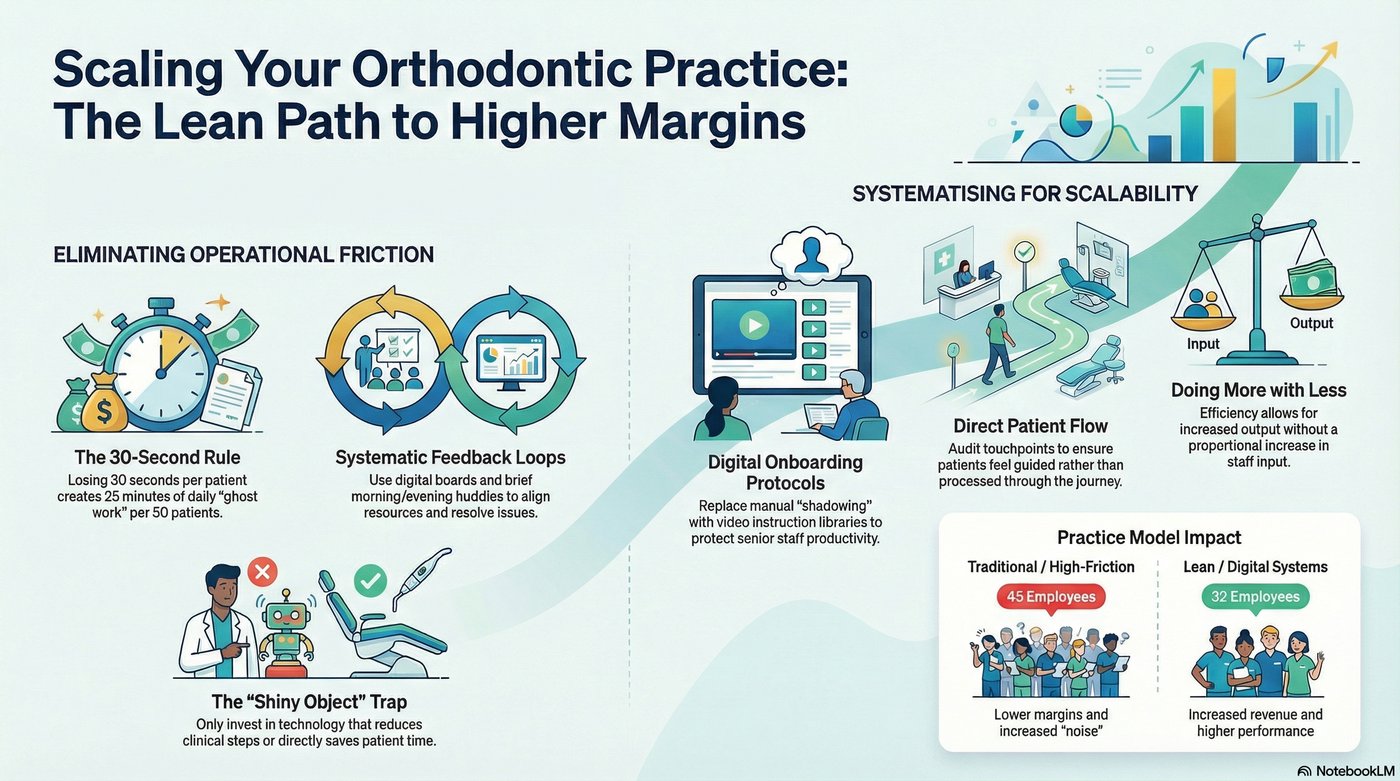
A common myth in orthodontic practice management is that more revenue requires more staff. For years, the traditional response to a growing patient base was to hire another assistant or an additional receptionist. However, without a lean foundation, adding more people to a broken system only creates more “noise,” leading to increased friction and lower margins.
The reality of modern practice growth is that high-level efficiency allows you to do more with less. By focusing on process optimization and digital systems, it is possible to maintain—or even increase—revenue while significantly reducing staff overhead. This is the ultimate goal of lean management in dentistry: a high-margin, low-stress clinic.
The Math of Efficiency: The 30-Second Rule
Operational excellence is built on the mastery of small increments. If your team loses just thirty seconds per patient due to a disorganized tray or a slow software login, and you see fifty patients a day, you have just added twenty-five minutes of “ghost work” to your schedule.
This wasted time inevitably leads to overtime, stressed employees, and a rushed patient experience. In our practice, we focus on removing the obstacles that allow this waste to occur. This requires a mindset shift from the leadership down. Like a person who removes chocolate from their house to avoid temptation, a leader must remove the procedural obstacles that allow waste to flourish. We use digital boards to record daily issues and hold brief morning and evening “huddles” to ensure resources are aligned, and feedback is immediate.
Avoiding the “Shiny Object” Trap in Dental Technology
Practice efficiency is often hampered by the pursuit of “shiny objects.” We see a high-end piece of equipment at a trade fair and buy it under the assumption that it will magically solve our problems. However, buying a forty-five-thousand-euro scanner without a plan for its implementation is not an investment—it is a waste.
True dental leadership involves clinical and financial discipline. Before adding any new technology, there must be a clear plan for how it integrates into the value stream. Does it save time for the patient? Does it reduce steps for the assistant? If the answer is no, or if the implementation plan is nonexistent, the equipment will sit unused, tying up capital that could have been used for practice growth.
Digital Onboarding: Protecting Your Most Valuable Assets
One of the greatest drains on a senior team’s time is the constant training of new hires. Traditionally, a senior assistant would spend weeks “shadowing” and instructing a new employee, effectively cutting the productivity of your most valuable talent in half.
We solved this through digital onboarding systems. By creating a comprehensive library of video instructions and digital protocols, new employees can become independent much faster. They feel more confident because they have a “source of truth” to refer to, and senior staff are freed up to focus on high-value clinical work. This systematic approach allowed us to reduce our staff from forty-five to thirty-two employees while increasing our revenue and overall dental team performance.
The Patient Perspective: A Seamless Journey
Waste can also be viewed through the lens of the patient. Any effort a patient has to make that does not provide them a direct benefit is a failure of the patient journey in orthodontics. If a patient has to visit different rooms for different parts of a single appointment, or if they aren’t told which “slips” or documents they need in advance, trust is eroded.
A lean practice ensures the flow for the patient is as direct as possible. We must audit our touchpoints to ensure that the patient feels “guided” rather than “processed.” When the patient journey is seamless, satisfaction scores rise, and the likelihood of referrals—the most efficient form of marketing—increases.
Conclusion: Creating the Leaner, Higher-Margin Practice
True scaling is about increasing the “output” of your practice without a proportional increase in “input.” By applying lean principles—eliminating physical and energetic waste, automating onboarding, and aligning talent—you create a resilient business model.
The journey to an efficient practice starts with a single observation. Look at your clinic today: where is the thirty-second leak? Where are the employees getting in each other’s way? By identifying and removing these frictions, you move your practice toward a state of flow that benefits the owner, the team, and the patient alike.