

Safety Anchors: How Standardization Protects Your Clinical Energy
Published on: Jul 5, 2026
The Fear of the “Cookbook” Approach
A common hesitation among orthodontists when discussing practice efficiency is the fear of standardization. Many clinicians worry that using a “cookbook” approach to treatment will strip away the artistry and individuality of their work. They feel that every case is a unique math problem that requires a custom solution from scratch.
This perspective often stems from a misconception that standardization mandates identical treatment plans for every patient. True clinical standardization, however, is about controlling the variables you can control, such as documentation, setup, and sequencing, so that your focus can be entirely dedicated to the complex, unique aspects of the case. It’s a mechanism for robust quality control, not artistic suppression.
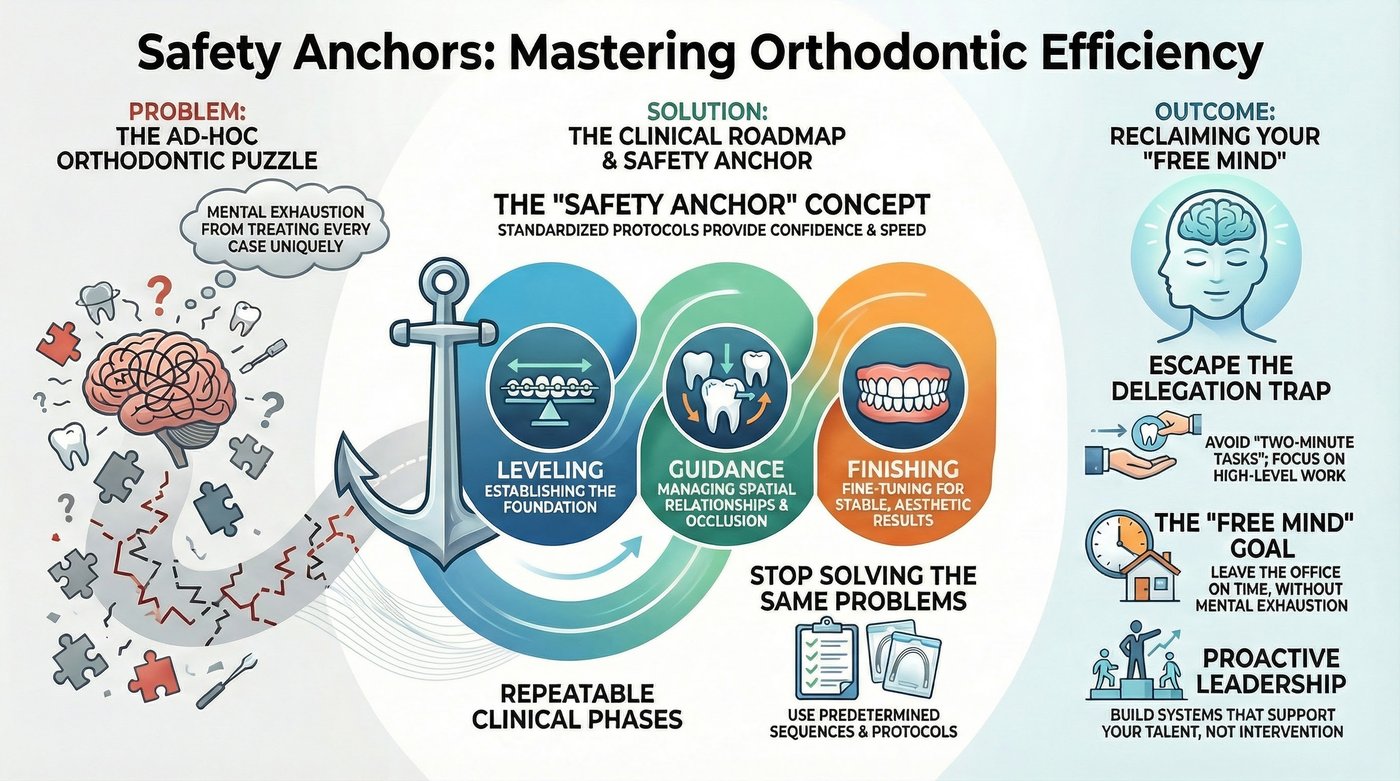
However, from a lean management in dentistry perspective, this way of thinking is a major source of waste. Staring at every patient as a brand-new puzzle is mentally draining and prone to error. Standardization isn’t about making every smile the same; it’s about providing “safety anchors” that allow you to navigate complex treatments with confidence and speed.
This mental burden, often called “decision fatigue,” directly compromises clinical accuracy and energy. When you must recalculate bonding height for every bracket or decide on a chairside setup on the fly, you are spending valuable cognitive resources on non-critical tasks. By implementing standards for these routine tasks, such as a universal tray setup for bonding or a defined patient chart structure, the clinician preserves their energy for diagnosis and treatment adjustments. This focused energy translates to better patient outcomes and a significantly more resilient practice.
Defining the Clinical Phases
To achieve operational excellence, we must break down the treatment into clear, repeatable phases. By categorizing treatment into stages like leveling, guidance, and finishing, you create a roadmap for the entire team.
These clinical phases serve as universal milestones that allow any member of the team to quickly assess a patient’s current status and the required next steps. A standardized phasing approach provides clarity and minimizes the potential for miscommunication between doctor, assistant, and front desk staff. For example, knowing a patient is firmly in the “Guidance” phase immediately directs the clinical assistant to check specific parameters like anchorage status and inter-arch relationships.
Leveling: Establishing the foundation.
Guidance: Managing the spatial relationships and occlusion.
Finishing: The fine-tuning that leads to a stable, aesthetic result.
The implementation of this phased approach necessitates documented protocols. A clinic might use a universal archwire progression protocol for the leveling phase, regardless of the malocclusion, minimizing ordering errors and setup time. Conversely, the finishing phase, while requiring high-level clinical judgment, still benefits from standardized processes, such as a final checklist for alignment, interproximal reduction (IPR), and retention setup. Adhering to these documented protocols ensures continuity of care and reduces variability in outcomes, which is the cornerstone of clinical quality.
Using predetermined archwire sequences or specific bonding protocols for these phases saves you from solving fifty different problems every afternoon. These standards act as the “Swiss watch” mechanics of your practice, ensuring that the clinical flow remains steady even when the office is at its busiest.
This consistency is essential for maintaining predictable appointment lengths and maximizing chair time efficiency. A streamlined flow reduces patient wait times and stress on the clinical team, turning a potentially chaotic afternoon into a series of predictable, manageable tasks. When every assistant knows the exact sequence for a wire change in the guidance phase, the doctor can transition seamlessly between operatories, minimizing downtime and truly leveraging their specialized expertise.
Delegating for High Performance
A key component of a high-performing practice is the ability to delegate effectively. Many practice owners avoid delegation because they feel explaining the task takes more time than just doing it themselves. This is a short-term trap.
This “short-term trap” is rooted in a failure to invest in training and system documentation. By initially spending the time to develop clear, step-by-step Standard Operating Procedures (SOPs), leaders unlock immense long-term gains in productivity. Effective delegation is only possible when the task is standardized, removing ambiguity and ensuring quality remains high regardless of who performs the work.
Failing to delegate leads to a day where the doctor is doing “two-minute tasks” while the high-level clinical and strategic work stalls. In a lean practice, dental team performance is boosted when roles are clearly defined. When you have a standard “recipe” for your protocols, it becomes significantly easier to train your team to handle the preparatory and administrative steps, freeing you to focus on the critical medical decisions.
Consider the example of clinical records collection. If the doctor personally reviews every scan and photo setup, they are acting as a technician. By standardizing the records protocol—defining angles, lighting, and required image count—the responsibility can be entirely shifted to a trained clinical coordinator. This frees the doctor to focus solely on diagnosis and high-stakes procedures like complex surgical setups or challenging mechanics. Properly documented standards empower the team to execute preparatory work autonomously, raising the entire practice’s productivity ceiling. This alignment of tasks with skill levels is crucial for optimizing the clinic’s financial model.
Reclaiming the “Free Mind”
The ultimate goal of clinical standardization is to leave the office on time with a “free mind.” If you spend your day in a state of chaotic decision-making, you carry that exhaustion home to your family and your hobbies.
This concept moves beyond mere physical exhaustion; it addresses the cumulative mental strain that leads to burnout among dental leaders. When every appointment requires ad-hoc decisions, the mind never truly rests, even after clocking out. Standardized systems create predictable closure points, allowing the clinician to mentally file away the workday because they trust that all necessary steps were followed and documented. This is the essence of professional well-being.
True dental leadership means building a system that doesn’t require your constant, frantic intervention to function. When the practice runs on structured systems, you can celebrate small milestones with your team and feel a genuine sense of accomplishment at the end of the day. You are no longer just “surviving” your schedule; you are mastering it.
Mastery in this context means being able to step back and analyze the system itself, rather than constantly performing triage. Leaders gain the bandwidth to focus on strategic growth initiatives, such as implementing new technology, refining the patient experience journey, or mentoring junior associates. By reducing the need for heroic, moment-to-moment interventions, standardization transforms the role of the practice owner from a perpetual firefighter into an architect of sustainable excellence. This strategic shift ultimately defines the difference between a high-production clinic and a high-performance organization.
Conclusion: The Path to Lasting Success
Achieving professional satisfaction requires a shift from reactive clinician to proactive leader. By embracing standardization and the “safety anchors” of lean thinking, you protect your mental health and enhance your clinic’s performance. Excellence is not about working harder; it’s about working with a system that supports your talent. Start simplifying your protocols today, and rediscover why you fell in love with orthodontics in the first place.
The decision to standardize is an investment in your future and the stability of your team. It reduces institutional knowledge loss, speeds up the onboarding of new staff, and provides a measurable framework for continuous improvement. When clinical processes are documented and consistently followed, the practice gains a competitive advantage through predictable quality and efficiency. This proactive approach ensures that your practice operates at peak capacity, allowing you to maximize your clinical impact while safeguarding your personal and professional longevity.