

Reproducible Success: Building a Sustainable Orthodontic System
Published on: Jul 1, 2026
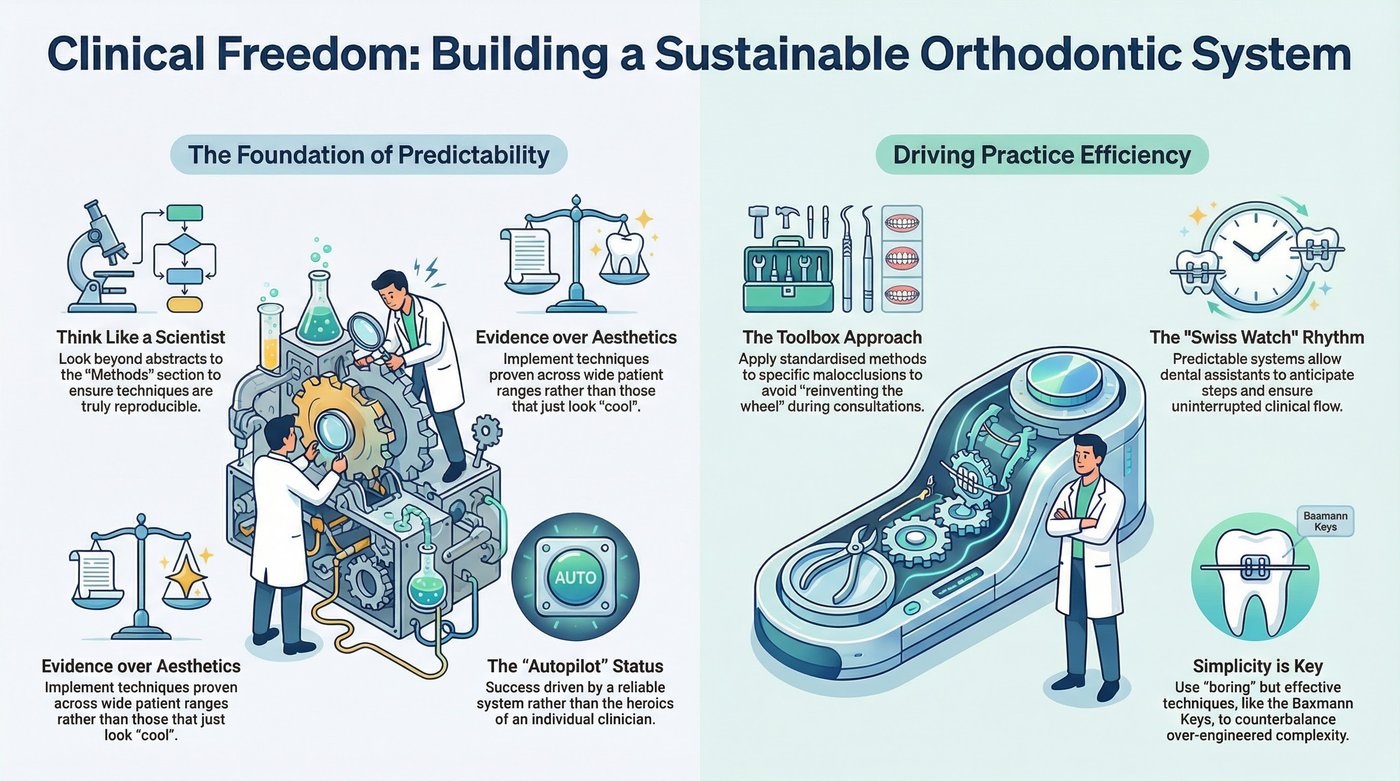
Beyond the Abstract: Thinking Like a Scientist
To achieve practice efficiency, a leader must be a critical consumer of information. This demands moving beyond marketing claims and embracing the discipline of genuine evidence-based dentistry. When you encounter a “breakthrough” technique, a new appliance, or a complex biomechanical study, your first instinct must be to look past the abstract. Analyze the claims with a rigorous scientific mindset, not a consumer’s curiosity.
Effective leaders routinely check the “Methods” section of any published work or clinical case presentation. Important questions to ask are: What was the sample size? Was the study based on five patients? Were there significant biases or confounding variables in patient selection? True clinical reproducibility requires results derived from large, diverse, and well-controlled cohorts, not anecdotal success stories.
Lean thinking is rooted in genuine scientific understanding. In a high-volume practice, predictability is currency. We do not implement a technique because it looks “cool” in a photo or because a key opinion leader endorses it; we implement it because it is proven to work predictably across a wide range of patients.
This disciplined, systemic approach is what allows you to move your practice toward “autopilot” status. This ensures your success is a result of a reliable, validated system rather than individual clinical heroics. A commitment to scientific scrutiny minimizes costly clinical errors and reduces chair time.
Every minute spent troubleshooting a procedure that failed outside of established parameters is a minute lost to potential revenue and patient care. By adopting only techniques that are scientifically validated for their efficiency and outcome, you build a resilient, high-throughput clinic model ready for scaling.
The Toolbox Approach
Every patient journey should be governed by a specific “toolbox”. This concept transforms clinical practice from an artistic endeavor into an engineering process. By deeply understanding which standardized methods apply to which specific malocclusion, you eliminate the mental burden of needing to “reinvent the wheel” for every new consultation. This standardization is the bedrock of scalability.
This approach is fundamentally about intelligent decision-making, not “cookbook medicine”. It means using your extensive expertise to select the single most efficient, reliable path to a high-quality goal. For instance, a Class II, high-angle case requires a completely different mechanical tool set than a Class I with moderate crowding. Pre-defining these pathways ensures optimal material utilization and staff preparedness.
In dental team performance, this clarity is vital for delegation and consistency. When the doctor utilizes a predictable, documented system, the clinical assistants can anticipate the next step. They know the required sequence of wires, the necessary auxiliary mechanics, and the materials are always ready. This operational synchronization ensures the clinical flow remains uninterrupted.
This efficiency is the hallmark of a high-performing clinic: a “Swiss watch” rhythm where everyone knows the melody and follows the score. For clinic leaders, this predictability means training is faster, cross-training is simpler, and the quality of care is non-negotiable, regardless of which team member is assisting. The system, not the person, dictates the baseline level of clinical excellence.
Counter-Programming Complexity
I want to encourage you, as a leader, to be a voice for simplicity within the profession. There is often a tendency to chase novelty, believing complexity equates to superior skill or outcome. However, true mastery lies in achieving exceptional results through the simplest and most reproducible means available.
We should actively share the effective, “boring” techniques that actually keep practices running smoothly and profitably. By showcasing the predictable power of foundational systems like the Baxmann Keys or a clean, established straight-wire sequence, you provide a necessary counterbalance to the over-engineered “Ego Orthodontics”.
“Ego Orthodontics” focuses on niche, highly complex solutions for common problems. These methods can overwhelm and discourage those who are still learning, increase inventory costs unnecessarily, and introduce variables that complicate team training and execution. Focusing on simplicity—standardizing bracket placement, bonding protocols, and defined wire sequences—de-risks the entire clinical operation and maximizes profitability per chair hour.
Conclusion: The Path to Clinical Freedom
Simplicity is the undisputed key to clinical freedom. The pursuit of excessive technical complexity often masks a lack of foundational systematic thinking. When you let go of the need to impress peers with intricate biomechanics, you gain the most valuable resources: time and energy.
This liberated focus allows you to channel your energy toward what truly matters: superior patient care and your personal well-being. The shift is from being a clinical performer to an operational architect. Focus relentlessly on optimizing your own clinical outcomes, implement durable, reproducible systems, and achieve consistently excellent results. This operational discipline is the defining characteristic of a practice that not only survives but flourishes in the long lane of professional success and provides genuine clinical freedom.