

Proactive Leadership: Identifying the Invisible “Pressure Points” in Your Practice
Published on: Jun 13, 2026
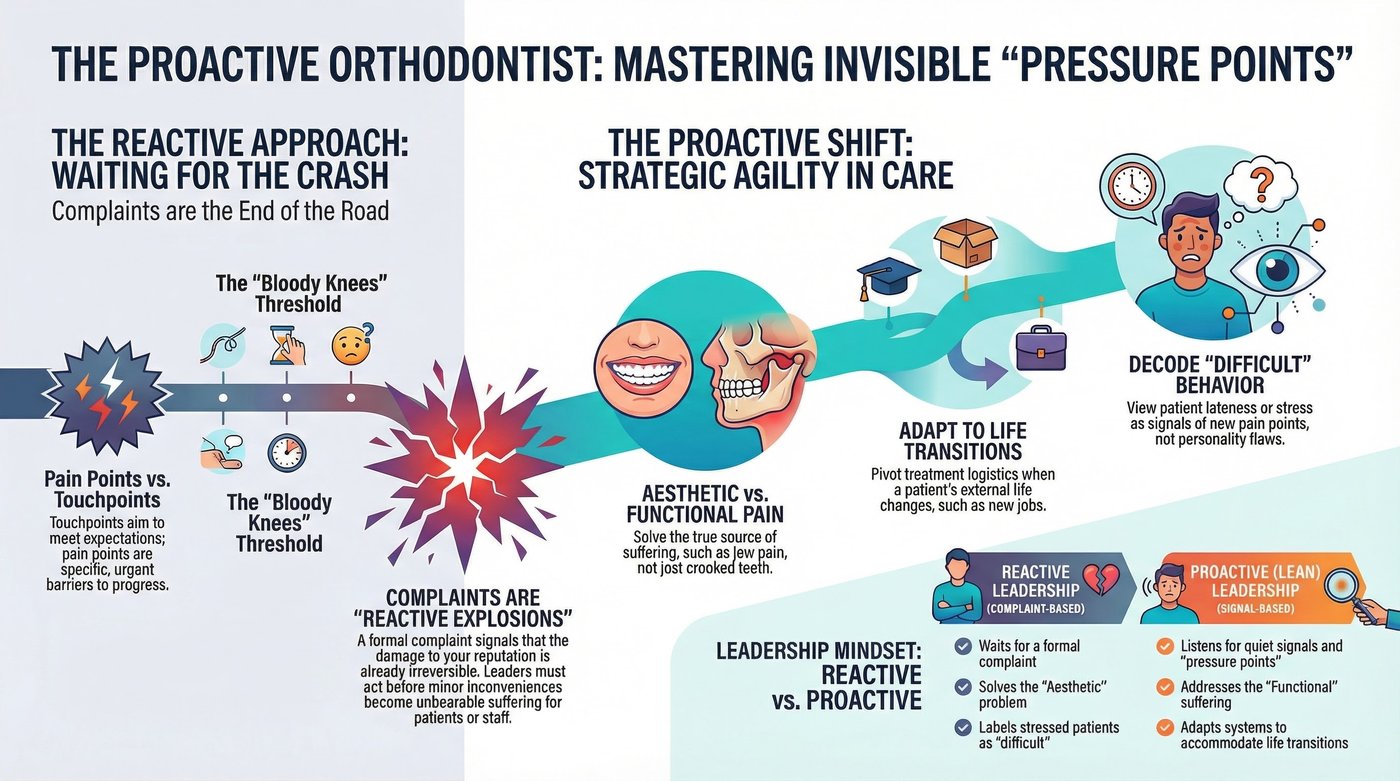
In the high-stakes environment of orthodontic practice management, most leaders rely on a reactive model: they wait for a formal complaint to signal that a system has failed. However, by the time a patient raises their voice, the damage to your reputation and the patient’s trust is often irreversible. True excellence in dental leadership requires a shift toward proactivity—the ability to identify and resolve “pain points” long before they escalate into conflicts.
This shift is not merely about better customer service; it is about sustainable practices and profitability. The erosion caused by systemic issues, even if silent, translates directly into diminished case acceptance and negative word-of-mouth referrals. Ignoring these quiet signals means you are managing a crisis, not a business.
A pain point is fundamentally different from a standard touchpoint. While a touchpoint is a routine interaction where we strive to meet or exceed expectations, a pain point is a specific source of suffering or a barrier to progress. It carries a sense of urgency. To master this, a practice owner must look at the clinic through three distinct lenses: the patient, the employee, and the business itself. The employee lens, for example, reveals that high staff turnover is often a symptom of unaddressed logistical pain points in daily workflows, such as poor inventory management or inefficient communication platforms.
The “Bloody Knees” Concept: Recognizing the Threshold of Change
In leadership coaching, we often refer to the concept of “bloody knees.” This describes the level of suffering an individual endures before they are finally forced to make a change. In a dental setting, patients and even team members often tolerate minor inconveniences—the “scraped knees” of daily life—until the pain becomes unbearable.
The “scraped knees” of a patient could be the repeated need to call the office to confirm the remaining balance on their treatment plan or perpetually confusing parking instructions. These small friction points accumulate, slowly eroding the perceived value of your premium service. We often miss these signals because they seem minor, but they represent a breakdown in client experience.
A visionary leader doesn’t wait for the “fall.” You must develop the sensitivity to notice when a patient is struggling with the logistical or psychological barriers of treatment. If a busy professional is constantly checking their watch in your waiting room, the “waiting time” isn’t just a metric; it’s a pain point that is slowly bleeding away their loyalty. By recognising this early, you can adapt your scheduling or communication before they reach their breaking point. Implementing a simple 30-second post-appointment digital survey that asks about convenience, not clinical results, can reveal these invisible issues, transforming soft data into actionable operational directives.
Solving the Right Problem: Aesthetic vs. Functional Pain
A classic failure in orthodontic practice management occurs when the clinician solves the wrong problem. Consider a patient with crooked teeth and a painful jaw joint disorder (CMD). If the orthodontist focuses solely on the “mechanics” of straight teeth, the patient may end up with a perfect smile but persistent physical pain.
Despite the clinical success of the alignment, the patient will remain dissatisfied because their primary pain point—the functional discomfort—was never addressed. This mismatch between clinical execution and patient expectation leads to dissatisfaction, regardless of the quality of the aesthetic outcome. The practitioner solved the stated problem (crooked teeth) but missed the emotional or functional problem (discomfort, lack of confidence).
As an expert, your role is to dig deeper during the initial consultation. You must ask, “What is the true source of your suffering?” If you align your treatment goals with the patient’s actual pain points, you create a level of value that “straight teeth” alone cannot provide. This requires advanced diagnostic interviewing, where the focus shifts from treatment features to patient benefits, effectively increasing case acceptance by addressing the patient’s core need. For clinic leaders, this means training team members to move beyond intake forms and use empathetic listening to uncover these functional priorities.
The Agility of Care: Adapting to Life Transitions
Pain points are not static; they evolve as the patient’s life changes. A treatment plan that was perfectly convenient at the start may become a massive burden if the patient changes jobs, moves, or experiences a shift in their daily schedule.
If a once-punctual patient starts arriving late or appearing stressed, a lean leader does not simply label them a “difficult patient.” Instead, recognise that a new pain point has emerged. Perhaps the 20-minute drive is now a 90-minute ordeal due to a job change or a school relocation. Alternatively, a financial shock may make continued large payments a source of anxiety and stress for the family.
By being agile—offering remote monitoring, grouping appointments, or adjusting the timing of visits—you solve the problem before it leads to a discontinued treatment. Agility means implementing a systematic “life check-in” during long-term treatments, especially orthodontic or multi-phase restorative care. This proactive check ensures the logistics of care remain synchronised with the patient’s evolving personal and professional commitments, minimising attrition and maximising compliance.
Conclusion: Turning Signals into Systems
A complaint is a reactive explosion; a pain point is the quiet signal that the fuse is lit. By training your team to listen for these signals and establishing internal channels to report them, you turn potential crises into opportunities for refinement. Proactive pain point management is the hallmark of a lean, sophisticated practice that values the human experience as much as the clinical result.
To achieve operational excellence, leaders must formalize the pain point discovery process. This involves creating a standardized operating procedure (SOP) for documenting non-clinical complaints and feedback from staff and patients. When a pattern emerges—for instance, three different staff members report difficulty finding a specific sterilization tool—that signal becomes a mandate for a systemic update, not just a one-off complaint.
Final Conclusion:
The mandate for contemporary dental leadership is clear: manage the invisible before it becomes visible. By adopting the three lenses of patient, employee, and business, and focusing relentlessly on alleviating “scraped knees” before they turn into “bloody knees,” practices can achieve superior patient retention and team stability. This proactive approach transforms the practice from a merely successful clinical enterprise into a resilient, high-value organization that defines its success by the seamless, pain-free experience it delivers every single day.