

Prioritization and the Two-Minute Rule: Leadership Strategies for a Fluid Workflow
Published on: Jun 20, 2026
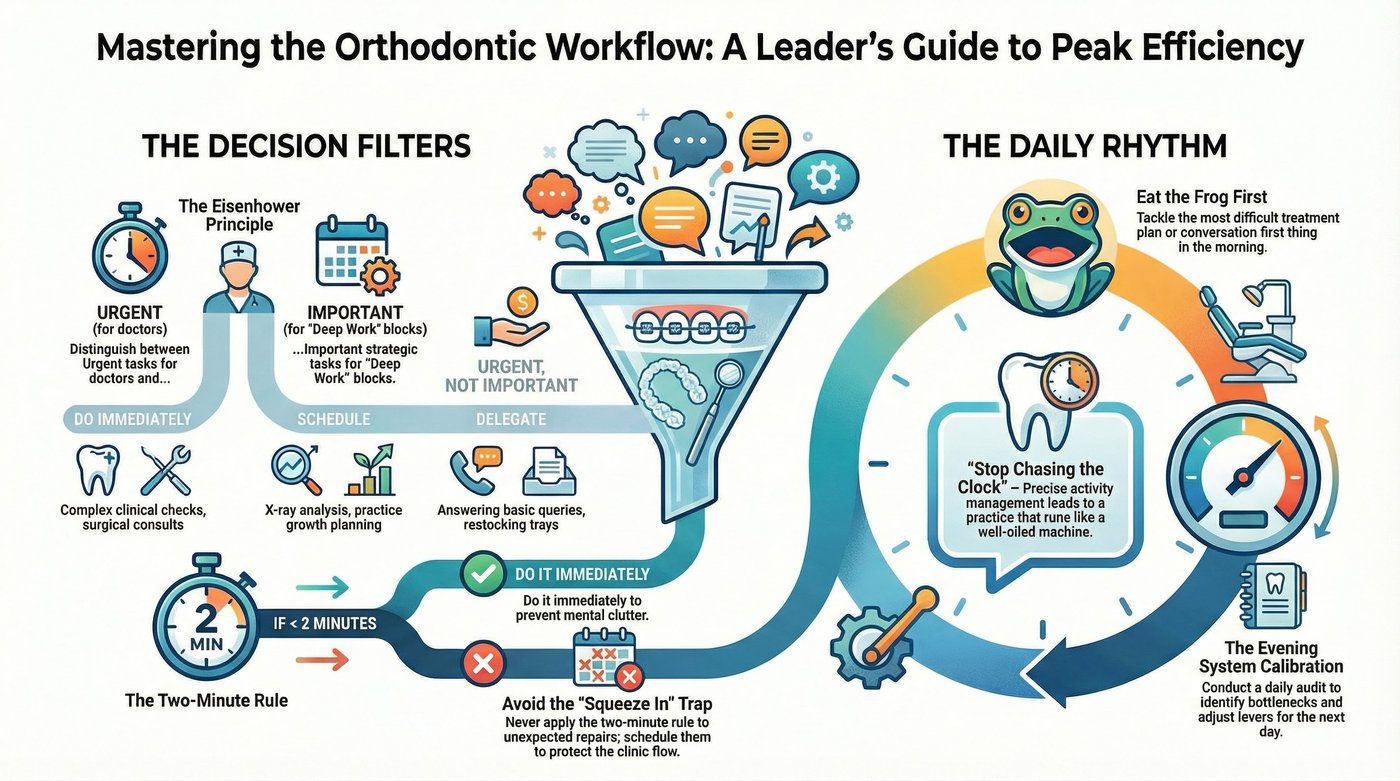
As an orthodontic clinic owner, your mental energy is your most valuable asset. When your mind is cluttered with a long list of “to-do” items, your clinical decision-making suffers. This cognitive overload is often the silent killer of practice profitability and staff morale. To lead a high-performance team, you must implement a system that filters activities based on their urgency and importance. This is not about simply working harder; it is about working with greater strategic intent and delegating effectively to protect your focus.
The adoption of lean management principles is critical for modern dental practice leadership. By applying established methods like the Eisenhower Principle and the Two-Minute Rule, you can eliminate the “noise” of a busy clinic and focus only on the high-impact leadership tasks that truly drive practice excellence and patient loyalty. This shift moves the focus from sheer volume to systematic value delivery.
The Eisenhower Principle in the Orthodontic Clinic
In a perpetually busy practice environment, nearly everything can initially feel urgent. However, a lean leader develops the discernment to distinguish clearly between what is Urgent and what is Important. This matrix defines the optimal action path for every task that crosses your desk.
Urgent & Important (Do Now): These are tasks that must be handled immediately by the doctor or a highly specialized staff member. Examples include a complex clinical check during an adjustment appointment, managing an acute patient complication, or conducting a time-sensitive surgical consultation. These items directly impact patient health and practice liability.
Urgent but Not Important (Delegate): These tasks require immediate action but do not necessitate the doctor’s direct involvement. This includes answering a basic patient query about insurance eligibility, handling routine supply restocking, or processing standard forms. Effectively delegating these tasks to trained administrative or auxiliary staff members is key to protecting the clinical schedule.
Important but Not Urgent (Schedule): These are strategic tasks that contribute to long-term success but have no immediate time constraint. Examples include analyzing complex cephlometric X-rays for future cases, conducting team performance reviews, or engaging in high-level practice growth planning. These must be scheduled for dedicated “Deep Work” blocks.
Not Urgent and Not Important (Eliminate): These tasks are pure time-wasters. For a clinic leader, this might involve checking personal emails excessively or engaging in non-essential, time-consuming social media activity during business hours. A true leader identifies and ruthlessly eliminates these distractors from the day’s routine.
A common efficiency leak in many dental offices is performing “Important but Not Urgent” tasks—like composing detailed referral letters, reviewing marketing datasets, or developing new protocols—during peak patient hours. This activity severely disrupts the clinical flow, causes bottlenecks, and diminishes the patient experience. By scheduling these strategic activities for quiet times, such as before the first patient or during a structured admin block, you ensure that your peak clinical hours are dedicated entirely to high-quality patient care and maximizing chair-time productivity.
The Two-Minute Rule and “Eating the Frog”
To prevent the accumulation of the small, annoying administrative tasks that lead to mental clutter and fatigue, leaders should institutionalize the Two-Minute Rule. The principle is simple: if a task, such as signing an end-of-day ledger, replying to a quick inter-office team query via messaging, or approving a lab case, takes less than two minutes, do it immediately. Do not add it to a list. This practice maintains a clean mental slate and prevents the insidious growth of low-impact, time-consuming backlog.
However, disciplined leadership dictates when not to apply this rule. A critical example is unexpected patient repairs. If a patient arrives with five loose brackets and you impulsively try to “squeeze it in” between scheduled patients, you ruin the schedule for everyone else downstream. That repair is “Not Urgent” for the current moment and must be politely but firmly scheduled into the appropriate time slot, protecting the integrity of the planned clinical flow.
Furthermore, we practice “Eating the Frog”—a concept that involves tackling the single most difficult, complex, or unpleasant task first thing in the morning. Whether this involves initiating a difficult conversation with a staff member about performance, finalizing a complex and intimidating treatment plan, or dealing with a major equipment failure, completing it early prevents it from hanging over you as a source of draining background stress and anxiety throughout the day. By conquering the “frog,” the rest of the day feels significantly easier and more manageable by comparison.
Closing the Loop: The Learning Evening Briefing
The ultimate goal of managing activities and prioritizing tasks is not merely to get things done, but to embed a culture of continuous process improvement. At the end of every day, we hold a brief, mandatory evening meeting—ideally lasting only 5 to 7 minutes. This is not for casual social chatting or reviewing tomorrow’s schedule; it is solely for system calibration and objective performance analysis. We use three targeted questions:
What activities went well? (Identifying successes and replicable processes.)
What activities caused a bottleneck? (Pinpointing specific process failures or resource limitations.)
How can we adjust our levers for tomorrow? (Defining a concrete, measurable action to improve the process.)
This rigorous daily audit instantly turns every clinical shift into a rapid learning opportunity. It ensures that system flaws and administrative mistakes are identified and corrected immediately, rather than becoming entrenched practice habits. The team remains focused on the principle of “Standard Work,” constantly refining the most efficient path. When you manage your activities with this level of precision, you find that the “time” takes care of itself. You stop constantly chasing the clock and start effectively leading a high-performing practice that runs with the effortless, predictable precision of a well-oiled machine.
Conclusion
Implementing these strategic prioritization tools—the Eisenhower Principle, the Two-Minute Rule, and the commitment to “Eating the Frog”—transforms a busy, reactive dental clinic into a proactive, systematically efficient healthcare business. True leadership is defined by the ability to create a clear focus for both yourself and your team. By dedicating your mental energy to high-value tasks and eliminating procedural noise, you do more than just save time; you elevate the quality of clinical care and establish a foundation for scalable, sustainable practice growth. These are the daily habits of market-leading dental professionals.