

Precision Communication: Mirroring and Digital Reach
Published on: Jun 28, 2026
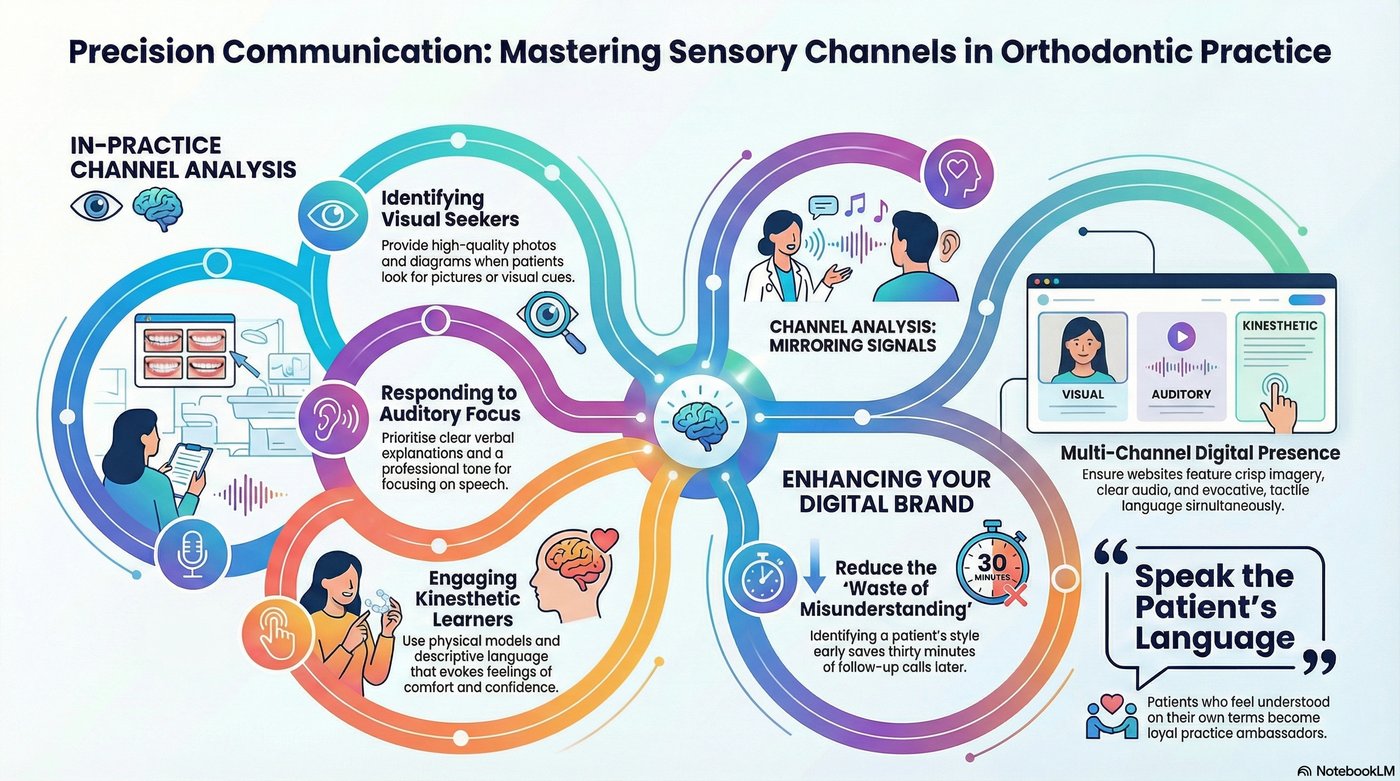
The “Channel Analysis” Technique
In orthodontic practice management, we often spend thousands on technical training and the latest clinical gadgets. Yet, the most effective tool for enhancing dental team performance is completely free: the ability to listen for sensory signals and adapt our frequency to match the patient.
Mastering this technique allows you to put your patient communication on a reliable “autopilot.” When your team can identify how a patient processes information, they stop guessing and start connecting. This shift reduces the friction often found in treatment presentations and financial discussions.
In the clinical environment, we often focus on the “what”—the malocclusion, the treatment plan, the hardware. However, the “how”—how the patient perceives this information—is what determines whether they move forward with care. By identifying these sensory channels early, you create a sense of psychological safety and professional trust.
When you are in a high-stakes meeting or a new patient consultation, observe the subtle signals and linguistic cues. Patients will tell you exactly how they want to be sold to if you know what to look for:
Seeking more pictures? Focus on the Visual channel. These patients use phrases like “I see what you mean” or “Can you show me a before-and-after?” They need to visualize the end result through scans and simulations.
Focusing on what others say? Focus on the Auditory channel. These individuals are sensitive to tone and word choice. They might say, “That sounds right” or ask about the reputation of the practice based on what they’ve heard from friends.
Reaching for models on the desk? Focus on the Kinesthetic channel. They need to “feel” the process. Hand them a 3D-printed model or an aligner sample. They use words like “grasp,” “touch,” or “comfortable.”
By responding to these subtle signals, you employ a form of professional mirroring that validates the other person’s reality. It turns a standard clinical conversation into a high-level psychological interaction that secures commitment and reduces “administrative ballast.”
When a doctor or treatment coordinator mirrors the patient’s primary sensory channel, the patient feels an immediate, often subconscious, sense of alignment. This reduces the “think about it” factor, as you have already answered their questions in the “language” they naturally speak.
Applying the 3 Channels to Your Digital Brand
Your digital presence—your website, social media, and online consultations—should address all three types simultaneously. In the digital space, you don’t always have the luxury of real-time adjustment, so your content must be “omni-channel” by design.
A truly effective digital brand creates a multi-sensory experience that begins long before the patient walks through your door. This ensures that no matter who visits your profile, they feel “at home” and understood by your practice philosophy.
Visual: Use high-resolution videos and crisp, professional photography. Showcase before-and-after galleries with clean, consistent lighting. Use diagrams that clearly explain the mechanics of a healthy bite or the stages of aligner therapy.
Auditory: Ensure your videos have clear, high-quality audio. Host a podcast or post video testimonials where the patient’s voice is clear. Use a professional, steady tone in your narration to project authority and calm expertise.
Kinesthetic: Use descriptive language that evokes “tangibility.” Use phrases like “Feel the confidence of a new smile” or “Experience the comfort of our modern scanners.” Describe the texture of the materials or the physical ease of the office flow.
Reducing the “Waste of Misunderstanding”
In a lean dental practice, we strive to avoid unnecessary rework. This principle applies to conversations just as much as it does to clinical chair time. Every time a patient calls back because they didn’t “understand” the plan, it represents a failure of channel alignment.
Misunderstandings lead to delays in treatment starts and increased overhead in the form of administrative follow-up. By investing just three minutes at the start of a consultation to identify the patient’s reception style, you save thirty minutes of repetitive follow-up calls and emails later.
Consider the cost of a “lost” treatment start simply because the patient didn’t feel they could “grasp” the value. By refining your delivery to match their receiver, you ensure the value proposition is heard clearly the first time, leading to higher conversion rates and smoother operations.
True dental leadership is about being flexible enough to speak the patient’s language rather than demanding they speak yours. It requires a leader who can coach their team to pivot their presentation style on the fly based on the patient’s reactions.
When people feel understood on their own terms, they don’t just accept your treatment; they become loyal ambassadors for your practice. This level of connection fosters a referral-based culture where patients advocate for you because the experience felt uniquely tailored to them.
Conclusion: The Professional Connection
Communication is the bridge between your clinical expertise and the patient’s desired results. By mastering the three channels of reception—visual, auditory, and kinesthetic—you ensure that the bridge is strong, efficient, and built on mutual understanding.
Whether you are leading a team of forty through a culture shift or a single patient through their first digital scan, the goal is the same: adapt your signal to their receiver. The result is a smoother, more relaxed, and significantly more profitable practice that thrives on precision and connection.