

Perfectionism is Procrastination: Breaking the Cycle of Clinical Paralysis
Published on: Jul 4, 2026
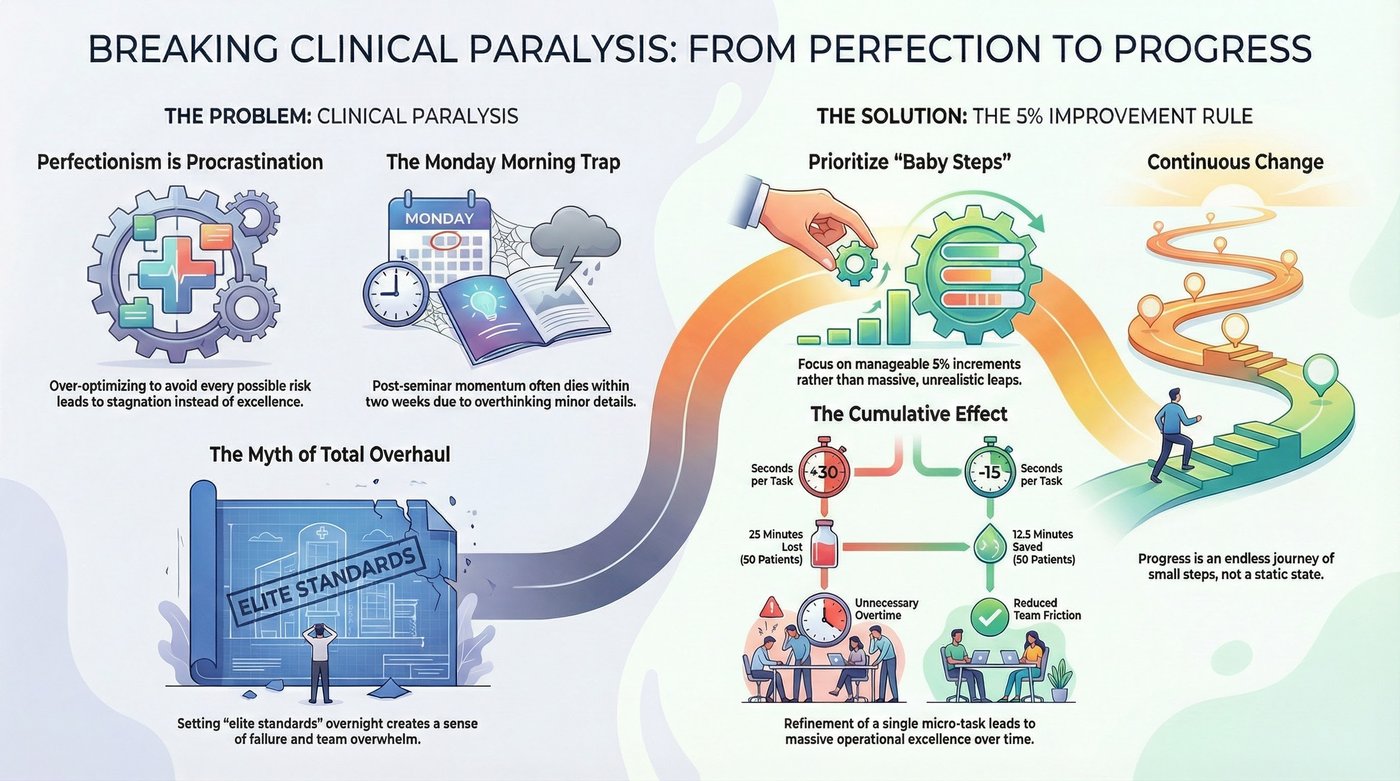
The Monday Morning Trap
We have all been there: you return from a high-energy professional seminar on Monday morning, fueled by new ideas and ready to overhaul your entire bracket inventory, rewrite your management protocols, and flip every system upside down. However, within two weeks, that initial enthusiasm often hits a wall of reality. You find yourself overthinking minor details—like how to sort old stock or minimizing every possible risk—until the momentum dies.
This common scenario is a psychological pitfall for clinic leaders. The desire to implement changes perfectly creates friction, especially when new protocols require team retraining or investment in new technology. The fear is not failure, but the temporary disruption caused by imperfect execution. This intense focus on a “flawless launch” is a significant roadblock to progress.
In lean orthodontics, we recognize that this “need for perfection” is often just a sophisticated form of procrastination. When you spend all your time trying to optimize a process in advance to avoid any possible problem, you never actually start. Perfectionism doesn’t lead to excellence; it leads to paralysis.
True lean methodology emphasizes immediate action and rapid iteration over exhaustive upfront planning. Clinical leaders must recognize the crucial difference between necessary, structured preparation and continuous stalling. Over-analyzing things like new inventory management software, for instance, often results in the continuous use of inefficient legacy systems simply because migrating to a new one seems too risky or complex to execute flawlessly. The potential risk of minor, correctable errors during implementation almost always outweighs the guaranteed costs of prolonged inaction.
The Myth of Total Overhaul
The danger of perfectionism lies in the desire for instant, massive leaps. If a practitioner currently takes 90 minutes to bond a multi-band appliance and sets a goal to reach a 15-minute elite standard by next week, the gap is simply too large. This impossible standard creates a sense of failure before the journey even begins.
Attempting to implement a total overhaul simultaneously across all departments—clinical flow, administrative processes, and financial systems—guarantees fragmentation and severe team burnout. Such radical, non-staggered changes lack the necessary foundational support for long-term integration and mastery. For example, a doctor might invest heavily in advanced intra-oral scanning equipment but then fail to fully integrate the technology because the team was never trained on a gradual schedule or given sufficient time to master the preliminary steps.
True dental leadership involves understanding that perfection is not a static state but a dynamic process of continuous, positive change. To move your practice forward, you must prioritize ‘baby steps’ over massive leaps. This structural way of working allows for sustainable growth and prevents the team from feeling overwhelmed by unrealistic expectations.
Effective leaders define a ‘minimum viable change’ (MVC)—the smallest, most focused action that delivers a measurable, positive improvement. Instead of aiming for a full practice redesign, an MVC might be revising the patient consent form process or standardizing the delivery of post-operative instructions. These small, successful projects build team confidence and organizational muscle, making subsequent, larger changes feel achievable rather than intimidating. Sustainable growth is built on a reliable foundation of small, repeated victories, not one single, heroic practice transformation effort.
The 1% Rule: Incremental Refinement
Instead of trying to be perfect tomorrow, aim for a 5% improvement today. If your bonding takes 90 minutes, aim for 85 this week, then 80 the next. These small, manageable increments are the secret to practice efficiency.
The 1% Rule is a firm commitment to scientifically auditing your current clinical and administrative processes to find marginal gains. This strategy requires clinic leaders to move past subjective gut feelings and apply objective measurements and time-motion analysis. For example, use a stopwatch to accurately track the time spent on specific phases of a patient visit, from check-in to chair dismissal. If the preclinical setup is consistently taking two minutes longer than necessary, that becomes the isolated, measurable target for immediate refinement.
When you focus on refining single steps, the cumulative effect is massive. Consider a simple archwire change: if an assistant takes just 30 seconds longer per patient, and you see 50 patients in an afternoon, you’ve created 25 minutes of unnecessary overtime and team friction. By refining that one micro-task by only 15 seconds, you cut that stress in half. This is how you achieve operational excellence—not through one giant change, but through a thousand small ones.
Apply this logic to material handling and supply chain management. If the time spent searching for a specific bonding agent or instrument can be reduced by 10 seconds through simple methods like better cabinet labeling or a reorganized sterilization workflow, the accumulated time savings across a full week will free up significant staff hours. These saved minutes can be directly reinvested into higher-value activities, such as patient education or staff training, significantly enhancing both the patient experience and clinic profitability. Operational excellence is simply the strategic sum of tiny, daily, and repeatable improvements.
Conclusion: Starting is the Goal
Improvement is an endless journey of small steps, whereas perfectionism is a barrier that keeps you at the starting line. By letting go of the need for an immediate overhaul, you allow your practice to evolve naturally into a highly efficient system. Stop planning for a ‘perfect’ start and simply start refining.
The most competitive and highly efficient dental practices are not those that wait for the ideal moment or the newest, perfect technology. They are the ones who began implementing measurable improvements immediately, accepting that the very first iteration of any new process will always be imperfect. Clinical progress, like any strategic endeavor, is about iterating quickly and learning from executed actions, not from protracted theoretical planning. The true strategic advantage lies in continuous, documented forward motion, transforming the perceived risk of ‘starting imperfectly’ into a necessary, foundational component of effective leadership and accelerated practice growth.