

Operational Excellence through Motion Economy: How to Walk Less and Accomplish More
Published on: Jul 4, 2026
The Silent Thief of Time: Unnecessary Motion
In orthodontic practice management, we often focus on clinical speed or digital technology, but we overlook the physical mechanics of the office. Unnecessary motion is one of the most significant forms of waste. Every time an assistant leaves the treatment room to find a clinical camera or a specific archwire, the professional flow is broken, and the “administrative ballast” of the day increases.
Consider the cumulative impact: if a clinician takes ten extra steps twenty times a day, they have walked miles of unproductive distance by year-end. This movement doesn’t just burn calories; it burns mental energy and patience. It creates a frantic atmosphere where the patient feels like an interruption rather than the focus of the visit.
To achieve operational excellence, you must master the principle of “motion economy.” This means arranging your physical environment so that the work comes to the person, rather than the person chasing the work. When your physical space is optimized, the clinic feels quieter, even on your busiest days.
Conducting Your Own Motion Audit
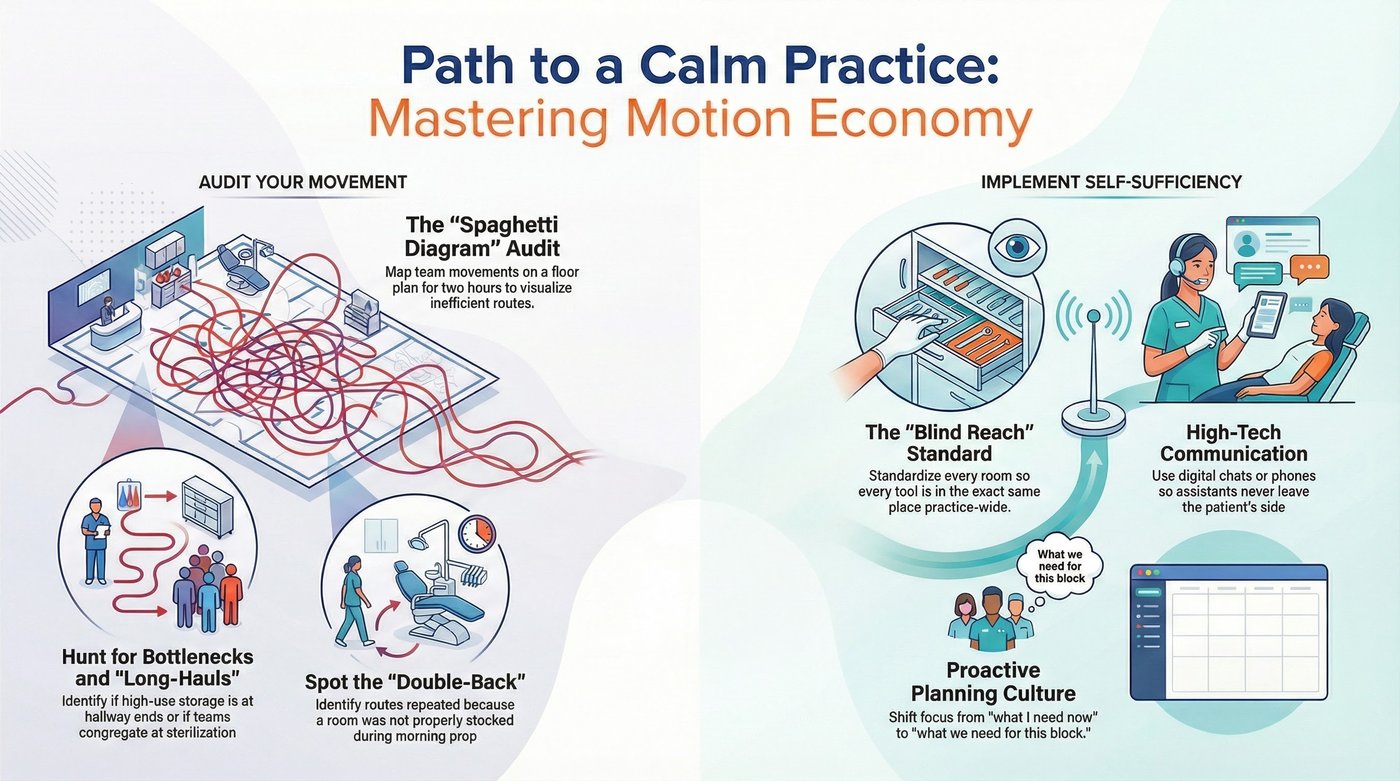
To transform your dental team’s performance, I suggest a practical team exercise: map out your movements for two hours using a floor plan. This is often called a “spaghetti diagram” because of the chaotic lines it produces. This isn’t about monitoring the staff; it’s about identifying systemic flaws that force them to work harder than necessary.
Encourage your team to be honest about their frustrations. Often, the staff knows exactly where the friction is but has accepted it as part of the job. By visualizing the physical paths taken during a typical morning rush, you can identify precisely where the office layout is fighting against your productivity.
Look for bottlenecks: Are people constantly congregating at the sterilization center or the X-ray suite? If everyone is waiting for one piece of equipment, that is a signal to rethink your scheduling or your equipment placement.
Identify “long-haul” routes: Is the most used storage cabinet located at the furthest end of the hallway? Moving high-frequency items just a few feet closer to the point of use can save hours of time over a single month.
Spot the “Double-Back”: How many times does a team member walk the same route because a room wasn’t properly stocked in the morning? Every double-back is a symptom of a breakdown in your morning prep or your inventory system.
The Self-Sufficient Room Standard
The most effective way to eliminate “spaghetti lines” is to ensure every treatment room is entirely self-sufficient. Standardization is the key. You should be able to reach into a drawer in any room and find the exact same tool in the exact same place. This “blind reach” capability is what separates elite practices from the rest.
When a room is fully stocked with the essentials for 90% of procedures, the clinician never has to apologize to a patient and step out to “grab one more thing.” This preserves the relationship and keeps the momentum of the appointment moving forward without unnecessary pauses.
When you combine self-sufficient rooms with internal communication systems (like work phones or digital chats), the need for physical movement drops dramatically. An assistant can request a printout or a follow-up appointment without ever leaving the patient’s side. This creates a high-tech, high-touch environment that defines modern dental leadership.
Furthermore, utilizing technology like intraoral scanners at every chair rather than a single “scanning station” further eliminates the need for patients and staff to shuffle between rooms. The goal is to make the dental chair the command center for the entire patient experience.
Strategic Planning for a Calm Practice
Reducing physical movement is a strategic decision that starts with the leader. When you challenge your team to work with as few steps as possible, you force a culture of proactive planning. The team starts to ask, “What do we need for this entire block of patients?” rather than “What do I need for this specific minute?”
This shift requires the doctor to model the behavior. If the leader is constantly running to the front desk to check the schedule or searching for a handpiece, the team will follow that lead. Leaders must prioritize the creation of systems that allow the team to stay “in the zone” for extended periods.
This shift in mindset from reactive to proactive is what allows a practice to stay high-performing without the chaos. You find that you have more time for complex clinical decisions because you aren’t exhausted by the physical “noise” of a disorganized office. A calm environment also significantly improves the patient’s perception of care.
Conclusion: The Reward of Efficiency
By reducing unnecessary movement, you aren’t just saving minutes; you are protecting your passion for the craft. A practice with optimized flow is a practice where professionals can thrive. When the workday ends, you should feel satisfied by the quality of your clinical work, not exhausted by the quantity of your steps.
Use the spaghetti diagram to untangle your routines, stock your rooms for a “blind reach,” and watch as your practice transforms into a model of efficiency and calm. Operational excellence is not a destination but a continuous commitment to removing the barriers that stand between you and your best work.