

Operational Excellence: The Practical and Human Pillars of the Lean Clinic
Published on: Jun 17, 2026
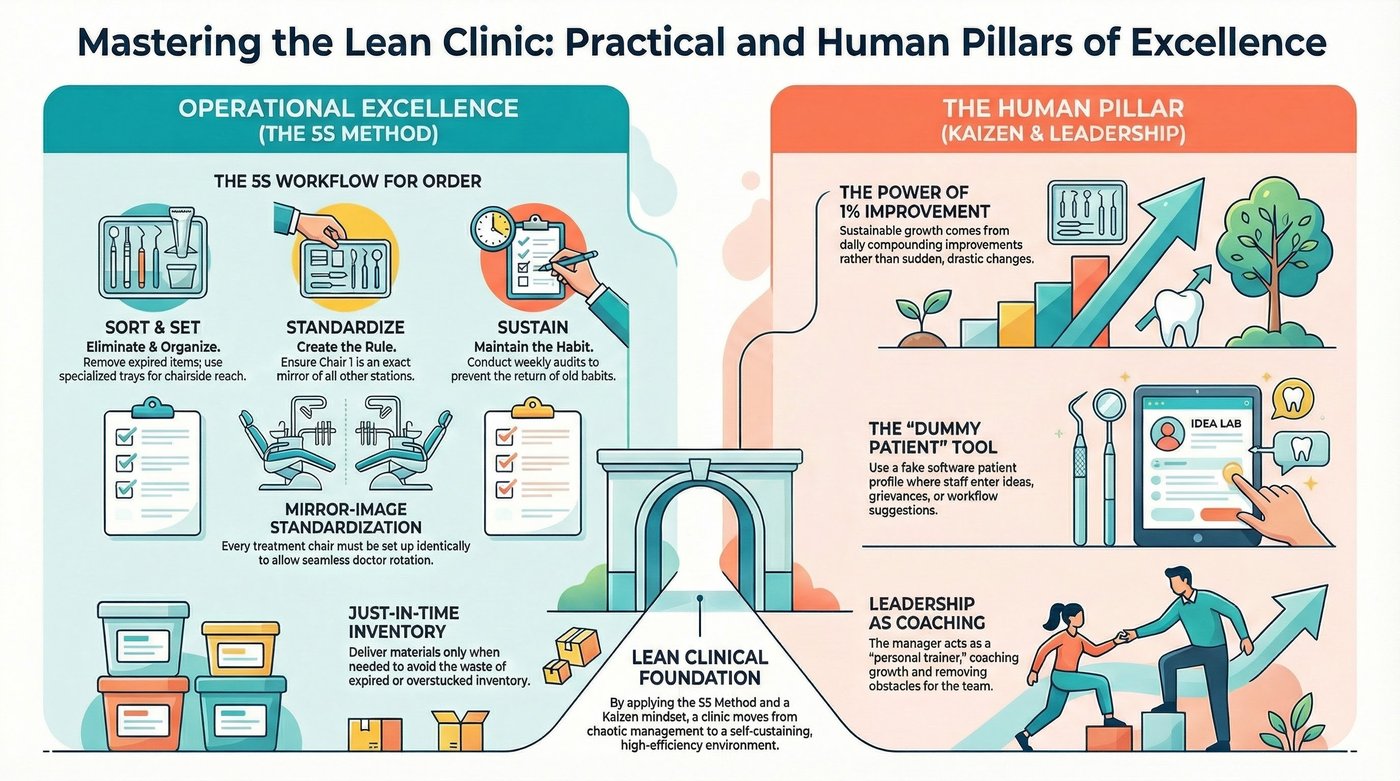
Mastering the philosophy of Lean is only half the battle. To transform your clinic into a self-managing, high-efficiency environment, you must apply Lean principles to the physical workspace and the human culture of your team. This is where the theoretical meets the practical and where your leadership as a “personal trainer” for your practice becomes the deciding factor.
The shift requires clinic leaders to stop managing outcomes and start managing processes. This operational focus is key to systematically eliminating the eight forms of waste (Muda) common in a dental setting, such as excess waiting time, unnecessary motion, and over-processing.
Continuing our journey through the ten pillars of Lean Orthodontics, we focus on the operational mechanics and the “kaizen” mindset required for long-term clinical success.
The 5S Method: Workplace Organization
Efficiency is a byproduct of order. Every treatment chair should be set up identically so that any doctor or assistant can sit down and find the necessary pliers in the exact same drawer. We achieve this through the 5S Method:
The goal of 5S is to create a visual workplace where abnormalities are immediately obvious. For example, “Set in Order” moves beyond basic labeling to using shadow boards for instruments in the sterilization lab, instantly signaling a missing piece.
“Standardize” ensures this exact setup is documented as the Standard Operating Procedure (SOP) across all operatories and shared service areas. To “Sustain” the effort, designate a “5S champion” on the team to conduct short, focused weekly audits, ensuring discipline is upheld.
Just-in-Time Production and Inventory
In a Lean practice, we treat one patient at one chair at one time. Everything needed for that specific appointment must be present the moment the patient sits down. This “Just-in-Time” approach extends to your warehouse. You don’t need a year’s supply of brackets; you need a system that delivers materials when needed, avoiding the waste of storage costs and the risk of expired inventory.
JIT principles drastically reduce the carrying costs of inventory, freeing up capital that can be reinvested. A key practical application is “pre-kitting” all trays and materials the night before, based on the next day’s schedule.
This proactive preparation shifts the burden away from the high-stress patient appointment time, ensuring zero downtime and maximizing chair utilization. By implementing simple minimum/maximum stock levels, reordering becomes automated and strictly demand-driven.
The Kaizen Philosophy: The Power of 1%
I often see practices try to improve by taking a “sledgehammer” to their systems—changing everything overnight. This leads to burnout and a “yo-yo effect.” True Lean growth comes from a 1% improvement every day. This compounding effect is the secret to sustainable excellence. A consistent, steady upward trend is far superior to erratic explosions of change.
Kaizen requires a dedicated, documented methodology for capturing and implementing these small, continuous changes. A weekly team huddle should include a dedicated agenda item: “One Process Improvement.”
This improvement could be shaving 30 seconds off the sterilization setup or streamlining the initial patient intake form. By tracking these minor successes, you maintain momentum and demonstrate that every team member’s incremental contribution is essential to the practice’s growth.
Participation and “The Dummy Patient”
You cannot be Lean alone. You must empower your team to be problem-solvers. In my clinic, we use a “dummy patient” in our software where staff can enter ideas, grievances, or suggestions. We evaluate these together. If your team is debating the best way to handle a workflow, celebrate it—it means they care. Silence is the enemy of innovation.
The “Dummy Patient” system fosters the psychological safety needed for staff to critique processes without fear. Ideas submitted must be formally reviewed, tested, and implemented, or respectfully declined with clear reasoning and documentation.
When frontline clinical staff are given the authority to test and implement an improved workflow, the adoption rate is near instantaneous. This empowerment transforms staff from order takers into process owners, dramatically improving the quality of work life and clinical output.
Leadership as Coaching
Finally, Lean management requires you to be a personal trainer for your team. You cannot simply pay the membership fee (their salary) and hope they get fit. You must coach them, support their growth, and remove the obstacles that prevent them from performing at their best.
This coaching role mandates that the leader spend time performing “Gemba walks”—going to the actual place where the work is done. This isn’t about micromanagement; it’s servant leadership focused on observing processes and identifying systemic issues.
Your primary job becomes the “obstacle remover,” providing the necessary tools, training, and clear documentation required for sustained peak performance.
Conclusion
Operational excellence in a dental practice is not achieved through a single expensive software installation or a one-time reorganization. It is the result of diligently applying both the practical systems of workplace organization and the human principles of continuous improvement and empowerment.
By leading as a coach and fostering a culture where every team member is a respected process-owner, you build a resilient, profitable, and high-quality clinic. This commitment to Lean is the ultimate differentiator, ensuring stability, efficiency, and clinical mastery for years to come.