

Operational Excellence: Solving Internal Pain Points to Drive Team Performance
Published on: Jun 13, 2026
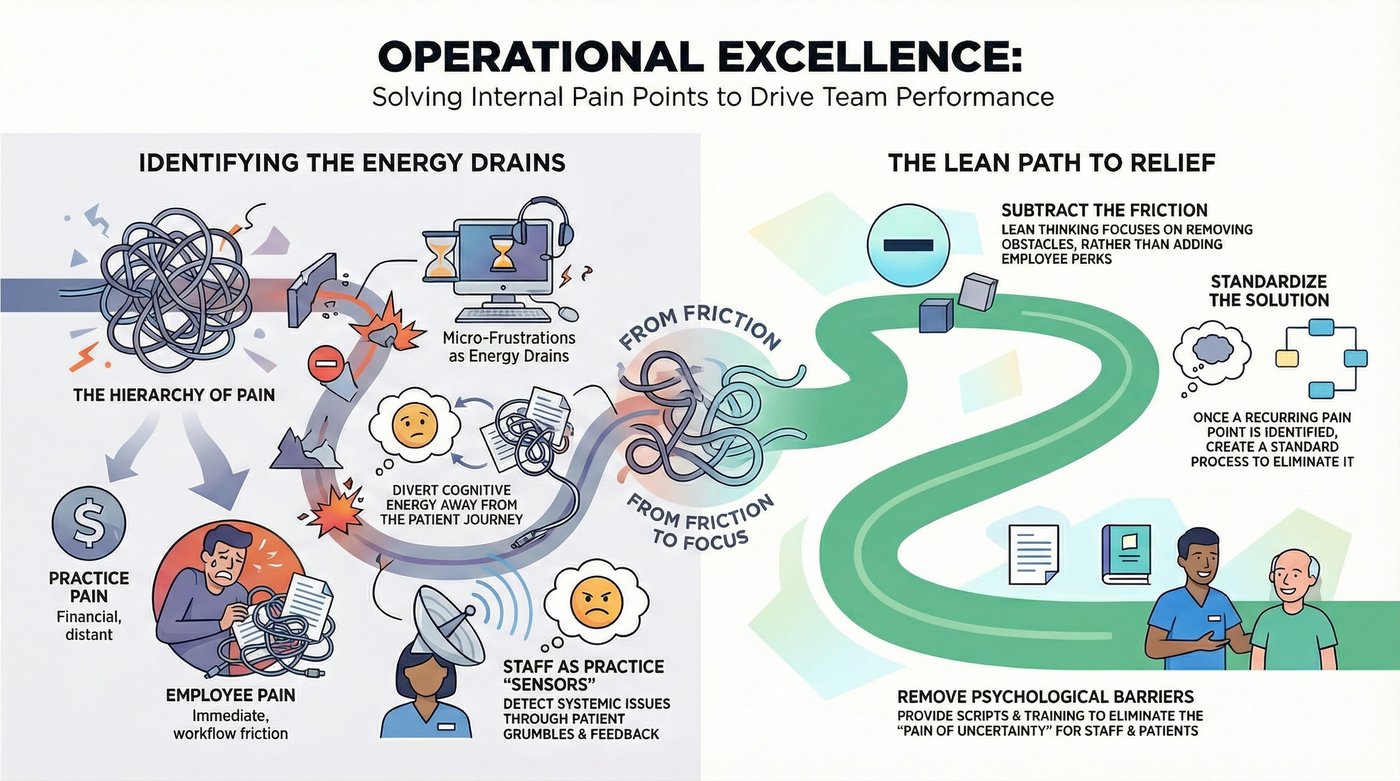
In the philosophy of Lean Orthodontics, we often focus on optimizing the external patient journey. This includes everything from the initial consultation to the final retention phase. However, a practice owner’s most critical “customers” are their own employees, whose internal experience dictates the patient-facing quality they can deliver.
If your team is experiencing internal pain points—workflow jams, broken equipment, or confusing protocols—it is impossible for them to deliver a consistently high-quality experience to the patients. These internal friction points are often insidious, manifesting as daily micro-stresses that lead to burnout and high staff turnover.
A culture of operational excellence recognizes that resolving internal inefficiency is the prerequisite for external service quality. To achieve this, you must treat employee pain points with the same urgency as patient complaints. Proactive internal system auditing is a leadership function, not merely a maintenance task.
When the internal engine is grinding due to poor systems or outdated technology, the external service will eventually fail, regardless of the clinical skill of the practitioners. Leaders must ensure the “internal engine” is well-oiled to support the delivery of exceptional patient care at every touchpoint.
The Hierarchy of Pain: Aligning Practice, Employee, and Patient
Interestingly, the pain points of the business, the staff, and the patient do not always align. For the practice as a business, a pain point might be a persistent drop in long-term profitability, often tracked via Key Performance Indicators (KPIs) like case acceptance rates or collections efficiency.
For an employee, however, the pain point is often more immediate and tactical: a printer that always jams during a busy afternoon or a sterilization protocol that feels unnecessarily complex and time-consuming. These daily struggles deplete morale and productivity far faster than abstract financial reports.
Strategic dental leadership involves identifying these “micro-frustrations” and understanding their compounding effect. A five-minute delay caused by clunky software in the scheduling department means less time focusing on patient rapport or handling complex inquiries. This diversion of energy is a direct threat to service excellence.
Consider the time spent searching for misplaced forms or waiting for lab cases to arrive. These moments are a waste according to Lean principles and represent direct financial loss. By implementing cloud-based digital forms or optimizing inventory management, you empower your team to focus on fostering patient relationships.
Empowering the Team as “Pain Detectors”
Patients are often more comfortable sharing their true struggles, anxieties, or procedural feedback with an assistant or a receptionist than with the doctor. Therefore, your dental team’s performance is directly tied to their ability to act as “sensors” for the practice, capturing vital feedback.
The front desk is the critical interface where systemic issues first become apparent. Your staff must be trained to recognize that a grumbling patient—or even a subtle question—is actually providing valuable operational data. If patients complain about a specific parking app, that indicates a systemic pain point.
Leadership must move beyond simply acknowledging these complaints and create a system for their capture and resolution. This shifts the team from being passive recipients of complaints to active partners in process improvement, ensuring that data drives the evolution of the practice protocols.
Create a Reporting Culture: Ensure there is a low-friction way for staff to report these “signals” to leadership. This could be a dedicated digital form or a standing “Pain Point Review” item on a weekly agenda.
Standardize the Relief: Once a recurring pain point is identified, create a standard, documented process to solve it. For example, provide a physical parking guide or simplify the electronic intake form to validate the team’s feedback.
Lean Thinking: Removing Barriers to Success
In a lean practice, the focus is not just on adding more “perks”; the most profound change comes from systematically subtracting the things that make people unhappy. This philosophy is the essence of solving pain points and achieving efficiency by eliminating waste (Muda) that consumes time.
If your team is consistently stressed during a specific block of time—such as post-lunch clinical sessions—use a root-cause analysis like the “Five Whys” to drill down. Is the pain point a lack of staff available or a bottleneck in the sterilization area?
By identifying the source of “suffering,” you can implement a lean solution that restores flow and reduces the “bloody knees” of your workforce. This might involve creating a visual management board for instrument tracking or leveling the patient schedule to avoid peak loads.
These systematic changes eliminate the need for heroic, stress-inducing efforts from your staff. By removing physical and procedural barriers, you create a workplace where performance is a natural outcome of the environment rather than a result of sheer willpower.
Managing the Psychological Barriers
Finally, remember that many pain points are psychological, representing hidden hurdles that prevent optimal performance. For your team, the “pain” might be the fear of handling a difficult financial conversation with a patient or the stress of assisting in a new, complicated clinical procedure.
For the patient, psychological pain is often the fear of cost, the anxiety of a long-term commitment, or the dread of the unknown. A practice leader’s job is to proactively remove these confidence and knowledge barriers for both internal and external stakeholders.
This requires strategic investment in communication skills and emotional intelligence. Provide your team with training, refined scripts, and resources—a “Catalogue of Solutions”—so they need to feel confident and articulate when discussing sensitive topics or complex treatments with patients.
Similarly, provide your patients with absolute transparency and educational resources. When you remove the pain of uncertainty and fear, the entire patient journey becomes smoother and more predictable for everyone involved, leading to higher conversion rates and increased trust in the practice.
Conclusion: Proactivity as a Competitive Advantage
The most successful dental and orthodontic practices aren’t those that never have problems; they are those that have developed a robust, iterative system for solving problems before they ever become visible to the patient. This proactive stance is the definition of a mature organization.
By shifting from reactive “managing complaints” to strategic “mastering pain points,” you build a more resilient and harmonious clinic. This commitment to refinement stops the fire before it starts, ensuring that energy is always directed toward clinical excellence and growth.
A pain-free internal environment is the ultimate foundation for enduring competitive advantage. By investing in the systems that support your staff, you create an unbreakable cycle of quality that benefits the business, the team, and most importantly, the patients you serve.