

Operational Excellence: Aligning Your Team for High-Level Treatment Acceptance
Published on: Jun 8, 2026
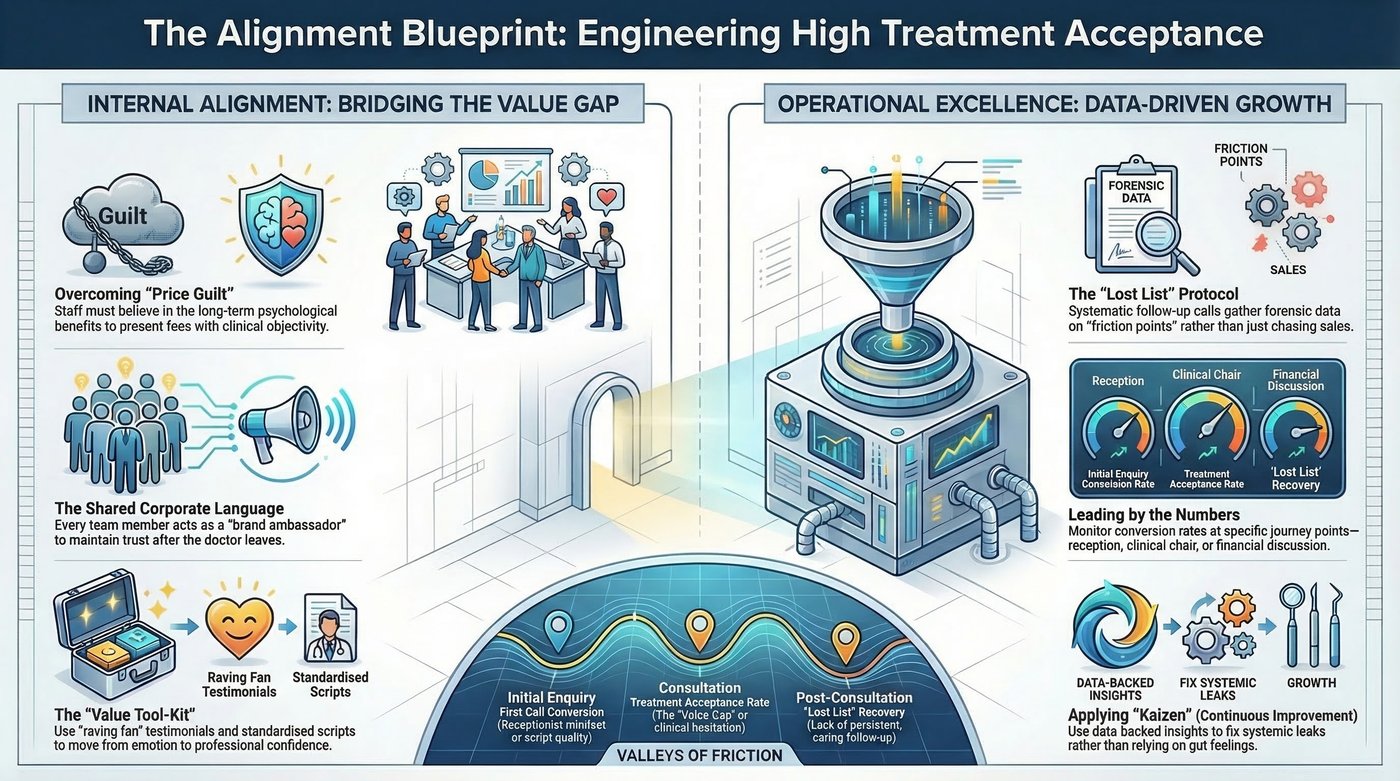
True orthodontic practice management is a team sport. While the doctor often initiates the clinical conversation, the ultimate success of a complex treatment plan often rests in the hands of the staff. Many clinic owners focus heavily on their own communication skills but neglect the “internal sales” required to align their team. If your staff does not believe in the value of the services you provide, they will unintentionally communicate that doubt to every patient they encounter.
Operational excellence requires that every team member understands the “why” behind the clinical recommendations. When a treatment coordinator or assistant is hesitant about a fee or a timeline, that hesitation manifests as a lack of confidence that patients detect instantly. To scale a practice effectively, leadership must bridge the gap between clinical expertise and team-wide conviction.
To achieve superior dental team performance, we must create a shared corporate language and an operational structure that supports the patient journey from the first phone call to the final follow-up. This involves moving beyond simple task management into a realm of cultural engineering where every interaction is optimized for trust.
Developing a Shared Corporate Language
Corporate identity is more than just matching uniforms or a sleek logo; it is about a unified mindset. Every member of your team—from the receptionist to the senior clinical assistant—must be a “brand ambassador.” This means they speak with a consistency that reinforces the doctor’s vision at every touchpoint of the patient experience.
When a team lacks a shared language, the patient receives mixed signals. The doctor might speak of “stability and long-term health,” while the front desk speaks only of “installments and insurance limits.” A shared language ensures that even financial discussions are framed within the context of the clinical value and the life-changing results the practice provides.
We often see a “leak” in practice efficiency when the doctor leaves the consultation room. The patient often turns to the assistant and asks, “What do you honestly think? Is it worth it?” This is a critical moment of truth. If the assistant has not been trained to understand the life-changing value of the treatment, or if they harbor the belief that the service is “too expensive,” their hesitation will destroy the trust the doctor just built.
Leadership means ensuring the team understands that we aren’t just selling braces or aligners; we are providing professional security and a guaranteed result. Training should focus on the “unspoken” consultation—the secondary conversation that happens at the chairside where the staff validates the doctor’s expertise. This alignment turns a clinical recommendation into a team-wide promise of excellence.
Bridging the Value Gap for Your Staff
A significant challenge in dental leadership is the socio-economic gap between the cost of treatment and the personal experience of the staff. For an employee, a six-thousand-euro treatment plan may seem like an astronomical sum. If they cannot personally fathom spending that amount, they may feel “guilty” when presenting the contract to a patient, leading to a defensive or apologetic tone.
This projection of personal financial values onto the patient is a common barrier to high-level acceptance. A patient who values their appearance and health may see 6,000 euros as a wise investment, but if the staff member presenting the plan views it as a “luxury,” they will struggle to close the case. Expanding the team’s perspective is a core leadership responsibility.
Part of your role as an entrepreneur is to help your team bridge this gap by shifting the focus from “cost” to “transformation.” When the team sees the treatment as a vehicle for a better life rather than a commodity, the price becomes secondary to the outcome. This is done through several strategic initiatives:
Education on Outcomes: Show them the long-term functional and psychological benefits. Use before-and-after photos not just to show straight teeth, but to discuss how that patient’s confidence or airway health improved, making the value tangible.
Reviewing Testimonials: Regularly share “raving fan” feedback during morning huddles. When the team hears a mother describe how her child stopped being bullied after treatment, the “cost” of the braces vanishes in the face of the emotional return on investment.
Standardized Scripts: Provide the “rules and the tools” so they can discuss fees with clinical objectivity. Scripts should not be robotic; they should provide a framework for handling objections with empathy and professional certainty, removing personal emotion from the transaction.
The Science of Follow-Up: Using “Lost Lists” for Growth
In a lean orthodontic practice, we do not leave follow-up to chance. Many administrative teams feel that calling a patient more than once is “pushy” or “desperate.” However, in any professional service industry, most contracts are finalized only after multiple points of contact. Silence from a patient is rarely a “no”; it is usually a “not right now” or “I forgot.”
Systematizing this process removes the emotional weight of the “sales call.” When follow-up is a standard operating procedure, the team views it as a customer service task rather than an attempt to sell. This mindset shift is essential for maintaining a healthy pipeline of new starts without the doctor having to micromanage every lead.
We utilize “Lost Lists”—systematic reports of patients who had a consultation but did not start treatment. This is not about harassment; it is about forensic data gathering. A professional follow-up call often reveals that the patient was simply busy, overwhelmed, or needed one more question answered by the doctor.
By documenting why patients drop out, you identify the “friction points” in your system. Perhaps the financial options are too rigid, or the initial exam feels too rushed. Applying Kaizen—continuous improvement—to your workflow based on this data ensures that your practice evolves. Every “no” is a lesson that makes the next “yes” easier to achieve.
Measuring Mindsets through Data and Statistics
To improve practice efficiency, you must move away from “leading by feel” and start leading by the numbers. Your statistics are a mirror of your team’s mindset. If the numbers are stagnating, it is usually a sign that the team’s energy or alignment has slipped. Data provides the objective truth needed for effective coaching.
When you present statistics to the team, frame them as a measure of how many lives you are impacting. A high conversion rate means the team is successfully helping more people access the care they need. This turns dry data into a motivational tool that aligns with the practice’s clinical mission.
Conversion Rates: If they are low, where exactly in the journey is the friction?
Drop-off Points: Is it at the reception desk, the financial discussion, or the clinical chair?
When you identify these “valleys” in your data, you can address the specific internal beliefs or training gaps causing them. True operational excellence is achieved when the entire team is synchronized, speaking the same professional language, and moving with the same confidence as the practice owner. This synchronization creates a “momentum of acceptance” where the patient feels swept up in a culture of certainty.
Conclusion: Engineering a Culture of Acceptance
High treatment acceptance is the result of a perfectly synchronized system. By aligning your team’s internal beliefs with your practice’s professional mission, you remove the barriers that prevent patients from saying “yes.” It requires constant vigilance, regular training, and a commitment to radical transparency regarding the practice’s goals and performance.
Do not let your practice plateau because of hidden hesitations about sales or value. Invest in your team’s development, systematize your follow-up, and lead with a focus on value. When your staff is empowered and the patient journey is clear, your practice becomes a high-output organization that thrives on excellence and trust. The result is a practice that not only grows financially but also serves its community with the highest level of care.