

Objective Value vs. Subjective Emotion: Navigating the Orthodontic Practice Sale
Published on: Jun 9, 2026
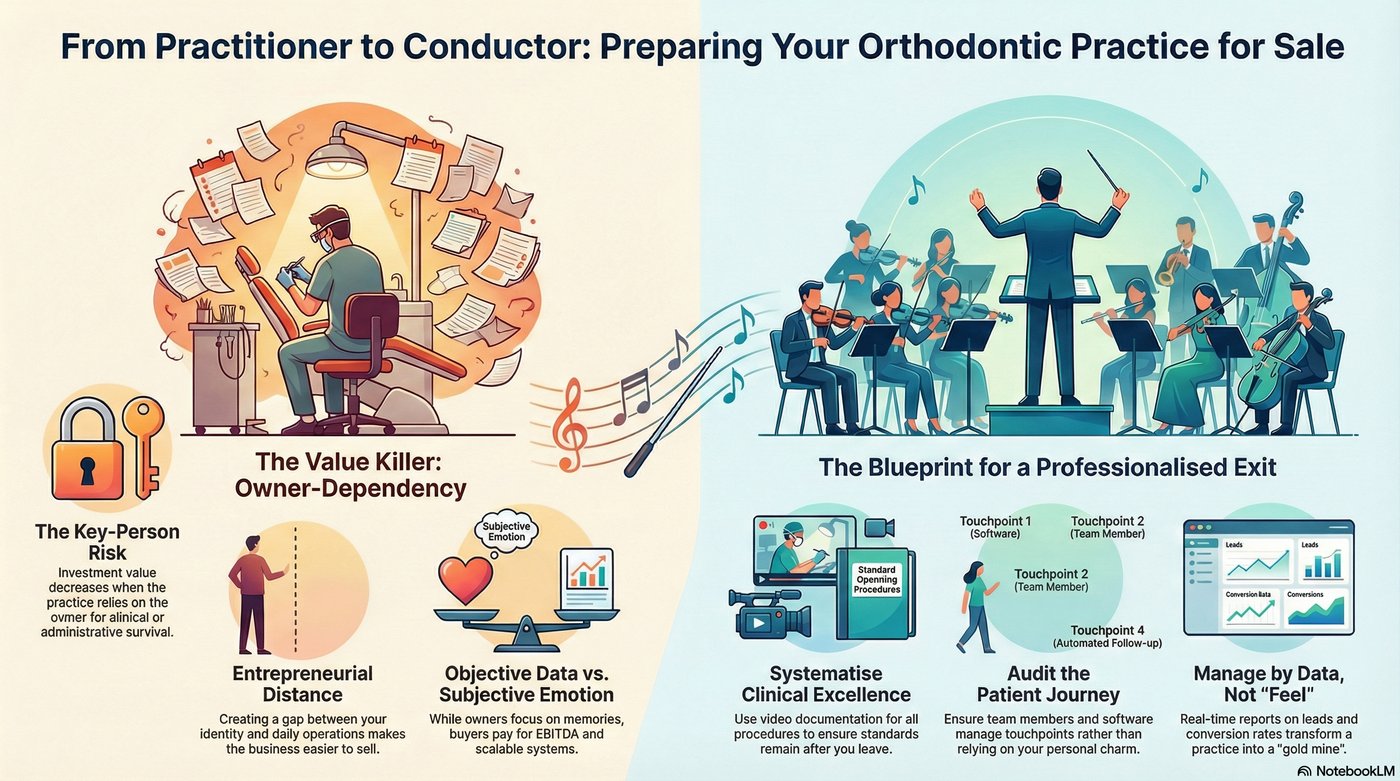
When it comes to handing over an orthodontic practice, there are two distinct dimensions: the objective data (the EBITDA, patient numbers, and equipment value) and the subjective emotion (the relationships, memories, and personal identity). While the accountant focuses on the former, it is almost always the latter that derails a successful handover.
The clinical and financial metrics are merely the baseline; the true friction emerges when personal identity is confused with enterprise value. A buyer performs due diligence on the books; the seller must perform self-due diligence on their readiness to exit. Many practitioners find their sense of self-worth is inextricably linked to their daily interactions with patients and staff, making a clean break psychologically difficult.
Mastering the “exit” requires a lean approach to your own professional identity. This means viewing the practice not as a personal creation, but as a robust, scalable business entity capable of running autonomously. By separating your personal worth from the daily operations of the clinic, you can build a business that is not only more profitable but also far easier to sell.
This emotional detachment is a critical leadership skill, signaling to potential buyers that the practice’s success is rooted in its processes, not just the founder’s presence. When a practice can demonstrate that its growth and patient satisfaction are products of a system rather than a single personality, it becomes a much more attractive and lower-risk acquisition for any buyer.
Moving Toward Entrepreneurial Distance
In Lean Orthodontics, we talk about the “Gemba”—the place where the work happens. To prepare for a sale, you must gradually step away from the Gemba. This transition is about transforming from a primary producer of clinical output into an executive orchestrator. If you are still the only person who knows how to handle a specific clinical complication or a difficult staff conversation, you have a “key-person risk”.
This risk significantly lowers the valuation multiplier, as the acquirer inherits a liability disguised as a practice strength. For example, if a buyer sees that the entire referral network relies solely on your personal Friday golf games rather than a structured professional outreach program, they will discount the value of those future leads significantly because that “system” walks out the door with you.
Investment value is inversely proportional to owner-dependency. Buyers are seeking predictability and minimized risk; a practice where all institutional knowledge resides in the owner’s head represents maximum risk. The more the practice needs you to survive, the less a buyer will pay for it. This dependency is often seen in clinical scheduling, where only the owner handles complex surgical cases, or in finance, where only the owner approves vendor payments.
By creating “entrepreneurial distance”—where you act as the conductor rather than the first violin—you prove to the buyer that the music will continue even after you put down the baton. This distance is created through delegation, documentation, and the empowerment of a mid-level leadership team. True entrepreneurial distance means the practice can generate predictable revenue even when the owner takes an extended leave.
Professionalizing the Structure
The financial security of the orthodontic profession is something many other entrepreneurs would envy. We operate in a stable, high-demand sector with strong recurring revenue potential. This stability should give us the confidence to invest heavily in the professionalization of our clinics. Professionalization transforms the practice from a collection of skilled individuals into a reliable, efficient machine.
Systematize Clinical Excellence: Use video documentation for every clinical procedure so your standards are preserved. This goes beyond basic protocol; it includes standardization of bracket placement, wire bending, and debonding procedures, creating an internal “orthodontic university” for new associates. This institutionalized knowledge ensures consistent patient outcomes, which is a prime factor for buyer confidence.
Audit the Patient Journey: Ensure the “touchpoints” are managed by the team and software, not just your personal charm. The patient’s experience, from initial inquiry to retention, should be mapped and automated using CRM technology. For instance, the conversion rate should not rely on a compelling personal sales pitch, but on a repeatable, data-backed onboarding process executed flawlessly by the treatment coordinator.
Data Transparency: Have clear, real-time reports on your leads, conversion rates, and clinical efficiency. A transparent data dashboard provides undeniable proof of the practice’s health. This includes metrics like case acceptance rates, treatment completion times, staff retention, and the cost per new patient acquisition. These reports must be readily available and easily interpreted by a third-party financial analyst.
A practice that is managed by “feel”—relying on instinct and personal memory for scheduling, staffing, and clinical decisions—is difficult to value. A practice managed by “data,” where every process is quantified, documented, and repeatable, is a gold mine. Data professionalization removes subjective judgment from the valuation process, leading to significantly higher offers from sophisticated buyers.
The Succession Strategy: Options for the Future
A well-prepared practice gives the owner more options, which is the ultimate goal of any entrepreneur. Preparation shifts the dynamic from desperation to negotiation, allowing the seller to dictate terms rather than accept the first offer. When your systems are in place, you are no longer forced to sell to the first bidder out of exhaustion. The strategic options available are diverse.
The Transition Period: You can stay on as a mentor, gradually handing over the clinical reins. This option is often favored by owners who want a phased exit and wish to ensure their patients and team are in capable hands. Financially, it can provide continued, steady income and often maximizes the purchase price by stabilizing the practice post-acquisition. The risk lies in the emotional difficulty of relinquishing control.
The Investor Path: You can sell to a group (DSO) while maintaining a minor stake or a consulting role. This path offers immediate liquidity and leverages the financial resources of a large organization for growth and back-office support. The owner retains a financial interest in the practice’s continued success, converting a labor-intensive asset into a passive investment. This requires accepting a shift in operational culture.
The “Hobby” Transition: You can reduce your hours to focus only on the clinical cases you love, while the systems manage the business. This is the ideal scenario for the orthodontist who remains passionate about clinical work but is fatigued by the administrative burdens of ownership. The new owner manages the overhead and marketing, while the original owner becomes a high-value, specialized part-time clinician.
Conclusion: Protecting Your Life’s Work
Your practice is the culmination of your life’s work. It represents decades of skill, relationship building, and financial sacrifice. To treat it with the respect it deserves, you must prepare it for its life without you. This preparation is the final, most impactful project of your career, requiring the same discipline you used to build it. By focusing on reduction—reducing complexity and owner-dependency—you build a sustainable legacy.
The blueprint for a successful exit is defined by control and foresight. Don’t wait until you are burnt out and faced with an urgent deadline to think about your exit. Start building the “blueprint” of your success today, recognizing that an exit strategy is simply an optimal operational strategy. When you approach the transition with a mindset of systemization, you ensure the process is a professional triumph.
A well-executed sale locks in your financial future and confirms your status as a successful business leader, not just a gifted clinician. By turning your practice into a turnkey operation, you provide the next generation of orthodontists with a firm foundation upon which to build, ensuring that your standard of care and your commitment to the community continue long after you have moved on to your next chapter.