

Navigating the Digital Legal Trap: Compliance and Precision in the Modern Clinic
Published on: Jun 27, 2026
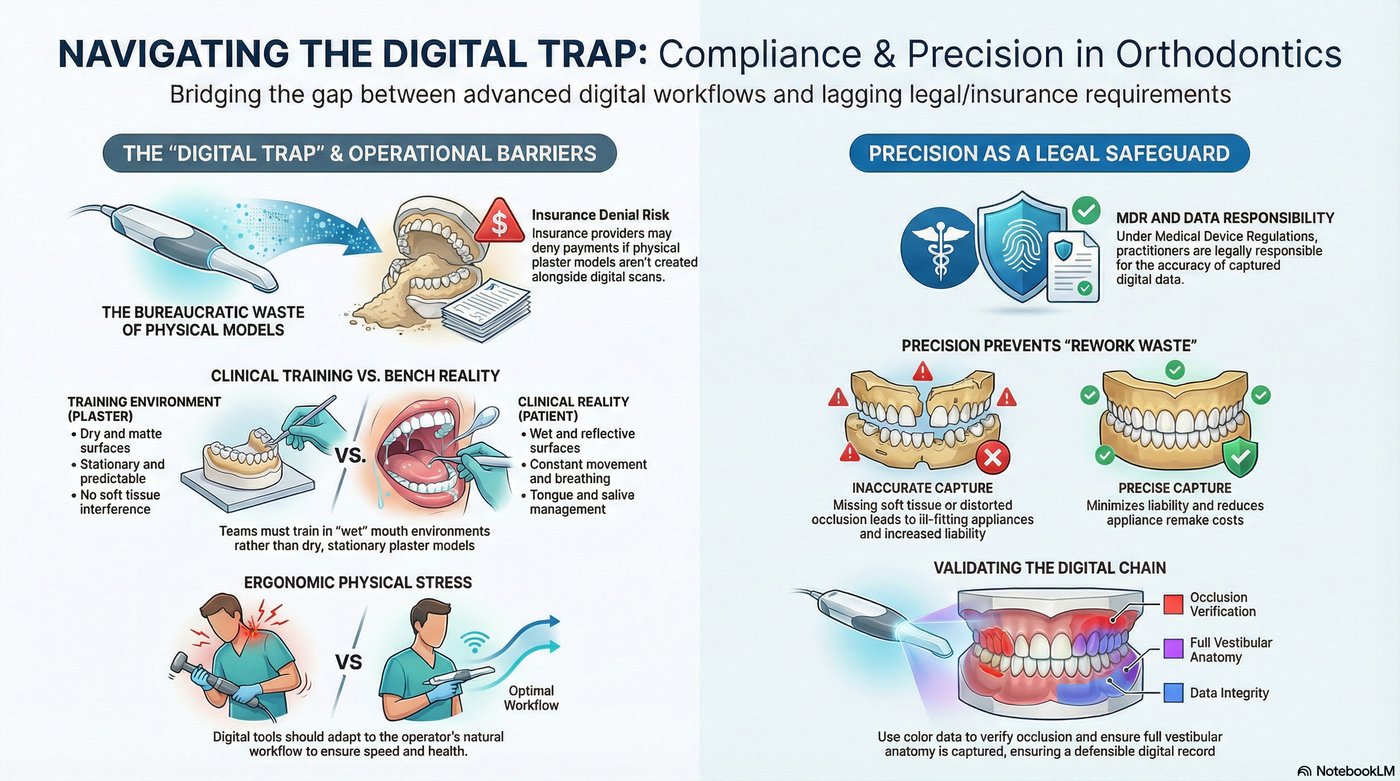
As orthodontic practice owners, we are currently living in a “technological gap.” While our clinical capabilities allow us to be 100% digital, the legal and regulatory frameworks—particularly regarding insurance billing and expert reviews—have not always kept pace. This creates a dangerous landscape where a clinic can be technically advanced but legally vulnerable.
Navigating the digital impression revolution requires more than just clinical skill; it requires a leadership mindset that protects the practice from bureaucratic waste and retroactive payment denials. We must ensure that our transition to digital is not just efficient, but also legally defensible.
The Bureaucratic Waste of Physical Models
In many jurisdictions, specifically under rigorous systems like those in Germany, there remains a demand for “physical models” for certain billing procedures or expert evaluations. We are seeing a rise in cases where insurance companies refuse payment because a physical plaster model was not created at the time of the impression, despite the existence of a high-precision 3D scan.
This is a classic example of “system waste.” As lean practitioners, we must protect our clinics. Until the law fully recognizes the digital file as the primary record, leaders must be strategic. This may involve maintaining a hybrid workflow for specific insurance cases or securing explicit agreements with payers. You must be loud about the accuracy of your high-tech work to ensure it is valued and reimbursed correctly.
Training for Reality: From Plaster to the Patient
A significant barrier to digital efficiency is improper training. Many teams attempt to learn scanning by practicing on dry, matte, and stationary plaster models. This is a false environment. The reality of the patient journey involves a mouth that is wet, reflective, and constantly moving.
Proficiency in scanning is a clinical skill, not a bench skill. Your team must be trained to manage “the fight” against the tongue, saliva pooling, and the patient’s breathing. Furthermore, ergonomics play a vital role in long-term efficiency. If a scanner forces you into a physical position that is contrary to your natural workflow, it becomes a source of physical stress. A lean clinic chooses tools that adapt to the operator, ensuring that the technology facilitates speed rather than hindering it.
The Liability of Data Quality: Why “Good Enough” Isn’t Enough
With the introduction of regulations like the Medical Device Regulation (MDR), the legal responsibility for the data we capture is higher than ever. If your scan is inaccurate—missing crucial soft tissue or distorting the occlusion—the resulting appliance or aligner will not fit. This leads to the ultimate form of waste: rework.
A “lean” digital workflow is one that is validated and verified. By utilizing color data to check occlusion and ensuring your team captures the full vestibular anatomy, you reduce the risk of clinical errors that lead to liability. Precision in the digital scan is the foundation of the entire digital treatment chain.
Conclusion: Lead the Revolution, Don’t Follow It
The digital impression revolution is an opportunity to transform your practice into a high-speed, high-precision environment. However, this transformation requires a leader who understands the intersection of data, law, and workflow.
By eliminating messy powders, bypassing redundant model scanning, and staying ahead of legal requirements, you position your practice at the forefront of the industry. Do not let your scanner become an expensive paperweight; make it the centerpiece of a lean, legally secure, and highly profitable digital ecosystem.