

Maximizing Practice Efficiency: Why Lean Orthodontics is the Key to Reclaiming Your Passion
Published on: Jul 6, 2026
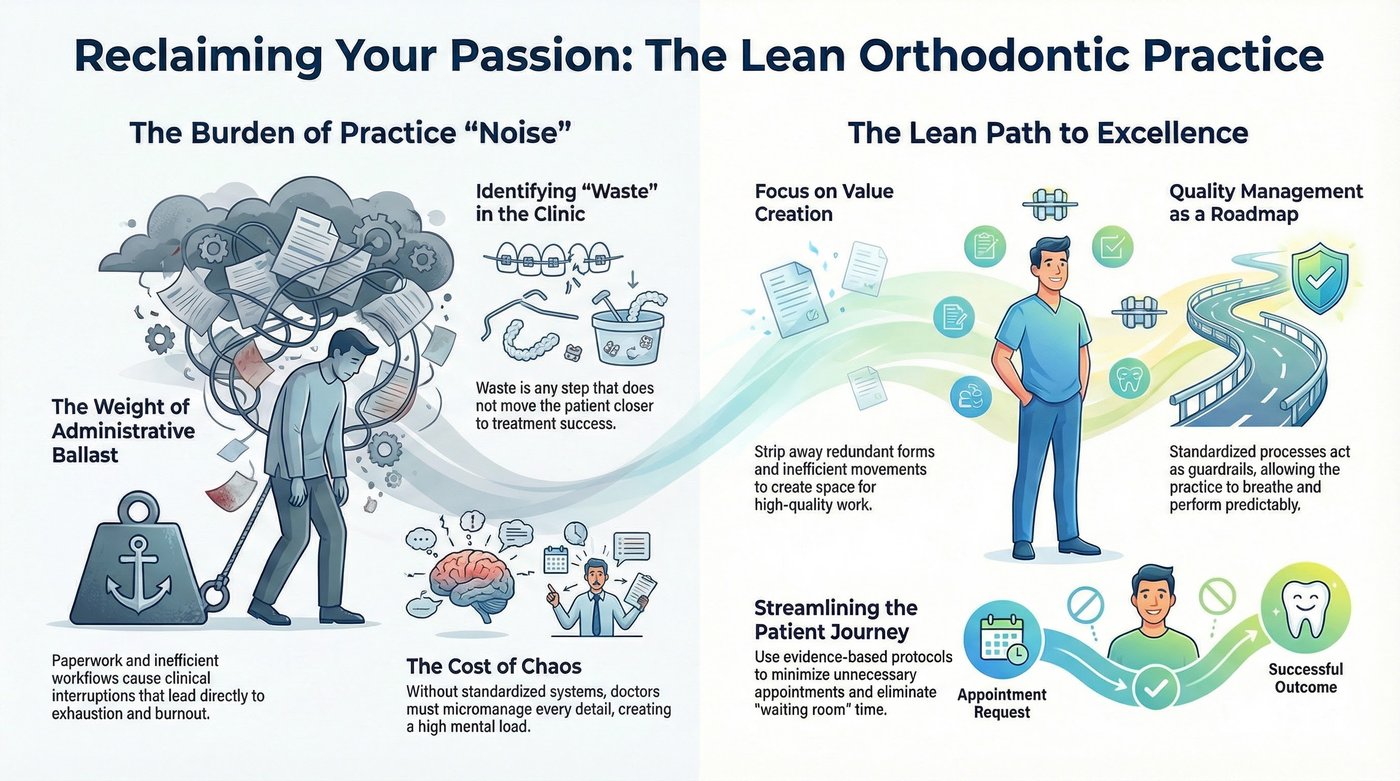
The Weight of the Modern Orthodontic Practice
Many orthodontists today start their careers with a deep passion for the craft, only to find themselves years later feeling the heavy burden of daily operations. We entered this profession to transform smiles and improve lives, yet the reality often involves being buried under a mountain of administrative ballast. When the weight of paperwork, inefficient workflows, and constant clinical interruptions becomes too much, it leads directly to exhaustion and, eventually, burnout.
The problem isn’t the orthodontics itself; it is the “noise” surrounding the clinical work. This noise is what we call waste in lean thinking. To move forward, we must ask ourselves how we can strip away the unnecessary and refocus on the essential tasks that make our profession the most beautiful in the world.
Defining Lean Management in Dentistry
The term “lean” is often misunderstood as simply cutting costs or doing more with less. In the context of orthodontic practice management, lean thinking is about making our clinical and administrative work significantly more efficient by concentrating on value creation. Every action we take in the clinic should serve a single purpose: moving the patient closer to a successful treatment outcome with maximum satisfaction.
If a step in your workflow does not add value to the patient journey in orthodontics, it is ballast. By identifying these non-value-adding steps—whether they are redundant forms, unnecessary double-checks, or inefficient chairside movements—we create space. This space allows for higher-quality work and a much more enjoyable daily life for both the practitioner and the team.
Rethinking Quality Management as a Strategic Asset
For many clinic owners, quality management is viewed as a “horror ghost”—a set of rigid rules and endless documentation that slows everyone down. However, when viewed through a lean lens, a robust quality management system is the very structure that allows a practice to breathe.
Instead of a burden, think of it as a roadmap. When every process is standardized and optimized, the mental load on the doctor is reduced. You no longer have to micromanage every detail because the system provides the guardrails. This structural way of working ensures that high performance becomes a predictable outcome rather than a result of constant, exhausting effort.
Streamlining the Patient Journey for Maximum Impact
Practice efficiency is built on the foundation of repetition and precision. In a lean practice, we look at the entire patient journey from the first consultation to the final retainer check. By looking at various treatment alternatives and staying updated with the latest clinical studies, we can identify the most direct and efficient path for every patient.
This isn’t about rushing treatments; it’s about eliminating the “waiting room” time within the biology of tooth movement. When we use evidence-based protocols to minimize unnecessary appointments, we increase the value for the patient while simultaneously reducing the operational stress on the clinic. This persistence in refining the process transforms a chaotic, reactive environment into a calm, proactive one.
Finding Fulfillment Through Efficient Excellence
True fun at work can only arise when we are doing high-quality, efficient work that we can be proud of. There is no joy in a practice that feels like a series of fires needing to be extinguished. By adopting lean management in dentistry, you are not just optimizing a business; you are protecting your passion for orthodontics.
Stripping away the ballast allows you to excel in what you were actually trained to do. It shifts the focus from surviving the day to thriving in your craft. As you remove the friction from your daily life, you find that the profession becomes a source of pride and fulfillment once again.
Conclusion: A Proactive Path Forward
The transition to a lean practice is a journey from chaos to structure. It requires a dedicated look at your current situation and a clear definition of your desired end result. By focusing on value creation and systemic efficiency, you can ensure that your practice remains a high-performing environment that supports your well-being rather than draining it. Start looking at your daily tasks today: if it doesn’t add value, it’s time to let it go.