

Mastery Through Reality: Role-Playing and Undercover Checks in Orthodontics
Published on: Jul 2, 2026
Training for the “Real World”
In orthodontic practice management, we often invest thousands in 3D scanners and digital workflows, yet we frequently neglect the most critical interface: the human conversation between your team and the patient.
Every interaction, from the initial phone inquiry to the final debrief consultation, is a touchpoint that either builds trust or creates friction. The way your team communicates determines your practice’s ultimate conversion rate and long-term reputation.
To elevate dental team performance, leadership must move beyond passive verbal instructions. True mastery requires active training and simulated environments where mistakes carry no clinical or financial risk.
While role-playing may initially feel uncomfortable for staff, it is the most effective tool for refining scripts and mastering standard operating procedures. It ensures practice efficiency remains high even during high-stress clinic days.
The Power of the Recorded Role-Play
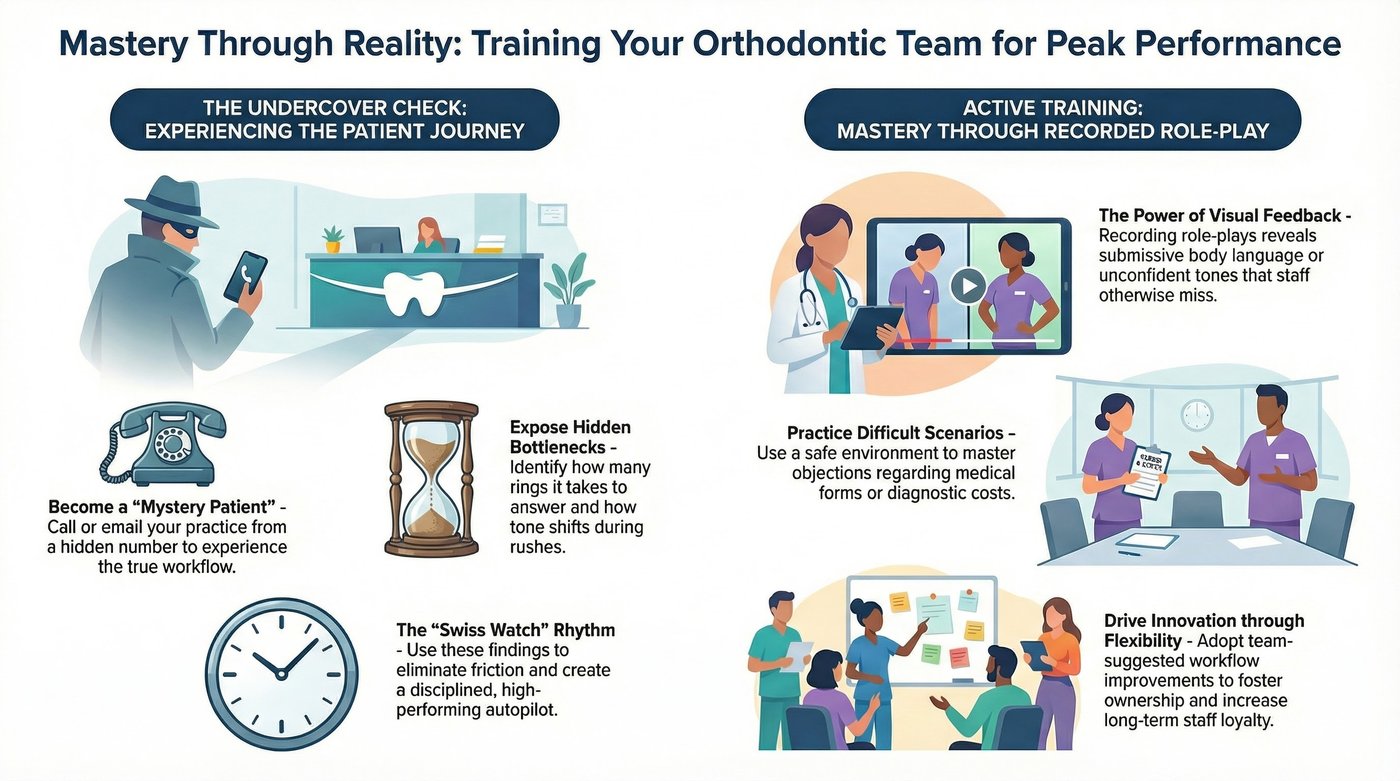
Ask your team to simulate high-stakes scenarios: a patient reacting poorly to a financial contract or a parent hesitant about the necessity of early Phase I treatment. These are the moments where cases are won or lost.
Practice the “LATTE” method (Listen, Acknowledge, Take action, Thank, Explain) to de-escalate concerns. Use these sessions to practice explaining the biomechanical value of specific bracket systems or clear aligner brands without sounding like a salesperson.
Recording these role-plays on video provides a transformative “aha” moment. Staff often don’t realize when their body language appears defensive or if they are using too much clinical jargon that confuses the layperson.
Reviewing the footage together allows for objective feedback on tone and confidence. This visual data is the fastest way to shorten the learning curve, ensuring your team’s presentation aligns perfectly with your practice’s premium brand identity.
The Undercover Check: Experiencing the Patient Journey
If you ask your staff how they handle phone calls, they will describe the ideal version of their workflow. However, to understand the true patient journey in orthodontics, you must step into the patient’s shoes.
Theoretical standards often crumble under the weight of a busy Monday morning. An undercover check reveals the gap between what is supposed to happen and what actually occurs when your attention is focused elsewhere.
Try calling your office from a private number during a peak period. Observe how many rings it takes to answer, the warmth of the greeting, and whether you are placed on hold for an unreasonable amount of time.
Submit a “Contact Us” form under a pseudonym to track response times. These checks expose hidden bottlenecks and operational fatigue that your team might be too busy—or too intimidated—to report to you directly.
Flexibility as a Leadership Tool
A truly lean leader avoids becoming a rigid dictator. If your team identifies a more efficient way to handle a task during training or observation, listen to their reasoning. The best ideas often come from those on the front lines.
Flexibility is a sign of leadership strength, not weakness. If a modified chairside workflow or a new digital tool produces consistent, high-quality results more quickly, adopt it immediately as the updated office standard.
By encouraging innovation, you foster a culture of ownership rather than mere compliance. When the team sees their ideas implemented, their commitment to the practice’s success deepens significantly.
This collaborative approach builds the “Swiss watch” rhythm every doctor desires. It transforms employees into stakeholders who are personally invested in the practice’s growth and the satisfaction of every patient who walks through the door.
Conclusion: Building a Disciplined Autopilot
Consistency in orthodontic care is never a product of chance; it is the result of disciplined observation and relentless training. A practice that prioritizes these reality checks builds a resilient, self-correcting culture.
By combining Gemba walks with active role-playing, you create a professional “autopilot” system. This empowers your team to manage daily operations with excellence, giving you the freedom to focus on clinical mastery and your personal life.