

Mastery Through Monotony: Embracing the “Boring” Path to Excellence
Published on: Jun 28, 2026
The Bruce Lee Principle of Orthodontics
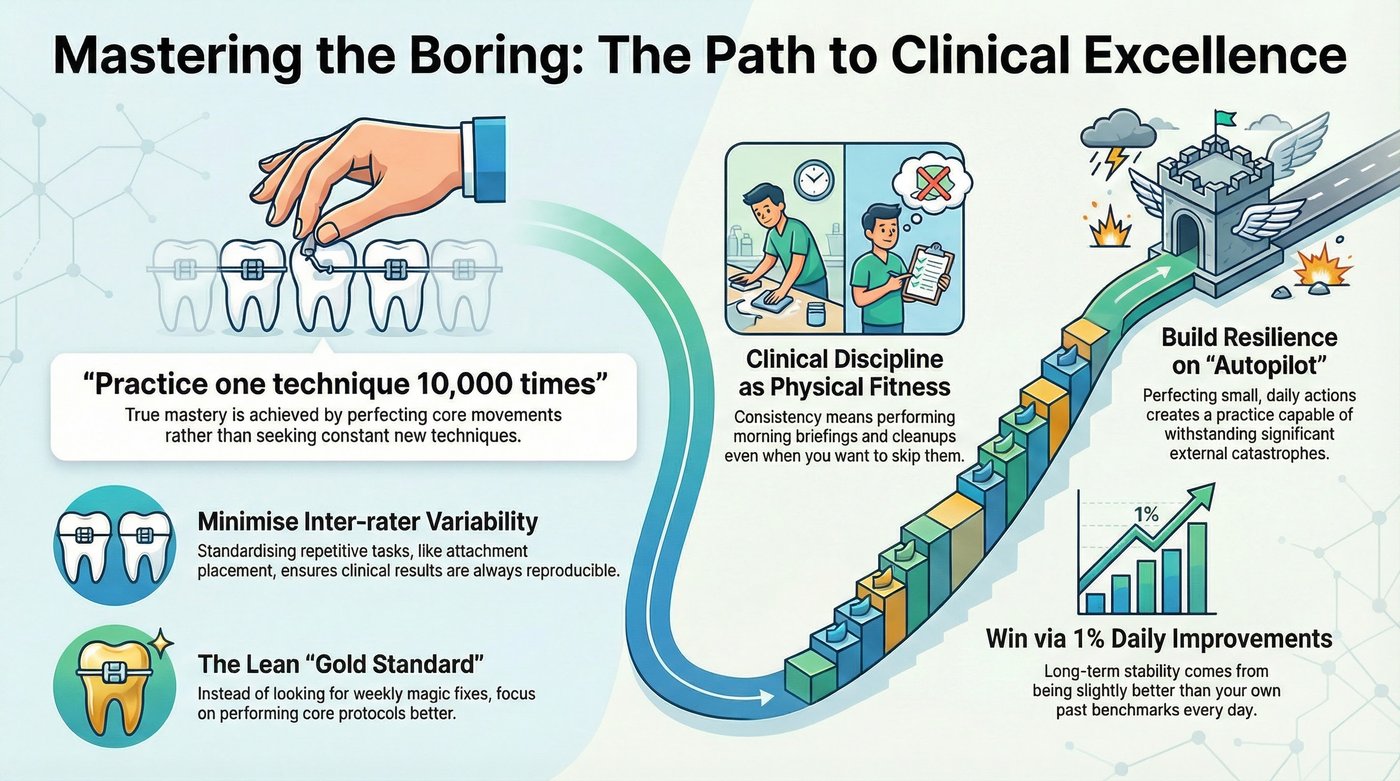
Bruce Lee famously said he did not fear the man who practiced ten thousand techniques, but the man who practiced one technique ten thousand times. Our clinical work can sometimes feel repetitive or even boring, but in a lean practice, we embrace that repetition as the path to mastery.
This repetition is the foundation for predictable and superior patient outcomes. When a procedure becomes instinctual, the mind is freed to focus on the nuances of the individual case, rather than the mechanical steps of the process. This cognitive freedom is where true clinical excellence resides.
Whether it is the 5-second model analysis or the standardized placement of an attachment, we do it over and over until it is optimized. This extends to every procedural step, from the sterile instrument tray setup to the precise documentation of patient progress notes.
This repetition reduces inter-rater variability across your entire clinical team, meaning that a patient receives the same high standard of care regardless of which assistant or associate is supporting the treatment.
Reduced variability is directly correlated with fewer errors, fewer reworks, and ultimately, faster, more efficient case completion. In orthodontic practice management, we don’t look for “magic” new techniques every week.
We look for ways to perform our core “Gold Standards” even better. The real innovation lies in systematically eliminating wasted movement and unnecessary decision-making from high-volume tasks. Standardization transforms a complex operation into a predictable system.
The continuous refinement of a single, reliable technique is far more profitable than the distraction of chasing every new gadget or fad. Practices that operate on established, proven protocols experience higher staff retention and clearer training pathways.
Discipline: From the Gym to the Clinic
The discipline required for a lean practice is identical to the discipline required for physical fitness. We recognize that clinical and operational excellence is achieved not through inspiration, but through schedule adherence and intentional action.
There are days when the weather is bad and you want to skip the gym—just as there are days you want to skip the morning briefing or the end-of-day cleanup. This is where leadership separates successful clinics from mediocre ones by relentlessly enforcing SOPs.
Consistency means doing it anyway. It means performing the daily financial reconciliation when you are tired, or meticulously managing inventory to prevent costly emergency orders. These unglamorous tasks are the operational bedrock of a high-performing practice.
Just as the body sees results during the recovery phase after a consistent workout, the practice sees results in its long-term stability and practice efficiency. This resilience allows the practice to handle unforeseen challenges without compromising flow.
When you make tiny, 1% improvements every single day, you are winning. These marginal gains compound quickly; a simple refinement to the scheduling template that saves three minutes per appointment can reclaim hours of chair time over a month.
This commitment to marginal improvement is the silent engine of growth. Practice leaders must model this consistency. If the clinic owner bypasses a checklist, the team quickly learns that “standard” is optional. Discipline starts at the top and must be non-negotiable.
The Never-Ending Game of Quality
Quality management is not about being bad today and perfect tomorrow. It is about an unwavering persistence to be slightly better than you were yesterday. It requires treating every patient interaction as a data point for system improvement.
We don’t compare our team members to each other; we compare our current performance to our own past benchmarks. Implementing KPIs for clinical processes—like treatment completion time or debond quality—provides objective metrics for continuous refinement.
This data-driven approach removes emotion from performance reviews and focuses all efforts on process enhancement, fostering a culture of accountability and shared ownership. The goal is to elevate the collective standard, not single out individual faults.
This is the hardest part of the job because it never ends. The market, technology, and patient expectations are constantly shifting, demanding a practice that is always learning. Complacency is the primary threat to long-term success.
Even after the clinic closes, the work of refining the next book, the next training, or the next clinical protocol continues. This dedication to systemic growth ensures that your standard of care remains state-of-the-art and robust against competition.
That is the level of consistency required to stay at the top of the field and put your practice on a reliable autopilot. Autopilot means the critical functions of the business run smoothly, freeing up leadership for strategic innovation and growth.
Conclusion: The Long-Term Reward
Consistency is the ultimate “lean” strategy. It builds trust with your patients, who rely on the predictability of their care experience. It cultivates loyalty in your team, who value working within a clear, high-standard system that reduces stress.
Furthermore, consistency builds profound resilience in your business. By doing the small things perfectly every day—from sterilizing instruments to tracking conversion rates—you create a practice that can withstand any “big catastrophe” that comes your way.
The seemingly “boring” pursuit of perfected fundamentals is, in fact, the most dynamic and future-proof strategy available to dental leaders. It is the steady hand that guides a high-growth practice through turbulent times.
Start tomorrow morning with a commitment to one small, consistent action—perhaps implementing a mandatory daily five-minute huddle. Watch the cumulative power of that discipline transform your professional life into a streamlined enterprise.