

Mastering the Motives: Precision Communication in Modern Dentistry
Published on: Jun 28, 2026
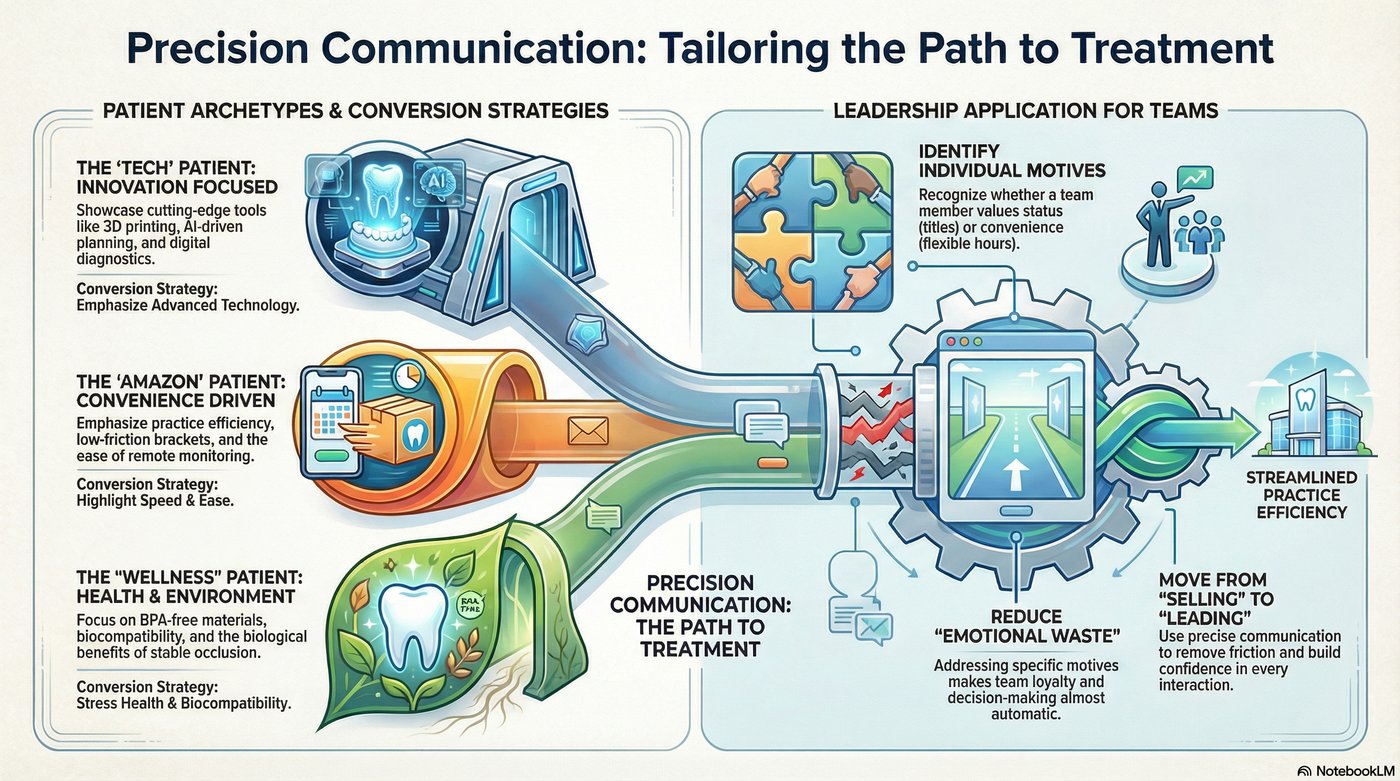
By aligning clinical expertise with patient psychology, practices can transform consultations into effortless pathways for treatment acceptance.
In the rapidly evolving landscape of modern dentistry, clinical excellence is only half of the equation for a successful practice. The other half lies in understanding the complex psychological drivers that lead a patient to say “yes.” Moving beyond generic marketing and standard clinical descriptions requires a tailored approach—one that recognizes the unique internal value systems of different patient archetypes.
This post explores how to identify and engage with specific patient motives, turning the consultation process from a hurdle into a seamless, trust-building experience that benefits both the patient journey and the overall practice culture.
The Innovators: Engaging the “Tech” Patient
These are the early adopters. They love the “Elon Musk” style of innovation and are drawn to the latest 3D printing and digital diagnostic tools. They view dental treatment not as a necessity but as an opportunity to engage with high-level engineering and precision science. This cohort often conducts extensive research, not just on outcomes, but on the proprietary mechanics of the systems used in the practice.
To engage this patient, a practice must move beyond simple descriptions of results and speak directly to the technical process. Highlight the clinical value of your CBCT by emphasizing its role in reducing treatment time through superior visualization and data. Detail how intraoral scanners eliminate the discomfort of traditional impressions while boosting accuracy for the ultimate clinical outcome.
For the “Tech” patient, the discussion should center on measurable improvements in clinical workflow and algorithmic sophistication. This approach validates their research and establishes the clinician as an equally sophisticated expert in modern dental technology.
Their decision to move forward is often an affirmation of the technology itself, viewing the investment as access to the highest standard.
The Strategy: Showcase your cutting-edge technology. Show them the 3D scan and talk about the “nerdy” details of the AI-driven planning. Their “yes” is triggered by the excitement of being at the forefront of the future.
The Efficient Choice: Serving the “Convenience” Patient
Influenced by brands like Amazon, these patients want results with minimal effort. They prioritize systems that respect their time. They see efficiency as the ultimate luxury and are highly attracted to treatments that require fewer visits or offer remote monitoring. This demographic is often comprised of busy executives, parents managing complex schedules, or entrepreneurs whose time is their most valuable asset.
The clinical strategy for the “Amazon” patient must be framed around a return on their significant time investment. Instead of focusing solely on the aesthetic outcome, emphasize how your choice of appliance translates into longer intervals between appointments. This is where remote monitoring tools become indispensable, offering psychological comfort without the logistical friction of a physical visit. Practices can highlight expedited processes, such as same-day start appointments, as tangible proof of their commitment to convenience.
For them, the perception of “seamlessness” in the patient journey is just as important as the clinical dental result.
The Strategy: Emphasize practice efficiency. Highlight the comfort of your “low-friction” brackets or the convenience of remote check-ups. For them, the best treatment is the one that fits seamlessly into their busy life.
The Holistic Path: Connecting with the “Wellness” Patient
This group focuses on biocompatibility and holistic health. Their interest extends beyond localized dental issues to systemic relationships. They look at the relationship between oral health, sleep, breathing, and overall well-being. They want a healthy body and planet. They frequently seek information on materials, sourcing, and the long-term impact of dental interventions on their biology.
The clinical consultation for the “Wellness” patient requires shifting the narrative from cosmetic enhancement to structural health. Discussing stable occlusion as a prerequisite for reducing chronic headache tension or minimizing wear and tear is critical. When presenting materials, focus on certifications, inert properties, and efforts the practice makes toward true sustainability. They would rather have a recyclable steel bracket than a plastic one. Practices can leverage this by offering airway treatments.
Presenting these services as comprehensive health interventions rather than just orthodontic procedures will resonate with their values.
The Strategy: Talk about recycled packaging, BPA-free materials, and the biological health benefits of a stable occlusion. They value the systemic approach.
Internal Alignment: Applying Psychological Motives to Team Leadership
These seven motives aren’t just for patients; they are vital for dental team performance. To lead, you must know what drives each individual. Effective leadership requires the same level of diagnostic precision applied to employee motivation as to patient care. Misaligning a staff member’s core motive with their assigned role inevitably leads to burnout and high practice turnover. Consider your team members through these same motivational lenses. Does your lead assistant value Status and training roles? Or does your receptionist value Convenience through flexible hours or a shorter commute, and a highly structured schedule? If an assistant driven by Curiosity is relegated to purely routine tasks, their productivity and tenure will suffer.
Conversely, a team member driven by Health may be the ideal champion for developing your infection control protocols. When you identify the right motive and address it, the decision-making process—and team loyalty—becomes almost automatic. By observing subtle signals—how they spend time or what they volunteer for—you reduce the “emotional waste” of the practice.
This strategic alignment of personality and role transforms management into true, experience-driven leadership and clinical success.
Conclusion: From Conversion to Congruency
By recognizing these seven patterns, you move from “selling” to “leading.” This framework allows clinicians to stop broadcasting generic benefits. Start speaking directly to the core psychological triggers of the individual in front of you to build immediate trust. You remove the friction from the consultation and provide the patient with exactly what they need to feel confident.
The ultimate goal is not just conversion, but congruency. A practice that masters motive-based communication ensures resonance. Every treatment recommendation must align with the patient’s internal value system, leading to higher case acceptance and compliance. This is the hallmark of a practice on autopilot: a system where every interaction is calibrated for long-term trust.
Generating powerful, authentic referrals becomes natural. When you understand the underlying ‘why,’ the ‘yes’ becomes an effortless extension.