

Mastering the Art of Delegation: Building a Lean Team for Strategic Success
Published on: Jun 12, 2026
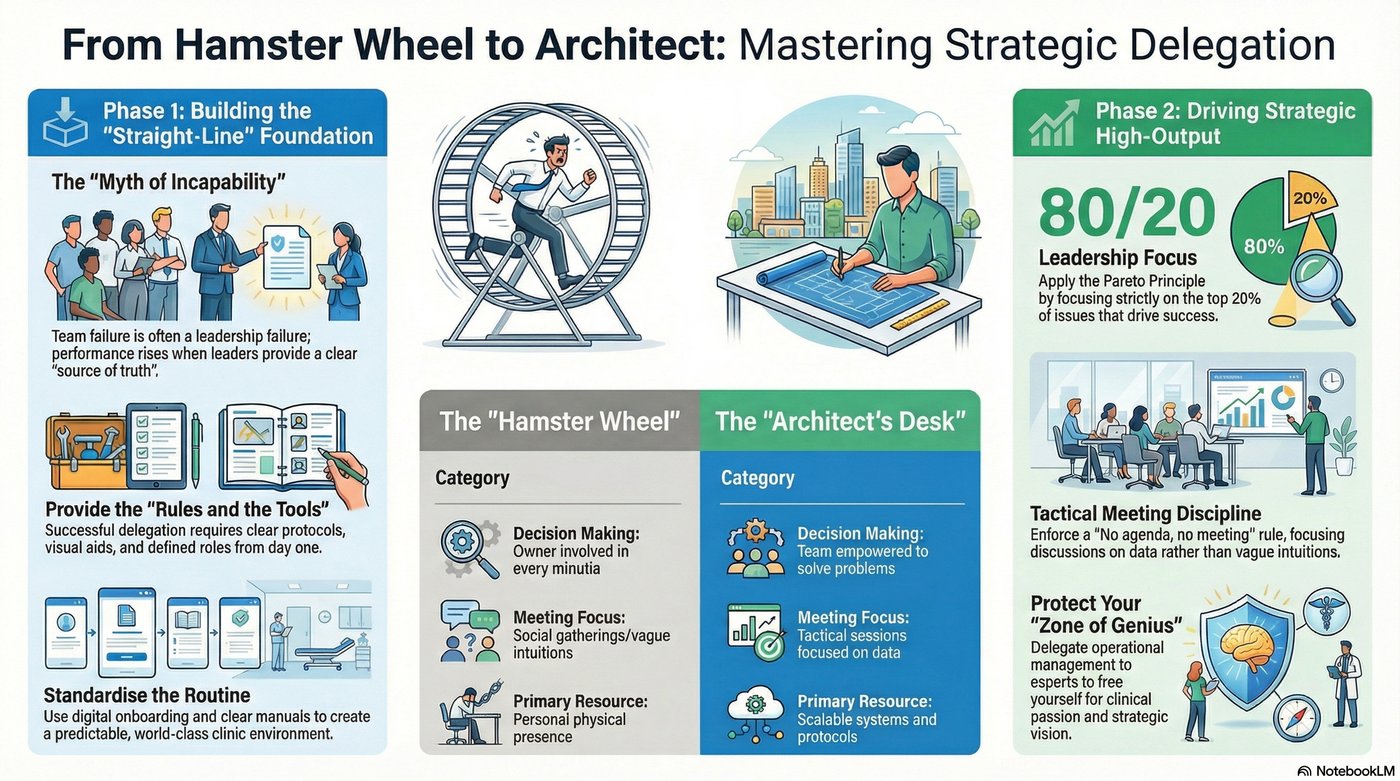
One of the most common reasons orthodontic practices plateau is a failure of delegation. Many practice owners feel trapped in the daily minutiae, convinced that if they aren’t personally involved in every decision, the quality of care will suffer. This lack of trust creates a massive bottleneck, stifling practice efficiency and leading to owner burnout.
To transition from a “dentist with a job” to a “practice owner with a business,” you must master the mechanics of delegation. This is not about simply dumping tasks on your staff; it is about creating a structured onboarding and communication system that empowers your team to perform at an expert level.
Effective leadership demands a shift in perspective: from doer to system designer. The practice owner’s job is to build the machine, not be the engine. By holding onto low-value tasks, you cap your capacity for growth and undermine your strategic role.
The Myth of the “Incapable” Team
When a leader says, “My staff isn’t smart enough to handle this,” they are actually making a statement about their own leadership. If your team is struggling, you must ask two questions:
Why did I hire them?
Why haven’t I built a system to train them?
Effective delegation requires a “Straight-Line” onboarding structure. You cannot hand over a responsibility and expect success without providing the “rules and the tools.” A lean leader provides clear protocols, visual aids, and a source of truth that employees can refer to. When roles are defined from day one, your team’s performance will almost always rise to meet your expectations.
For example, documenting a clear protocol for insurance verification with a step-by-step checklist eliminates guesswork. These documented Standard Operating Procedures (SOPs) ensure process fidelity across all shifts. When Key Performance Indicators (KPIs) are attached to roles, the team is empowered to achieve measurable results.
Meeting Discipline: Protecting Your Highest-Value Resource
Time is the only non-renewable resource in your practice. To protect it, you must implement strict meeting discipline. In an efficient practice, meetings are not social gatherings; they are tactical sessions focused on data.
A key rule for any high-performing leader is: No agenda, no meeting.
Preparedness: Every item must be on a list before the session starts.
Focus: Discussions must center on statistics, survey results, and analyzed reports rather than vague intuitions.
Efficiency: By focusing strictly on the “Top 20%” of issues, you ensure that your time—and your manager’s time—is used to move the practice forward, not just to talk about it.
This discipline transforms meetings into powerful strategic assets rather than operational liabilities. Tactical sessions should be short, typically under 20 minutes, and focus solely on solving specific, data-driven problems. They must enforce accountability for measurable outcomes.
Moving Toward Strategic Vision
The ultimate goal of delegation is to free the entrepreneur to focus on their unique talents. Whether you are an introvert who loves clinical analysis or an extrovert who thrives on networking, you must spend the majority of your time in your “zone of genius.”
If you find that you suffer through the daily decision-making of business management, the lean solution is to build a structure where an external manager handles the operations while you focus on your clinical passion. There is no shame in acknowledging that you are a clinician first and an entrepreneur second—but you must build the structure that allows you to succeed in that role.
Stop confusing busyness with productivity. Your highest-value activities involve high-level negotiations, advanced treatment planning, and business development—tasks only you can perform. Delegating operational management is an investment in your mental health and the practice’s long-term sustainability.
Trusting the System to Drive Output
When you delegate successfully, you are essentially “buying back” your life. You create a practice that can function—and even grow—without your constant physical presence at every chair. This predictability is the hallmark of a world-class clinic.
True trust should be placed in the established system, not merely the individual. When the system is robust, any competent, well-trained team member can execute the required functions flawlessly. This resilience protects the practice from employee turnover and unexpected absences.
Standardize the routine: Use digital onboarding and clear manuals.
Monitor the metrics: Trust the data, not just your “gut feeling.”
Empower the experts: Give your team the authority to solve problems within their roles.
Conclusion: Leading a High-Output Organization
By applying the Pareto Principle to your leadership and your team, you stop wasting energy on things you are mediocre at and start focusing on the few actions that truly drive success. Trust your team, trust your systems, and move from the hamster wheel to the architect’s desk. The result is a practice that delivers elite clinical results with significantly less stress and effort.
Masterful delegation is the blueprint for a thriving, high-output dental organization. By prioritizing structure over personal involvement, you ensure your legacy is built on leveraged success and lasting scalability.