

Master the Machine: Why Expert Intelligence Must Drive Aligner AI
Published on: Jun 27, 2026
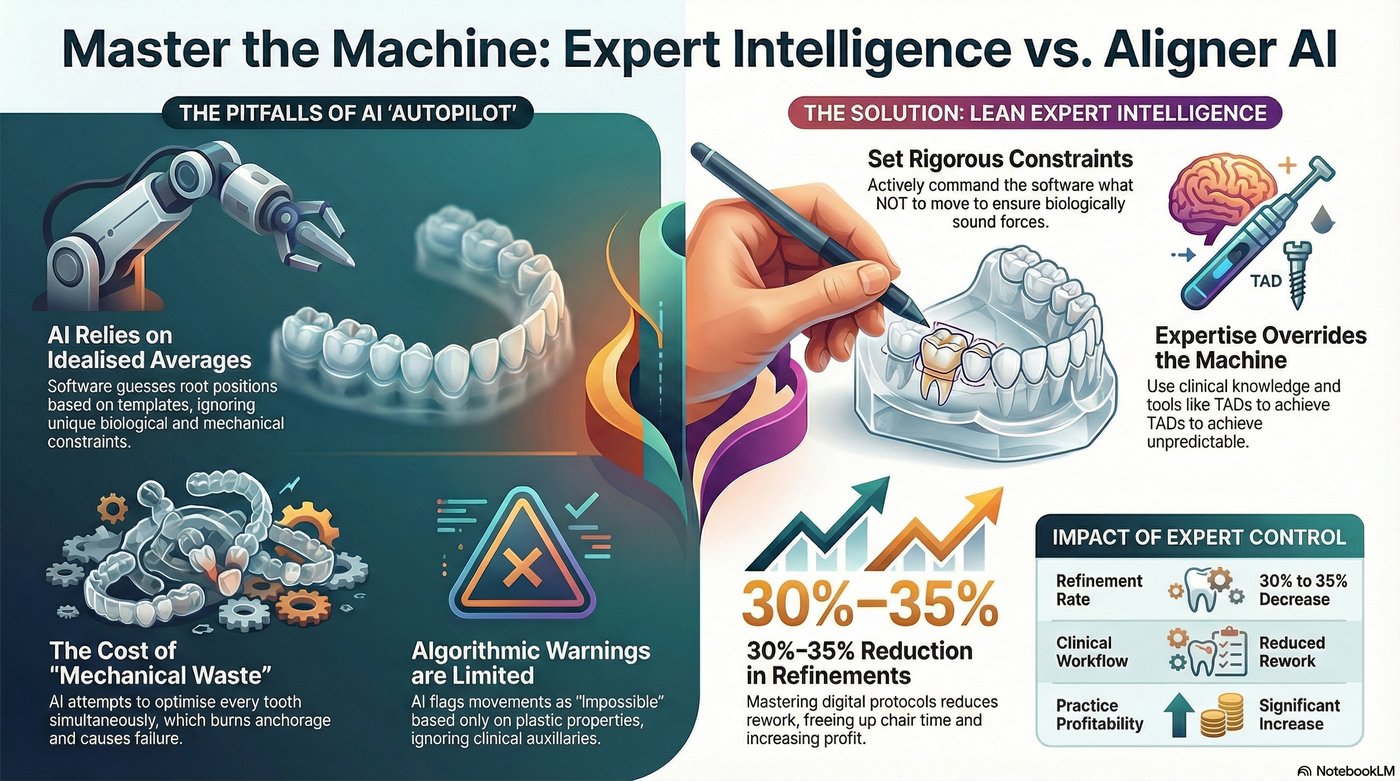
In the current era of digital orthodontics, “Artificial Intelligence” has become the ultimate industry buzzword. We are frequently told that algorithms, backed by data from millions of successfully treated patients, are now capable of moving teeth with superhuman precision. While the technology is undeniably impressive, it presents a significant strategic risk to the lean orthodontist. The danger lies in the gap between “artificial intelligence” and “expert intelligence.”
As a practice leader, you must recognize that the software operates on averages and idealized blueprints. It scans a clinical crown, guesses the root position, and attempts to reach a theoretical “perfect” finish. However, the algorithm does not understand the unique biological and mechanical constraints of your specific patient. To achieve predictable, high-quality results, you must stop being a passenger in your digital workflow and start acting as the disciplined driver of the machine.
The Pitfall of the “Autopilot” Treatment Plan
The fundamental problem with AI-driven aligner software is its desire to idealize everything simultaneously. If you allow the software to run on autopilot, it will attempt to optimize torque, tip, and rotation on every single tooth in the arch. From a lean management perspective, this is “mechanical waste.”
Consider a deep bite case with significant anterior crowding. The clinical priority is intrusion and resolution of the crowding. However, the algorithm might decide to apply several degrees of mesial root torque to the molars simply because that matches an idealized template. In reality, you need those posterior teeth to remain rock-solid anchors. By letting the AI “idealize” your anchor teeth, you inadvertently burn your anchorage, leading to unpredictable movements and clinical failure.
Setting Constraints: The Lean Way to Predictability
In lean orthodontics, efficiency is gained by doing only what is necessary to achieve the desired outcome. This means you must actively tell the software what not to do. Instead of accepting the initial proposal, a master clinician sets rigorous constraints. You must command the system: “Do not move the molars. Do not expand the arch in this quadrant.”
By limiting the movements to the essential corrections, you increase the predictability of the treatment. You are not just accepting a destination; you are defining the most efficient route to get there. This reduces the mechanical load on the aligners and ensures that the forces being applied are biologically sound. When you treat the software as a tool rather than a guru, you minimize the “noise” in your treatment plan and maximize the “signal” of effective tooth movement.
Clinical Expertise vs. Algorithmic Warnings
Artificial intelligence is programmed with conservative thresholds. For example, if a treatment plan calls for more than one millimeter of posterior intrusion, the software will often flag this with a “black dot” warning, labeling it as an unpredictable or impossible movement. The AI says “no” because it can only calculate based on the aligner’s plastic properties.
This is where your leadership and clinical expertise override the machine. You know that by integrating auxiliary tools—such as micro-implants (TADs) or external elastics—you can achieve movements that the software deems impossible. You understand the biology of bone remodeling that the algorithm ignores. A lean orthodontist uses the software to visualize the final position but relies on their own expertise to engineer the mechanics required to get there.
Reducing Refinements: The Economic Impact of Control
Taking full control of your aligner planning is not just about clinical pride; it is a massive driver of practice profitability. Internal data consistently shows that orthodontists who master digital protocols and set active constraints reduce their refinement rates by 30% to 35%.
In the lean practice model, a refinement is a form of “rework”—a waste of clinical time, materials, and patient goodwill. By reducing refinements, you free up chair time, decrease your overhead, and increase patient satisfaction. Mastering the AI is the key to a smoother, faster, and significantly more profitable digital workflow
Conclusion: Driving the Future of Digital Orthodontics
Ultimately, the success of digital orthodontics depends on the clinician’s ability to transition from a passive passenger to a disciplined driver of the machine. While AI offers powerful data-driven insights, it cannot replace the expert intelligence required to navigate complex biological and mechanical realities. By actively setting constraints, eliminating mechanical waste, and overriding algorithmic warnings with seasoned clinical judgment, the lean orthodontist ensures superior predictability and efficiency. Embracing this level of control not only elevates the standard of care but also serves as a critical driver of practice profitability in the modern era.