

Master of the Moment: Why Every Touchpoint is a Leadership Decision
Published on: Jun 13, 2026
In the world of high-performance orthodontics, many practitioners focus exclusively on the “main event”—the clinical procedure. This is a common leadership blind spot. While technical precision is the price of entry, it is rarely the metric by which a patient judges their experience.
The patient’s perception of your value is actually formed during the dozens of smaller interactions that happen before, between, and after the chair time. These are the “touchpoints.” From the first Google search to the final retainer check, each moment serves as a silent testimonial to your clinical standards.
As a leader, you must recognize that if you do not consciously design these interactions, you are leaving your practice’s reputation to chance. If a patient waits ten minutes past their appointment time without an explanation, your clinical excellence is immediately devalued in their mind.
Masterful orthodontic practice management requires moving from being a passive observer to becoming the active architect of the patient journey. Every touchpoint is an opportunity to either build trust or erode it. When you control the narrative of the journey, you control the perceived value of the outcome.
The Danger of the “Expectation Gap”
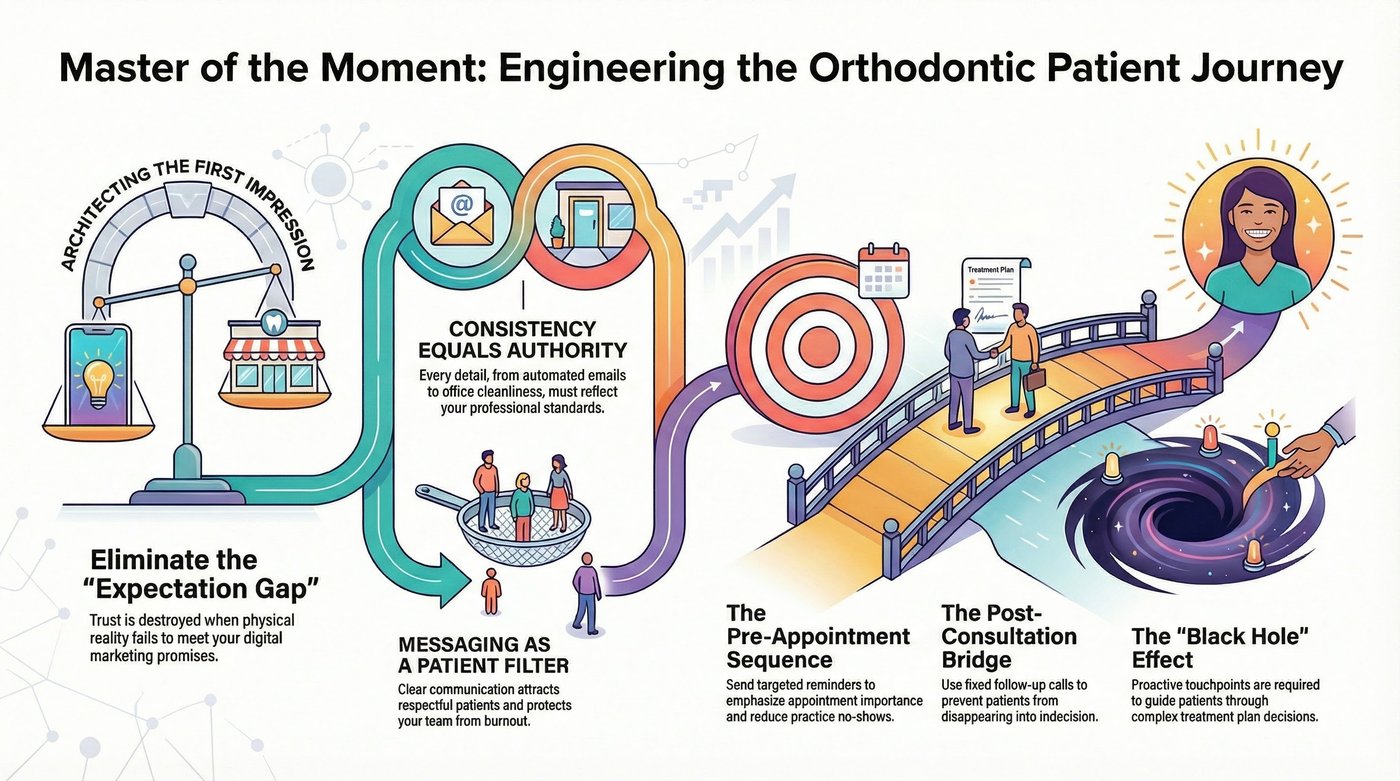
The patient journey often begins with a digital touchpoint: your website or social media presence. This is where most practices make their first leadership mistake—overpromising. In an era of highly curated digital content, it is easy to build a persona that the physical office cannot support.
If your marketing displays a high-tech, futuristic oasis with a glowing team, but the physical reality involves an outdated waiting room and a receptionist who doesn’t look up from their phone, you have created a catastrophic “expectation gap.” This gap triggers immediate buyer’s remorse and skepticism.
Trust is destroyed the moment the physical reality fails to meet the digital promise. Strategic dental leadership involves ensuring alignment. Your online presence should be a window into your office, not a mask for it. Authenticity is a powerful differentiator in a competitive market.
If you promote excellence, every touchpoint—from the cleanliness of the front door to the tone of your automated emails—must reflect that standard. Consistency is the foundation of professional authority. A leader’s job is to audit these transitions to ensure the promise and the delivery are identical.
Strategic Interventions: Closing the “Black Hole”
Many patients drop out of the journey after the treatment plan presentation. They are handed a complex cost plan, bombarded with clinical jargon, and then disappear into a “black hole” of indecision. This is rarely due to a lack of need; it is a failure of journey design.
Patients often stall because they feel overwhelmed by the financial commitment or the duration of the procedure. Without a structured follow-up, the urgency created during the consultation evaporates within 48 hours. Strategic leaders recognize this period as the most fragile part of the conversion funnel.
To increase treatment acceptance and practice efficiency, you must insert proactive touchpoints. Do not wait for the patient to call you; in their mind, that is a sales activity. Instead, design a follow-up system that adds value and clarity, moving the relationship from transactional to consultative.
The Pre-Appointment Sequence: Send targeted reminders a week and a day before high-value appointments to emphasize their importance and reduce no-shows.
The Post-Consultation Bridge: Schedule a fixed follow-up call or “Q&A” appointment specifically to address lingering concerns.
By guiding the patient through these decision points, you demonstrate that you are not just a provider but a partner in their transformation. Each contact should solve a problem. Whether it is clarifying insurance benefits or sharing a video testimonial, you are actively removing the friction that prevents them from saying “yes.”
Using Touchpoints to Protect Your Team
Touchpoints are not just for the patient; they are also a filter for the practice. Your dental team’s performance depends on the quality of the patients they serve. If you run a high-end practice but fail to communicate your values at the initial touchpoints, you will attract “C-level” patients.
These are the patients who demand the lowest prices, frequently miss appointments, and treat your staff poorly. Leadership means using your touchpoints as a gatekeeper; by clearly articulating your brand’s “Why,” you repel those who aren’t a fit and attract those who value your expertise.
Use your communication channels to set the tone early. Clearly state your standards for care, punctuality, and mutual respect. This isn’t about being exclusionary; it is about protecting your culture. When your messaging aligns with your operations, the resulting patient base is one that supports your team.
When you attract the right patients through clear touchpoint messaging, you protect your best employees from burnout. A harmonious work environment is only possible when the leader takes responsibility for the quality of the interactions entering the practice ecosystem.
Conclusion: Designing the Seamless Journey
Leadership is about intentionality. By mapping every point of contact and applying the Kano model—ensuring basic needs are met, and excitement is created—you transform your practice into a streamlined, high-value brand. Every email, every greeting, and every follow-up is a leadership decision that dictates your growth.
Stop letting the patient experience happen “to” you. Start engineering the journey you want your patients to have. When the journey is seamless, the clinical outcome becomes the natural conclusion of a world-class experience rather than an isolated event.
In conclusion, the modern orthodontic leader must be as skilled in experience design as they are in clinical mechanics. By mastering the moment, you don’t just build straighter smiles; you build a resilient, profitable practice that patients are proud to champion. The journey is the treatment.