

Linguistic Waste: Removing the “Deadly Terms” That Stall Practice Momentum
Published on: Jul 2, 2026
The Psychology of Language in Leadership
In an orthodontic practice, energy is a finite resource. We often focus on physical waste—wasted materials or wasted chair time—but we frequently overlook “linguistic waste.” The words and phrases your team uses daily can either act as a catalyst for practice efficiency or as a “black hole” that drains motivation and professional momentum.
Linguistic waste is the unseen overhead that leads to “employee waste,” where talent is wasted on repetitive or non-value-adding tasks. When your team constantly uses passive or uncertain language, it indicates a deep-seated failure in system documentation and process clarity. It creates unnecessary friction, forcing the doctor or manager to clarify vague instructions, which contributes to the “switching cost” that kills clinical productivity.
As a leader and entrepreneur, you must recognize that your team’s vocabulary is a direct reflection of your practice culture. This shared language is the foundation of high-level treatment acceptance and operational excellence. To move toward a state of operational excellence, you must identify and eliminate the “deadly terms” that signal powerlessness and stagnation.
By replacing these phrases with solution-oriented language, you transform your communication into a superpower that drives the practice forward. This is the difference between a reactive practice—one that is always “putting out fires”—and a lean practice that is engineered for proactive success and sustained professional joy.
The Illusion of “I Hope So”
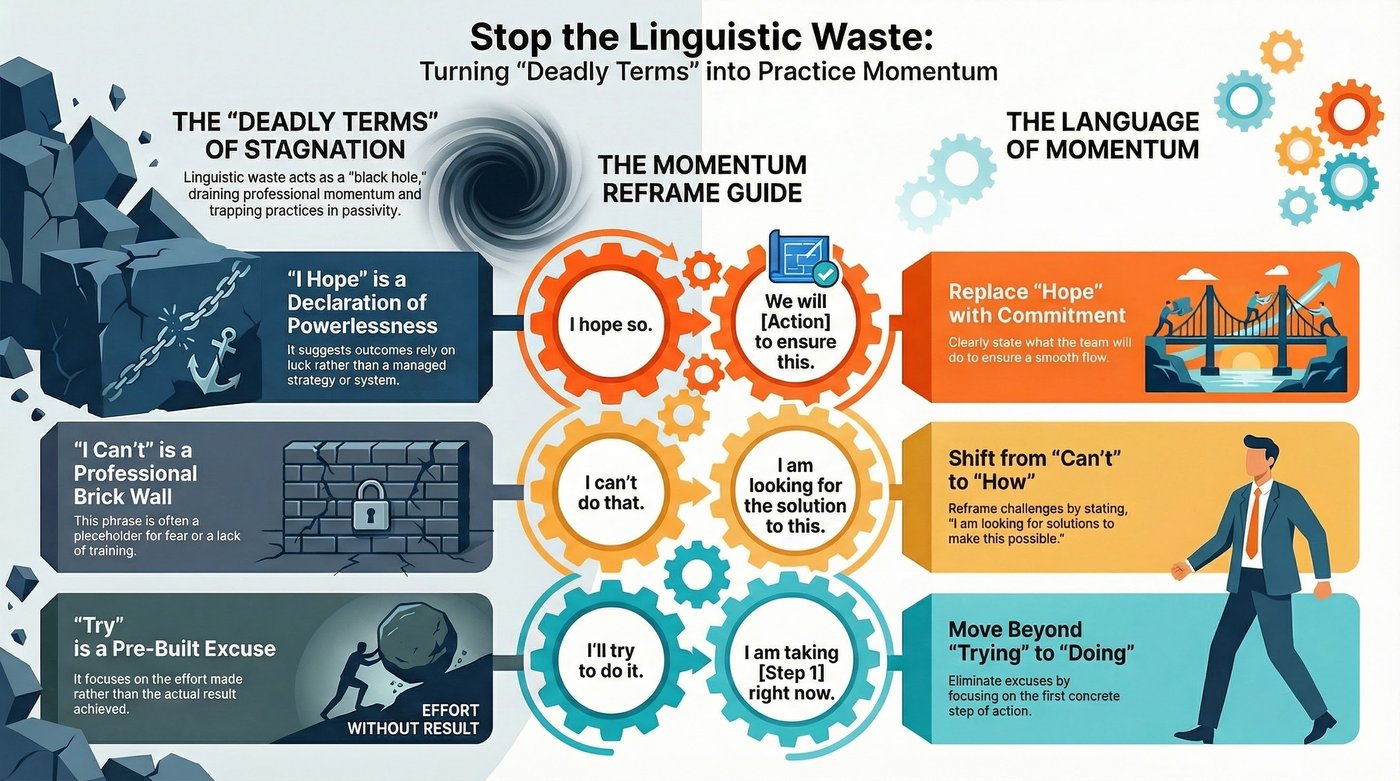
On the surface, “I hope so” sounds positive. We hope the patients are on time; we hope the afternoon won’t be stressful. However, in lean orthodontics, hope is not a strategy. It is a declaration of powerlessness that suggests the outcome is entirely in the hands of external factors or luck.
A high-performing practice must move away from ad hoc, situational decision-making to a codified system of predictable pathways. When a staff member relies on hope, they are effectively resigning from their responsibility to manage the system. Hope externalizes the results, removing the team’s internal locus of control and preventing them from proactively solving potential problems.
To improve dental team performance, replace “I hope” with a commitment to action and definitive protocols. Instead of hoping the schedule stays on track, the team should state what they will do to ensure a smooth flow, such as pre-staging all necessary trays or proactively confirming complex patient appointments. This commitment transforms vague intent into a measurable goal.
This shift requires leaders to institute “if-then” logic, where a standard problem triggers a standard, documented solution. For example, instead of hoping a patient shows up for a records appointment, the administrative team should state, “If the patient has not confirmed, we will call and confirm the diagnostic appointment at 9:00 AM”. This simple shift puts the control back into the hands of the professionals, moving the practice from a passive state to an active, proactive environment.
The Brick Wall of “I Can’t”
“I can’t” is the ultimate finality. It acts as a brick wall that stops professional development in its tracks. In many cases, “I can’t” is simply a placeholder for “I haven’t learned how yet” or “I am afraid to try.” It is a limiting belief that ignores the reality of clinical and administrative growth.
In a growth-focused environment, “I can’t” creates a dependency trap, crippling team initiative and making the leader an unnecessary bottleneck. If the doctor is the only one who can solve a complex problem—like a difficult insurance verification or a minor appliance adjustment—the practice cannot function without their constant intervention. This dependency severely limits the practice’s scalability and increases personal stress.
The response to “I can’t” should never be punishment but immediate calibration and coaching. When a colleague claims they cannot perform a specific task—whether it’s a complex digital scan or a difficult patient negotiation—encourage them to rephrase: “I am looking for the solutions to make this possible.”
This keeps the door open for targeted training and ensures the patient journey in orthodontics is never hindered by a lack of team confidence. Furthermore, this challenge forces the team to articulate the why behind their limitation, exposing a gap in training or a missing standard operating procedure (SOP) that the leader must immediately address. True delegation is only possible when tasks are standardized, removing ambiguity and the necessity for the phrase “I can’t.”
Action Over “Trying”
The word “try” is often a pre-built excuse for failure. It suggests that effort was made, even if the result was not achieved. In a high-performing practice, we move beyond trying and focus on doing. Action is the only way to move past the stagnation of “trying.”
Vague commands like “Try to organize the clinical cabinet this afternoon” invite poor results and require wasteful rework. Precision protocols are required to replace “trying.” Instead, the instruction must define the desired outcome and the required metric for success before the task is assigned. For example: “The clinical cabinet must be organized according to the new SOP by 5:00 PM today, and a photo of the final result must be uploaded to the knowledge portfolio.”
When you hear “I’ll try my best,” the correct leadership response is to press for definiteness. Ask the team member to explain the task in their own words, and then describe the first three concrete actions they will take. This calibration eliminates the “waste of rework” and forces them to solidify their commitment to action.
This discipline of immediate action fosters momentum and creates psychological closure for the team, helping them clear mental clutter throughout the day. Whether it is implementing the Baxmann Keys for quality assurance or organizing a clinical cabinet, the focus should always be on the first concrete step. This systematic focus on doing allows the team to operate in a high-performance flow state, where errors are actively prevented, and quality is consistent.
Conclusion: Creating a Culture of Ownership
Language is the foundation of your practice’s “autopilot” system. By eliminating “I hope,” “I can’t,” and “I try,” you foster a culture of discipline and ownership. This linguistic refinement ensures that your team remains high-performing even during the busiest rushes, allowing you to lead with calm confidence and professional pride.
This level of responsibility is the ultimate goal of effective practice management. When your team is empowered to own the conversion rate or the efficiency of a clinical room, their professional satisfaction and engagement skyrocket. They move from passively following tasks to actively managing outcomes.
A self-managed leader takes failure as data for the next iteration, and this same ethos must be instilled in the team. The practice must move from a model where the doctor constantly intervenes to one where the team is empowered to solve issues using structured systems and solution-oriented language. This strategic shift transforms the practice owner from a perpetual firefighter into an architect of sustainable excellence, ensuring longevity and consistent operational excellence.