

Lean Orthodontics: Streamlining the Patient Journey for Operational Excellence
Published on: Jun 16, 2026
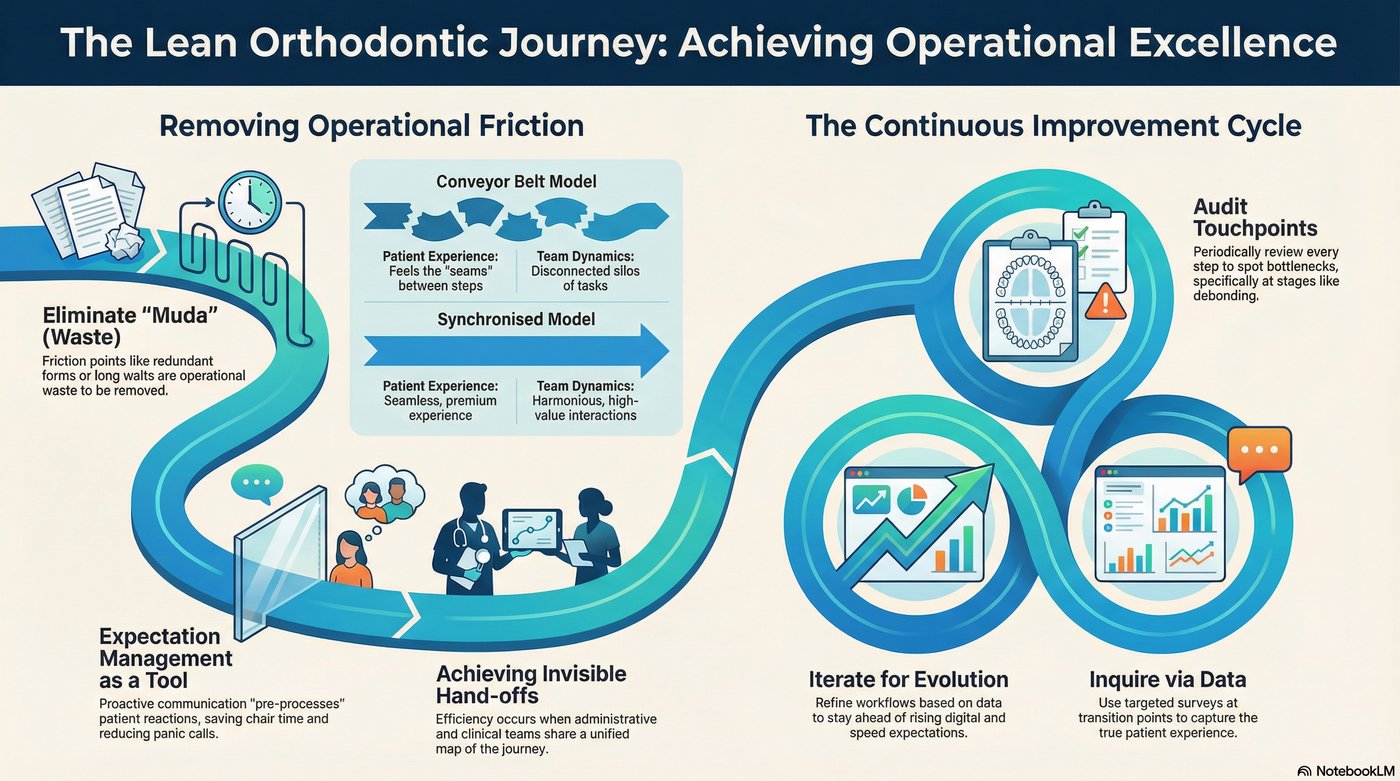
In the pursuit of practice efficiency, many clinic owners find themselves trapped in a paradox: they implement more systems, hire more staff, and buy more technology, yet the practice feels more chaotic than ever. The missing link is often a failure to apply lean management in dentistry to the most critical aspect of the business—the patient journey.
The “patient journey in orthodontics” is not a marketing concept; it is an operational workflow. Every unnecessary form, every redundant question, and every confusing transition is “waste” in the lean sense. To achieve true operational excellence, we must strip away the friction and focus on delivering maximum value with minimum frustration.
Eliminating Friction: The Lean Approach to Touchpoints
In lean management, we look for “muda” or waste. In a clinical setting, waste often manifests as “friction touchpoints.” If a patient has to provide the same information three times, or if they wait twenty minutes for a five-minute check-up, the journey is failing.
A high-performing practice owner evaluates every step of the process with a critical eye. Does this touchpoint add value to the patient, or is it just there because “that’s how we’ve always done it”? Sometimes, improving the journey actually means removing steps. A simpler, more direct path to the result is always superior to a complex, multi-layered process. By streamlining the workflow, you improve dental team performance and allow your staff to focus on high-value patient interactions rather than administrative hurdles.
Expectation Management as a Workflow Tool
One of the most significant causes of “clogged” workflows is the dissatisfied patient who requires extra chair time for reassurance or complaints. Often, this dissatisfaction stems from a mismatch between expectations and reality.
From an operational perspective, honesty is a tool for efficiency. When we are upfront about the realities of orthodontic treatment—the discomfort, the dietary changes, the time commitment—we “pre-process” the patient’s psychological response. A patient who expects a “bump in the road” doesn’t call the office in a panic when it happens. This proactive communication reduces the burden on your front desk and clinical staff, allowing the practice to run like a well-oiled machine.
Data-Driven Evolution of the Practice Journey
You cannot manage what you do not measure. A hallmark of modern orthodontic practice management is the regular, data-driven review of the patient experience. The world is changing rapidly; patient expectations regarding digital interaction, speed, and safety are higher than ever before.
To stay ahead, leaders must implement a cycle of continuous improvement:
Audit: Review your journey touchpoints every few months.
Inquire: Use specific surveys to ask patients about their experience at key transition points (e.g., the transition from consultation to active treatment).
Iterate: Use that data to refine the process.
This isn’t a “one and done” task. It is a living process that ensures your clinic remains relevant and efficient. If the data shows a bottleneck at the debonding stage, that is where your leadership focus must go.
From “Conveyor Belt” to Synchronized Experience
The “conveyor belt” feel is a symptom of a practice that has prioritized mechanics over systems thinking. When the clinical team is disconnected from the administrative team, the patient feels the “seams” in the journey.
True practice efficiency is achieved when every team member understands the entire map of the journey. The clinical assistant should know what the patient was told during the initial consultation, and the front desk should know the progress of the treatment. When the hand-offs between team members are invisible to the patient, you have moved from a collection of tasks to a synchronized experience. This level of operational maturity is what defines the most successful orthodontic clinics worldwide.
Conclusion: The Efficiency of the Seamless Journey
Operational excellence in orthodontics is not just about how fast you can change a wire; it is about how smoothly you can guide a human being through a multi-year transformation. By applying lean principles to the patient journey, you reduce stress for your team, eliminate waste in your schedule, and create a premium experience that justifies premium fees.
As you look at your clinic tomorrow, ask yourself: “Are we moving teeth, or are we moving people?” When you master the journey, the clinical results follow more easily, the team works more harmoniously, and the practice grows naturally. The most efficient path to success is a journey that patients actually enjoy.