
Lean Communication: Why the “Feedback Sandwich” is a Diet for Disaster
Published on: Jul 7, 2026
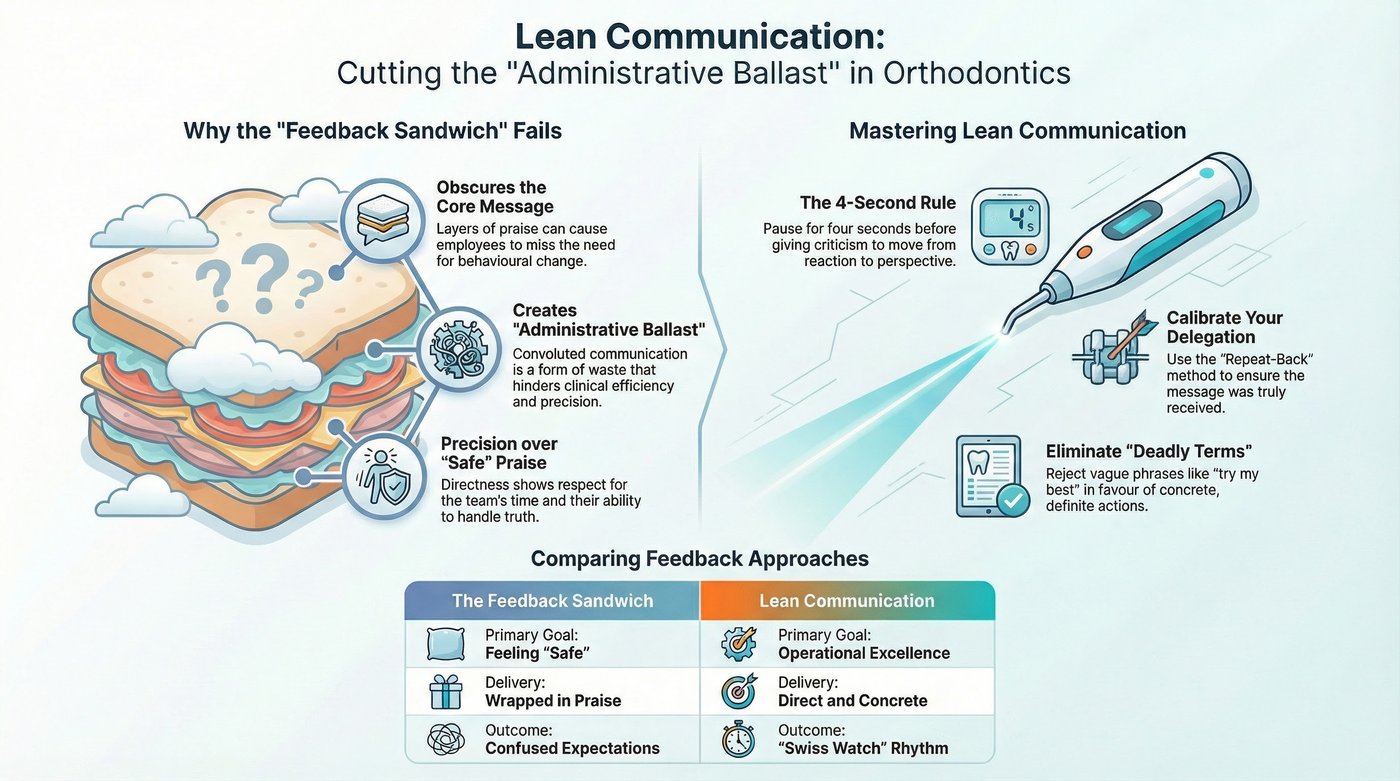
Stripping Away the Packaging
In the world of lean orthodontics, we focus heavily on clinical efficiency and material waste. However, one of the most significant sources of “administrative ballast” is convoluted communication. This “ballast” includes the time wasted in unnecessary follow-up conversations, the morale drain from persistent errors, and the confusion that arises when expectations are not crystal clear.
Many of us were taught the “Sandwich Technique”—praising a staff member, delivering criticism, and ending with more praise. While this feels “safe,” it is often a disaster for operational excellence. When you wrap a serious clinical error in layers of sugarcoated fluff, the core message gets lost.
The employee walks away feeling valued, but they often miss the fact that their behavior needs to change. For a clinic leader, this avoidance creates a false sense of compliance; the underlying issue, whether it’s improper sterilization technique or consistent charting errors, remains unresolved. This failure to address the root cause directly is a significant source of inefficiency and potential liability.
Speaking plainly isn’t about being unfriendly; it’s about precision and respect. When a critical task, such as verifying a patient’s medical history or managing a complex insurance submission, is performed incorrectly, the professional responsibility demands clarity. By being concrete and specific, you show that you value your team’s time and their ability to handle professional truths.
A five-minute, direct conversation about a procedural breach is more respectful than an hour of vague, circular commentary. True leadership is rooted in establishing a culture of high-bar accountability, where staff members are expected to receive and act on factual feedback. This creates an environment of psychological safety where team members trust that critical feedback is for growth, not personal attack.
The 4-Second Rule: Mastering Impulse Control
While praise should be delivered immediately to reinforce good habits, criticism requires a different approach. Being direct is not the same as being impulsive. To avoid an emotional reaction that could damage your dental team’s performance, I recommend the “4-Second Rule.”
This micro-pause provides the necessary cognitive bridge to transition from frustration into a methodical, coaching mindset. It prevents the feedback from becoming reactive and helps ensure the discussion remains focused on the process, not the person. When you spot an error, take four seconds to breathe.
This brief pause allows you to move from a reactive state to a factual perspective. For instance, if a scheduling coordinator incorrectly books a 60-minute procedure into a 30-minute slot, the immediate reaction is often stress. The 4-Second Rule ensures you frame the conversation around the scheduling protocol failure, rather than accusing the staff member of incompetence.
This intentional delay allows you to gather your thoughts and select precise language that targets the operational misalignment. It gives you the space to consider the other person’s “backpack”—their current stress levels or point of view—before you address the issue plainly.
Perhaps the assistant who missed a crucial step in the tray setup is overwhelmed by a new digital workflow or a family stressor. Acknowledging this context allows you to deliver firm, professional feedback while maintaining empathy, which is crucial for retaining valuable team members. This ensures your feedback is a tool for realignment rather than a spark for drama.
Calibrating Your Delegation
A major bottleneck in orthodontic practice management occurs when we think we have been clear, but the message was never truly received. Never assume perfect understanding. When delegating tasks that require high-stakes precision, such as ordering custom appliances or updating complex patient records, ambiguity is unacceptable.
To achieve a “Swiss watch” rhythm, where every action is synchronized and purposeful, you must calibrate your communication. This calibration process transforms delegation from a monologue into a verified commitment. The first step in verification is The Repeat-Back.
Ask the employee to explain the task in their own words. This is not a test of their memory, but a test of your clarity as a leader. If their summary contains gaps or misunderstandings about critical details—such as the exact due date for a lab case or the required retention protocol—you have an immediate, non-confrontational opportunity to clarify the instruction.
This simple action alone drastically reduces the waste of rework that plagues administrative processes. Secondly, Avoid “Deadly Terms”. If they say they will “try their best,” push for definiteness. Phrases like “I’ll get to it later,” “ASAP,” or “It should be fine” are red flags in a high-performance environment.
Leaders must push for concrete language and verifiable milestones. Instead of accepting vague assurances, ask, “What specific time will this report be finalized?” or “What exact criteria defines ‘finished’?” Finally, Identify Next Steps. Ask them to describe the first three concrete actions they will take.
Breaking down a large delegation—like implementing a new patient recall system—into three small, sequential steps creates immediate momentum and verifiable benchmarks. This eliminates the “waste of rework” and ensures that the clinical or administrative task is handled correctly the first time. This level of focused detail is what separates efficient practices from those perpetually stuck in reactive mode.
Ultimately, lean communication is about stripping away the administrative waste that slows down your practice. By moving beyond the “Feedback Sandwich” and embracing directness, impulse control, and active calibration, you create a culture of transparency and high performance.
Start implementing these shifts today to transform your team’s efficiency and foster a more professional, respect-based environment.
Conclusion
Effective leadership in a modern dental practice requires a shift from sugarcoated feedback to radical transparency. By stripping away administrative ballast and addressing errors with precision, leaders foster a culture of high-bar accountability where team members feel respected and empowered to grow professionally.
Operational efficiency is directly linked to the clarity of delegation and the implementation of logical pauses like the 4-Second Rule. These practices ensure that communication remains focused on process improvement rather than personal friction, drastically reducing the waste of rework and the systemic drain of persistent clinical or administrative errors.
Ultimately, mastering lean communication through verified commitments and concrete language creates a “Swiss watch” rhythm within the clinic. Embracing these direct communication strategies transforms the practice environment into one of synchronized purpose, where professional truths drive both team performance and patient care excellence.