

Helicopter Leadership: Avoiding the “Helper Complex” in Team Conflict
Published on: Jun 1, 2026
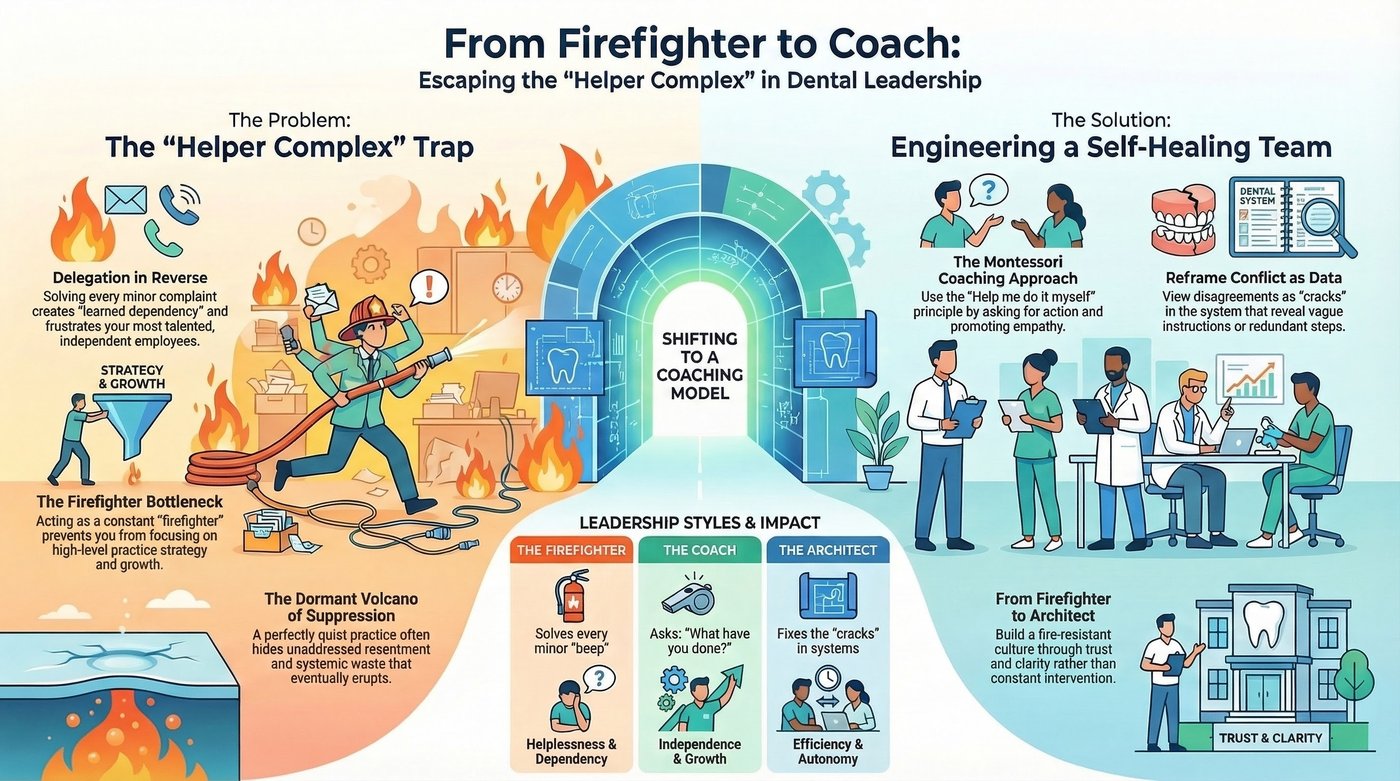
One of the most common bottlenecks in dental leadership is the Helper Complex. When an employee “beeps” with a minor interpersonal complaint, the “helicopter leader” jumps in immediately to solve it. While this feels like proactive management, it is actually a form of delegation in reverse. This quick-fix habit places the leader at the center of every minor administrative issue, instantly draining bandwidth needed for strategic growth or complex clinical cases.
To achieve true practice efficiency, you must move from being a “firefighter” to being a “coach”. Constant intervention sends an unspoken message that team members are incapable of navigating professional disagreements. This reliance not only stifles growth but also significantly raises the cost of management. By empowering your team to resolve their own friction, you create a self-healing system where trust is the primary foundation and independence is the standard. This shift leverages collective intelligence rather than relying on a single authority figure.
The Montessori Concept: “Help Me Do It Myself”
We can apply the Montessori education principle to orthodontic team performance: “Help me do it myself”. This concept transitions the leader from an ultimate problem-solver to a facilitator of solutions. When a staff member brings you a complaint about a colleague being “unfriendly” or failing a handoff, resist the urge to summon both parties for an immediate lecture. Stepping in preemptively validates the employee’s fear of confrontation, reinforcing their inability to handle professional friction.
Instead, act as a coach who guides them toward autonomous problem-solving. This redirection forces the employee to structure a professional resolution strategy based on facts, not emotion. The coaching script focuses on self-reflection and accountability before any intervention is considered.
Ask for Action: “What have you already done to understand their perspective?” This mandates that the complaining employee has initiated a factual attempt to gather information, such as asking about the colleague’s current workload or stress level.
Promote Empathy: “What do you think might be the real reason behind their behavior today?” Encouraging empathy shifts the focus from perceived personal offense to potential systemic pressure or external factors, which are often the true root causes in a high-paced clinical setting.
Assign the Responsibility: Encourage them to have a direct, professional conversation to find the solution. Provide specific, non-judgmental language they can use, such as, “I noticed X happened; I was hoping we could discuss a system to make sure that doesn’t affect our patient flow again.”
This structured approach prevents learned dependency. If you solve every minor problem, you unintentionally frustrate your most talented employees—who naturally desire autonomy and challenge—while encouraging the less independent staff to remain helplessly reliant on the leader. High performers recognize their time is being wasted waiting for the leader to manage issues they could resolve independently. A culture of accountability, supported by coaching, signals that maturity and self-management are valued.
Bridging the Academic and Social Gap
Orthodontic teams are uniquely diverse. You have specialists with years of university training working alongside clinical and administrative assistants with vastly different academic backgrounds. This intellectual diversity is a massive strength for complex problem-solving, but it can also be a significant source of friction when communication styles clash.
For instance, a clinically focused specialist might rely on precise, technical terminology, while an administrative assistant needs instructions framed around patient flow and billing metrics. Misunderstandings arise when professional language is mistaken for superiority or when different roles have competing priorities for the same resource, like scheduling slots.
A lean leader recognizes that what looks like “mutiny” or “difficulty” is often just an intelligent person with a contribution struggling to articulate their idea within the practice’s existing structure. Their challenge is not an emotional outburst but a functional misalignment within a process.
Reframe the Challenge: When someone questions a protocol, they aren’t necessarily being difficult; they are looking for a way to add value by optimizing the current process. This reframing instantly shifts the focus from personnel issues to process improvement opportunities.
Bridge the Communication: Translate high-level strategic goals (like “increase treatment acceptance”) into practical, daily actions that resonate with every team member’s role. This ensures everyone understands how their specific task contributes to the overall success of the clinic and patient care.
This gap-bridging requires the leader to establish a universal communication framework, such as standardized huddles and structured feedback sessions. By creating a neutral platform for discussing ideas, the leader ensures all contributions, regardless of the source’s title, are evaluated based on their merit and potential impact on efficiency.
The Danger of Suppression
Suppression is the most dangerous path a leader can take. A leader who seeks artificial harmony often creates an environment where feedback is punished, and necessary friction is avoided. If your practice is perfectly quiet because people are afraid to speak their truth, your system is fundamentally broken. You are sitting on a “dormant volcano” of unaddressed waste and resentment that will eventually erupt in high staff turnover or systemic clinical failure.
The illusion of quiet efficiency masks deep operational issues. When employees stop flagging problems—such as a broken piece of equipment, an ineffective supply ordering system, or repeated scheduling errors—these issues become normalized defects. This refusal to engage is often a sign of burnout and a lack of psychological safety within the team.
To achieve Kaizen (continuous improvement), you need the feedback that conflict provides. Constructive disagreements are valuable indicators of where the practice is struggling to meet its own standards.
Conflict as Data: Every disagreement reveals a “crack” in the system—a vague instruction, a redundant step, or an unfair workload. For example, a conflict over a clean-up task reveals a missing step in the closing checklist, not a lazy employee.
Resolution as Progress: Solving these “cracks” leads to structural development that benefits the entire practice. By treating conflict as an opportunity for process mapping and refinement, leaders permanently fix systemic issues, reducing future disagreements and improving long-term patient outcomes.
Conclusion: Engineering a Self-Healing Team
Excellence is not the absence of conflict; it is the presence of effective resolution. By stepping back and coaching your team through their friction, you are not shirking responsibility—you are building capacity. This constructs a high-output organization that can handle the “waves” of daily clinical life without the owner’s constant, exhausting intervention. A self-healing team maintains performance even when the leader is occupied with high-level strategic tasks or is absent from the office.
Stop being the person who puts out every fire. The time you reclaim by not mediating minor disputes should be reinvested in strategic leadership, advanced clinical training, and marketing growth. Start being the architect who builds a fire-resistant culture through trust, clarity, and the courage to let the team find its own balance. This involves intentionally designing systems and protocols that anticipate and mitigate conflict, positioning the team as the first line of defense against inefficiency.
The transition from “helicopter leader” to “process coach” is the final evolutionary step for a dental practice owner seeking sustainable success. It moves the focus from personal control to systemic strength, creating a culture where accountability is shared, and every team member views professional friction not as a threat but as a critical data point for improvement. This empowered, resilient team structure is the most powerful catalyst for maximizing patient satisfaction, streamlining clinical workflow, and ultimately achieving profound practice autonomy.