

Furnishing for Flow: Creating Self-Sufficient Treatment Rooms
Published on: Jul 4, 2026
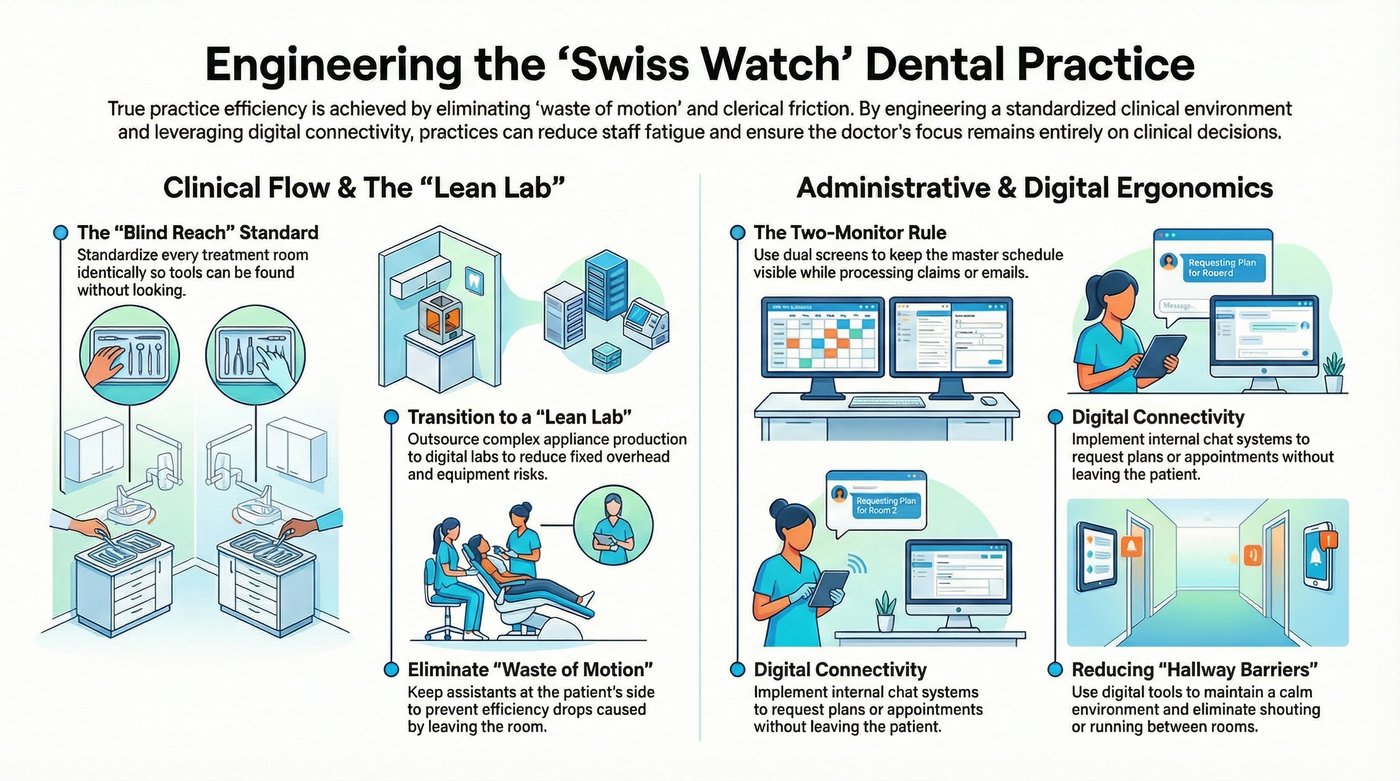
The “Blind Reach” Standard
One of the most insidious forms of waste in a dental office is the “waste of motion.” We have all witnessed the scene: an assistant realizes a curing light is missing or a specific archwire isn’t in the drawer, necessitating a trip to the central sterilization or storage area. Every time a team member leaves the patient’s side, the “spaghetti” of disorganized movement increases, and practice efficiency plummets.
In a leadership-focused practice, this isn’t just a minor annoyance; it is a systemic failure. When staff are forced to scavenge for tools, it breaks the clinical rhythm and erodes patient trust. The patient perceives the lack of preparation as a lack of professional care. To counter this, clinical leaders must audit room usage to identify these “motion leaks” and plug them with better logistical planning.
To achieve operational excellence, every treatment room must be 100% self-sufficient and stocked identically. You should be able to reach into a drawer blindly and find exactly what you need because the layout is standardized across the entire practice. This “Blind Reach” standard ensures that any assistant can step into any room and perform at peak capacity immediately.
Implementing this requires a commitment to a “Lean” inventory system. By utilizing clear, labeled bins and shadow boards, you remove the mental load of searching. This allows for rapid transitions between patients and ensures that the doctor’s time at the chair is spent strictly on clinical decisions and patient connection, not waiting for supplies. Standardization is the foundation of scale.
Administrative Ergonomics: The Two-Monitor Rule
Efficiency is not limited to the clinical bay; it starts at the front desk. The mental fatigue of constantly switching between software windows—from the calendar to patient emails to diagnostic imaging—is a silent drain on your team’s cognitive energy. Every “click” and “tab” is a micro-delay that compounds over an eight-hour shift.
Leadership means providing the tools that prevent burnout. High-performing administrative teams require workspaces designed for high-velocity data management. When the physical environment is cluttered or technologically inadequate, the team’s output will naturally throttle to match those limitations.
I highly recommend a two-monitor setup for every administrative and planning workstation. This allows the staff to keep the master schedule visible at all times while processing paperwork or insurance claims on the second screen. This isn’t just a luxury; it’s a necessity for modern orthodontic practice management.
This small investment in hardware results in a significant increase in administrative speed and a drastic reduction in clerical errors. By seeing the “big picture” (the schedule) alongside the “detail work” (the claim), your team can make better real-time decisions about patient flow and scheduling gaps, ultimately driving higher revenue and smoother days.
The Lean Lab: Outsourcing for Agility
The traditional orthodontic laboratory—with long plaster counters, heavy dust, and high-maintenance equipment—is becoming a relic of the past. In a lean practice, we avoid the massive overhead and space requirements of a full-scale on-site lab. Space is one of your most expensive assets; using it for storage or dusty production is often a poor ROI.
Strategic leadership involves knowing what to keep in-house and what to delegate. Most technical work, from clear aligners to complex functional appliances, can now be outsourced more effectively to specialized digital labs that utilize industrial-grade 3D printers and high-end software that an individual practice simply cannot justify.
Keeping a small area for quick repairs and simple retainers is sensible for immediate patient service, but outsourcing the bulk of production protects the practice from operational crises. If a lab technician falls ill or an expensive printer breaks down, your production doesn’t grind to a halt because your partner lab handles the redundancy.
This agility reduces your fixed costs and allows you to focus on your core clinical expertise: diagnosis and treatment planning. By shifting from a “manufacturer” mindset to a “clinical architect” mindset, you create a more scalable and less stressful business model.
Digital Connectivity: Breaking the Hallway Barrier
To maintain a calm, professional environment, individual rooms must stay connected without the need for shouting or hallway running. Internal chat systems and integrated work phones are essential. Communication should be “low-decibel, high-impact.”
An assistant should be able to request a treatment plan printout or schedule a follow-up appointment digitally without ever leaving the patient. This seamless connectivity is a hallmark of dental team performance and ensures the patient feels cared for in a high-tech, high-touch environment. It maintains the “sacred space” of the treatment chair, keeping the focus entirely on the person being treated.
Conclusion: Building the “Swiss Watch” Practice
Furnishing a practice is about more than just aesthetics; it is about engineering a workflow that supports leadership and growth. By standardizing your rooms, optimizing your administrative tools, and leveraging digital outsourcing, you create a practice that runs like a Swiss watch—complex on the inside, but effortless on the surface.
This structural approach allows you to scale your success while minimizing the chaos that typically accompanies growth. It ensures that your office remains a source of pride, professional fulfillment, and consistent clinical excellence for every patient who walks through your doors.