

From “Wishing” to “Winning”: The Architecture of SMART Orthodontic Growth
Published on: Jun 18, 2026
Many orthodontists harbor a general desire for their practices to become “more profitable,” “more efficient,” or “less stressful.” While these aspirations are noble, in the world of Lean Orthodontics, a wish without a structured plan is merely a dream. To transition from a stagnant plateau to a trajectory of continuous improvement, a leader must move beyond vague intentions and implement a rigorous system for defining and reverse-engineering success.
In a clinical setting, “wishing” often manifests as waiting for the next big referral or hoping that a new software update will magically solve scheduling bottlenecks. True growth, however, is never accidental. It requires a fundamental shift in the leadership mindset—from being a reactive problem-solver to a proactive architect of systems.
I am Dr. Martin Baxmann, and I believe that the primary difference between a “surviving” practice and a “thriving” practice is the quality of its goal setting. By applying the SMART principle—Specific, Measurable, Achievable, Relevant, and Time-bound—you transform abstract desires into a clinical and operational roadmap that your entire team can follow.
When your team understands exactly what “winning” looks like for the quarter, their daily decisions align with your vision. Without this clarity, staff members often work at cross-purposes, wasting valuable energy on tasks that do not move the needle. A SMART goal acts as the unified language of your orthodontic enterprise.
Reverse-Engineering the Revenue Goal
A common mistake in practice management is setting a goal that is too far removed from daily activity. Saying “I want to grow by 10% this year” is a good start because it is specific and time-bound, but it provides no instruction for Monday morning. To make a goal achievable, you must reverse-engineer the “Patient Pipeline.”
Think of your annual revenue as the final output of a complex machine. To change the output, you must adjust the gears within the machine. This means looking at your conversion rates from initial phone calls to consultations, and from consultations to bonded cases. Each of these represents a lever you can pull to achieve your larger financial objective.
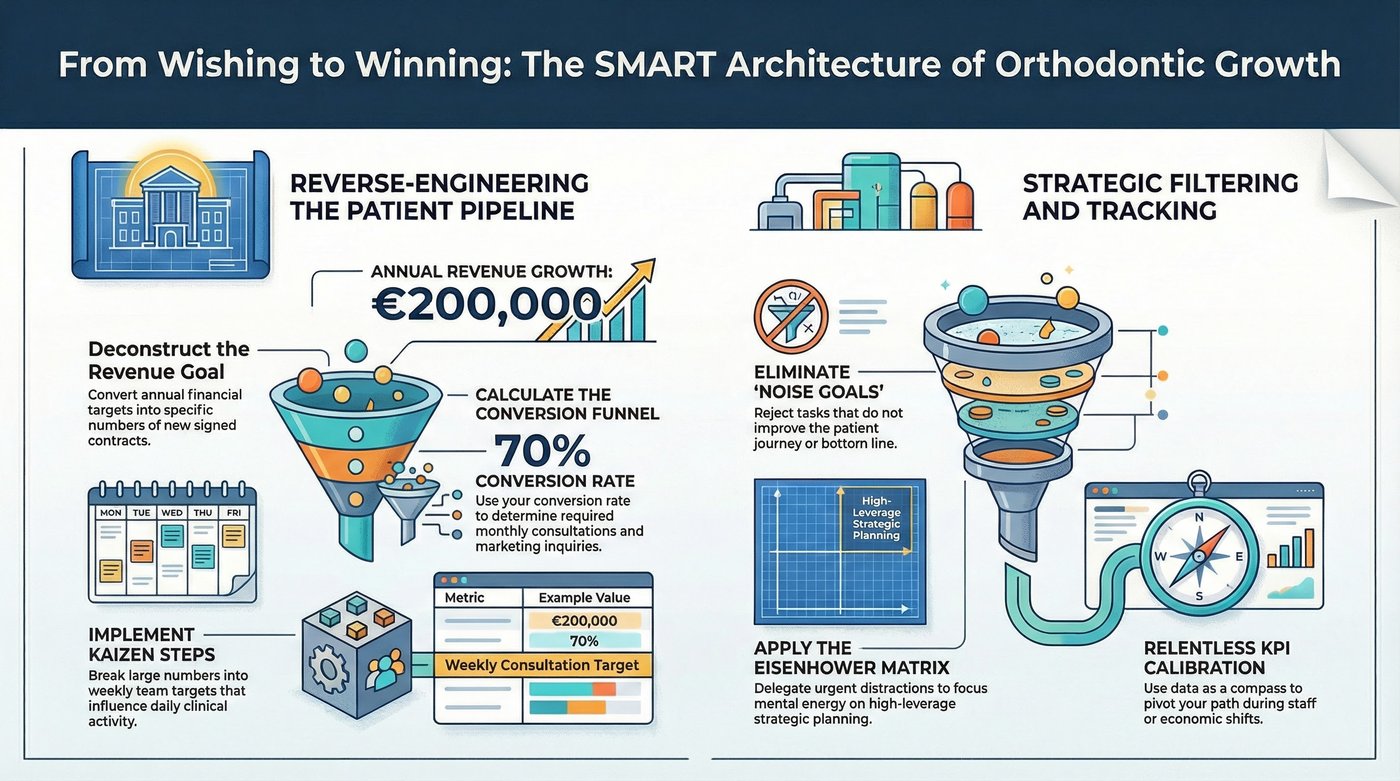
If a 10% revenue increase requires €200,000 in new contracts, how many signatures does that represent? If your conversion rate is 70%, how many new patient consultations do you need per month? From there, you can determine how many raw inquiries your marketing must generate. By breaking a large, abstract number down into a weekly “consultation target,” you give your team a metric they can actually influence.
This is the essence of Kaizen: small, manageable steps that lead to massive cumulative results. When a Treatment Coordinator knows they need to close three cases this week to stay on track, the goal becomes tangible and less intimidating. It shifts the focus from an overwhelming annual figure to a series of achievable, daily victories.
The Filter of Relevance: Avoiding the “Noise”
In the search for efficiency, many clinicians fall into the trap of setting “noise goals.” These are tasks that feel like work but have no impact on the core value of the practice—for example, obsessively redesigning a brochure that is rarely handed out or researching expensive clinical gadgets that don’t actually reduce chair time.
As a lean leader, you must distinguish between productive movement and mere activity. If your current bottleneck is a three-month waiting list for new starts, spending time on social media aesthetics is noise. Your relevant goal should instead focus on optimizing clinical workflow or delegating non-clinical tasks to free up more chair capacity.
Every goal in your clinic must pass the Relevance test. Ask yourself: “Does this goal directly improve the patient journey, clinical excellence, or our bottom line?” If the answer is no, it is a distraction. As the practice owner, your focus must remain on high-leverage activities. Use the Eisenhower Matrix to filter your daily tasks.
Delegate the “urgent but not important” noise, such as routine administrative emails, so you can spend your mental energy on the “important but not urgent” strategic planning. This high-level thinking is what defines your future. If you are constantly putting out fires in the sterilization room, you cannot build the architecture for a multi-location expansion.
Tracking the Compass in the Forest
Goal setting is not a “set it and forget it” exercise. It is a dynamic process of constant calibration. Think of your goal as a castle on a hill and your practice as a team walking through a forest to reach it. Sometimes the path twists, or a “dark patch” of unexpected staff turnover or economic shifts obscures the view.
Without regular tracking, a minor deviation in the first month can lead to a massive miss by the end of the year. In Lean Orthodontics, we use visual management and huddles to ensure everyone is looking at the same map. This transparency prevents the “drift” that occurs when teams lose sight of the objective during busy clinical weeks.
You must check your compass—your Key Performance Indicators (KPIs)—relentlessly. Are you thirty centimeters closer to the goal today than you were yesterday? If the data shows you are drifting, you don’t abandon the castle; you pivot the path. Flexibility combined with rigid tracking is the hallmark of a lean leader.
When you turn your vague wishes into concrete, measured achievements, you stop being a passenger in your practice and start being the architect of your success. This discipline allows you to enjoy the process of growth, knowing that every action taken by you and your team is a calculated step toward a more prosperous and less stressful professional life.
Conclusion: Building Your Legacy
Transitioning from a “wishing” mindset to a “winning” architecture requires courage and consistency. It is the commitment to measure what others ignore and to refine what others accept as “good enough.” By implementing SMART goals and reverse-engineering your pipeline, you create a self-sustaining system of excellence.
The architecture of growth is not built on grand gestures, but on the relentless pursuit of incremental improvement. Start today by identifying one vague wish in your practice and turning it into a SMART goal. Your team, your patients, and your future self will thank you for the clarity and direction you provide as a lean leader.